Writing Greek Letters
Introduction
Welcome back to Writing Math in LaTeX — this is lesson six of seven, which means we are one lesson away from the finish line. If you have ever glanced at a physics textbook, a statistics report, or even the specifications on a smartphone camera lens, chances are you spotted a Greek letter. Symbols like , , and are woven into the fabric of modern science and mathematics.
Over the previous five lessons, we built a solid toolkit: math mode delimiters, subscripts and superscripts, fractions, square roots, and standard function commands like \sin and \log. In fact, last lesson we used \theta in an example without fully explaining where it came from. Today, Greek letters get the spotlight. By the end of this lesson, you will know how to produce the most commonly used Greek letters in LaTeX and understand an important quirk about their uppercase forms.
Why Math Uses Greek Letters
Mathematics borrows heavily from the Greek alphabet. Letters like , , , and show up everywhere — from geometry and trigonometry to statistics and physics. The reason is practical: the Latin alphabet alone does not provide enough distinct symbols to name all the variables, constants, and parameters that math requires. Greek letters give us a second full alphabet to work with, and many of them have acquired conventional meanings in specific fields.
You have almost certainly seen for the ratio of a circle's circumference to its diameter, or for standard deviation in statistics. In LaTeX, every Greek letter has a dedicated command that works inside math mode, following the same backslash pattern we have been using throughout this course. The commands are intuitive — they are simply the English names of the letters — so picking them up is straightforward once you see the pattern.
Lowercase Greek Letters
Each lowercase Greek letter is produced by typing a backslash followed by the letter's English name. Here are the ones you will encounter most often:
| Command | Output | Common Use |
|---|---|---|
\alpha | Angles, coefficients | |
\beta | Angles, coefficients | |
\gamma | Angles, constants | |
\delta | Small changes, differences | |
\epsilon | Small quantities | |
\theta | Angles (especially in trigonometry) | |
\lambda | Eigenvalues, wavelength | |
\mu | Mean, micro- | |
\pi | Circle constant (3.14159…) | |
\sigma | Standard deviation, summation index | |
\phi | Angles, the golden ratio | |
\omega | Angular frequency |
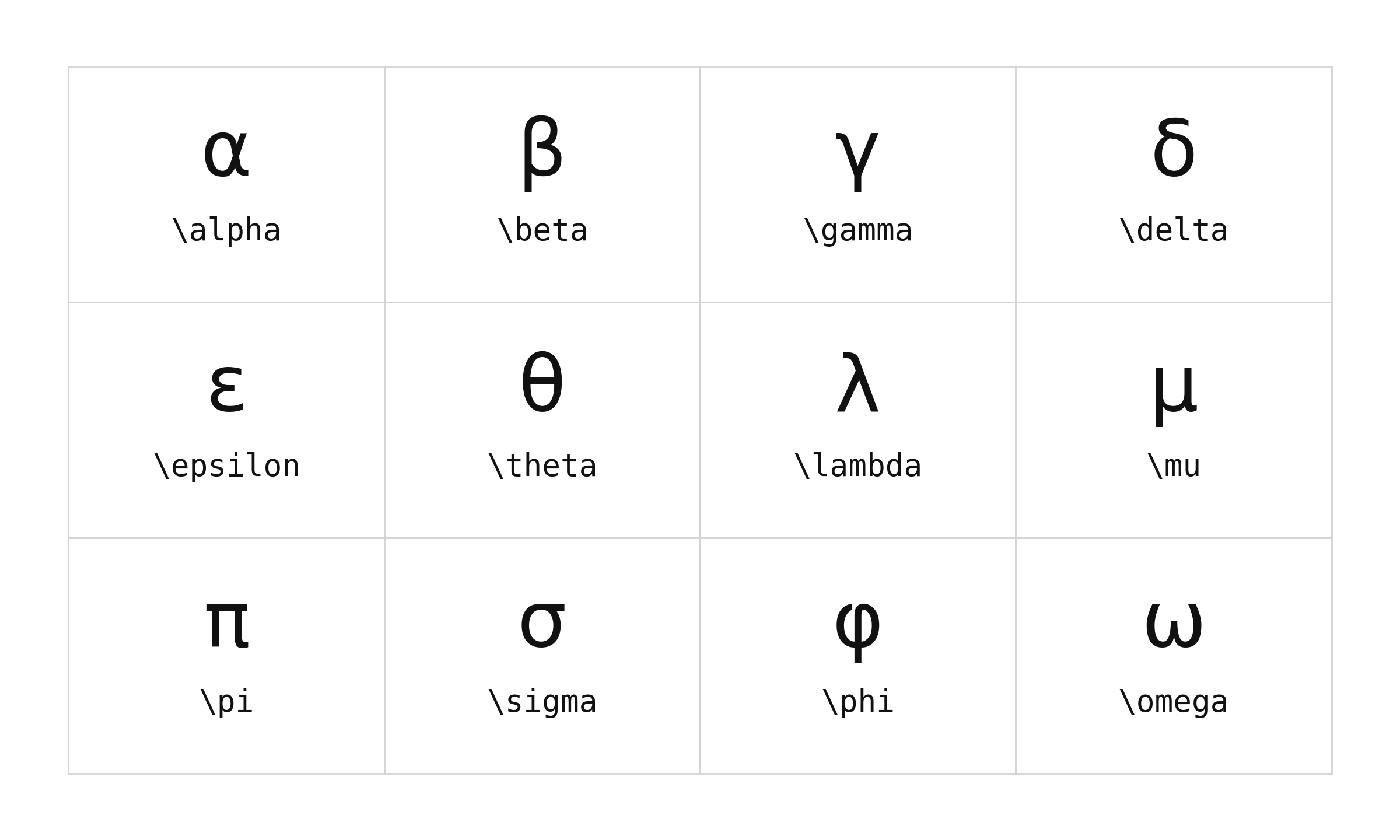
The syntax is exactly what we would expect from our experience with commands like \frac and \sqrt. For example:
These produce , , and . One important reminder: Greek letter commands, like all math-mode symbols, must appear inside math mode — whether inline dollar signs or display-mode delimiters like \[...\]. Outside of math mode, LaTeX will not recognize them and will produce an error.
Uppercase Greek Letters
Many Greek letters also have uppercase forms with their own distinct shapes. To produce an uppercase Greek letter, we capitalize the first letter of the command name. Here are the most common ones:
| Command | Output | Lowercase | Lowercase Output |
|---|---|---|---|
\Gamma | \gamma | ||
\Delta | \delta | ||
\Theta | \theta | ||
\Lambda | \lambda | ||
\Pi | \pi | ||
\Sigma | \sigma | ||
\Phi | \phi | ||
\Omega | \omega |
The pattern is consistent: \gamma gives the lowercase , and \Gamma gives the uppercase . These uppercase letters appear frequently in mathematical writing — is used for summation notation, often represents a change or difference, and shows up in physics and set theory. With the lowercase commands already in your memory, the uppercase versions require almost no extra effort to learn.
Latin Look-Alikes: When No Command Exists
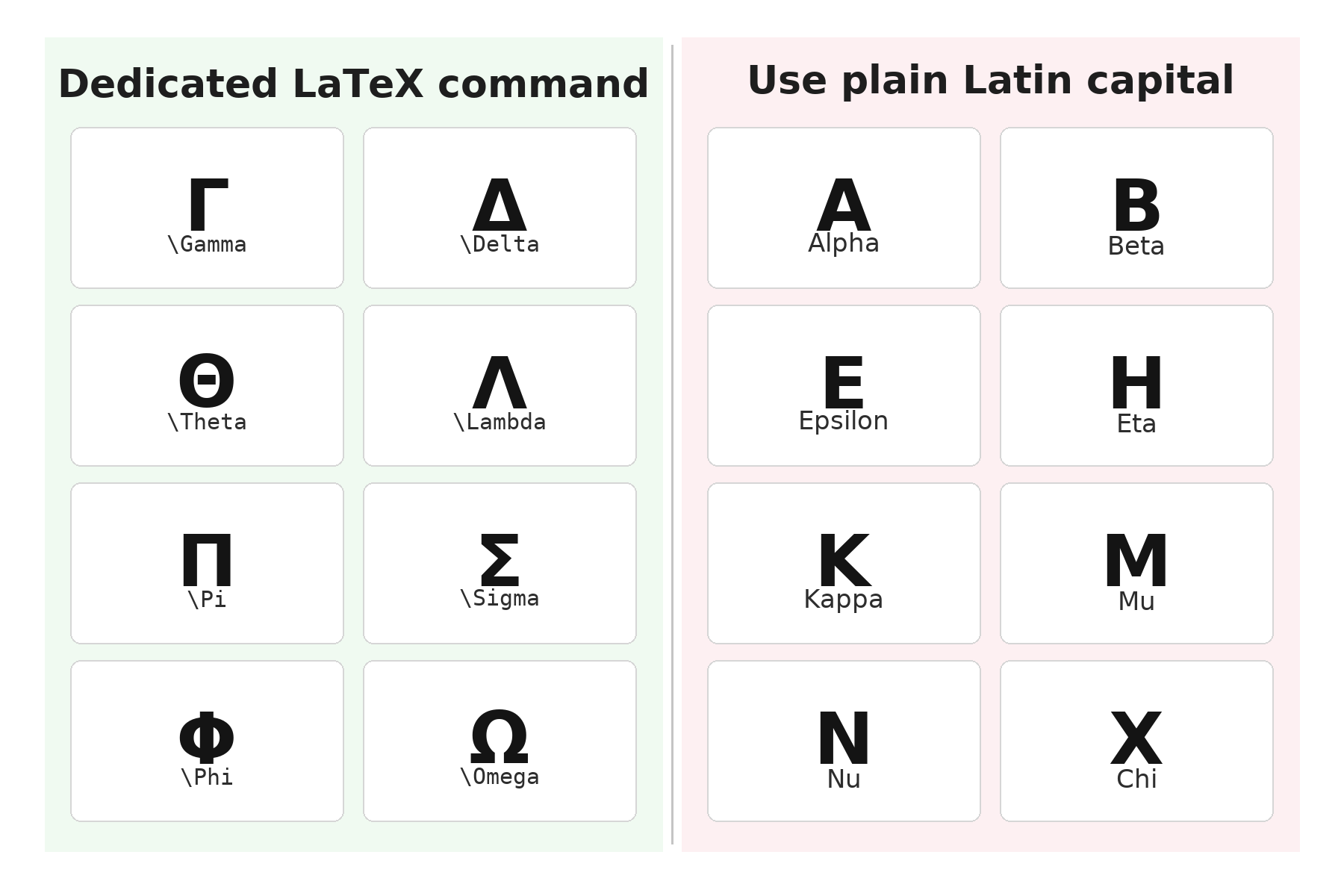
Here is the quirk we mentioned in the introduction. Not every Greek letter has a dedicated uppercase command, and the reason is surprisingly simple: some uppercase Greek letters look identical to Latin (English) capitals. Uppercase Alpha looks just like A, uppercase Beta looks just like B, uppercase Epsilon looks just like E, and so on.
Because these shapes already exist as ordinary Latin letters, LaTeX does not define separate commands for them. If we try to use \Alpha or \Beta, we get a compilation error — not a different symbol, but a hard stop. Instead, we type the Latin capital letter directly in math mode:
These produce the familiar capital letters, which are visually indistinguishable from their Greek uppercase counterparts. The following table summarizes the distinction:
| Situation | What to Type | Example |
|---|---|---|
| Uppercase shape differs from any Latin letter | Use \UppercaseName | \Gamma, \Delta, \Sigma, \Omega |
| Uppercase shape matches a Latin capital | Use the plain Latin letter | A for Alpha, B for Beta, E for Epsilon |
The rule of thumb is straightforward: if a capitalized command causes an error, the Latin capital is the correct replacement.
Greek Letters in Real Formulas
Greek letters combine seamlessly with everything we have learned so far — subscripts, superscripts, fractions, roots, and function commands all work exactly the same way. Let us walk through a few real examples that put these symbols in context.
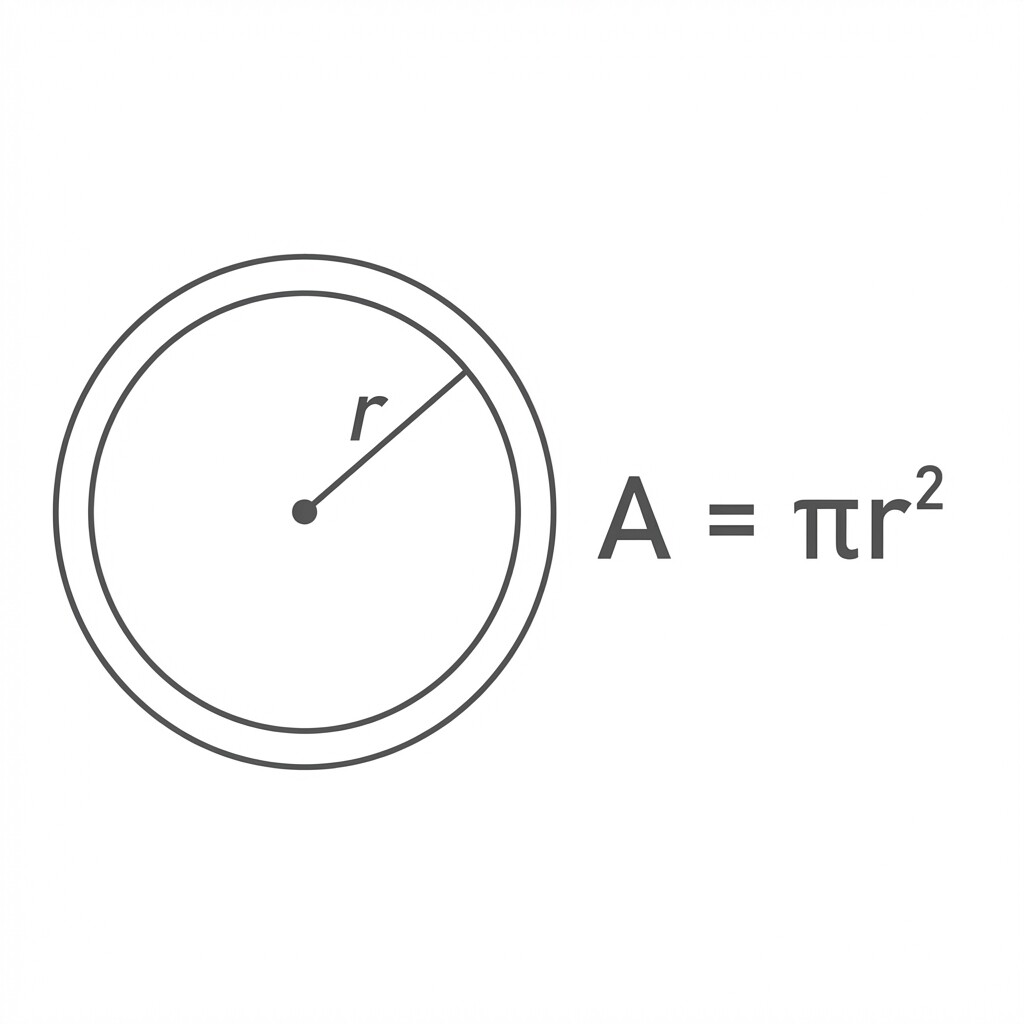
The area of a circle uses alongside a superscript:
This gives us . Notice that here is just a plain Latin letter representing area, while is produced by its command.
In statistics, a common expression involves the mean and the standard deviation :
This produces , describing a value three standard deviations above the mean. For a more involved formula, consider a wave function where several Greek letters appear together:
This expression describes a sinusoidal wave with amplitude , angular frequency , time , and phase shift . Notice how \sin from our previous lesson works alongside the Greek letters \omega and \phi — every piece nests together naturally. If you recall the Pythagorean identity from last lesson, you can now see that \theta was simply another Greek letter command the whole time.
One last example brings Greek letters into a superscript group. Euler's famous identity can be written in display mode:
Here, \pi sits inside a superscript alongside , grouped by curly braces. As we learned in Lesson 2, the braces combine everything into a single unit for the exponent.
Conclusion and Next Steps
In this lesson, we learned how to produce Greek letters in LaTeX using backslash commands like \alpha, \beta, \pi, and \sigma for lowercase, and capitalized versions like \Gamma, \Delta, \Sigma, and \Omega for uppercase. We also discovered that some uppercase Greek letters — such as Alpha and Beta — share their appearance with Latin capitals and therefore have no dedicated command, meaning we simply type the Latin letter instead.
Now it is time to put these symbols to work in the practice exercises. You will start by writing common lowercase and uppercase Greek letters, then investigate what happens when you try a command that does not exist, and finish by building complete formulas that blend Greek letters with the notation you have been mastering throughout this course.
