The Probability Scale
Introduction
Welcome back to What Is Probability?! We are now on lesson 2 of 4 in this course, and we are making solid progress. In the previous lesson, we built the essential vocabulary of probability: outcomes, sample spaces, and events, giving us a precise way to describe what can happen in a chance process. Now it is time to take things further and ask: how likely is any given event to occur?
From Words to Numbers
We already have intuitive ways of describing likelihood. We say a raffle win is "practically impossible," that a coin flip is "50/50," or that a summer thunderstorm is "very unlikely." The trouble is that words like "likely" or "unlikely" mean different things to different people. Mathematics needs something more reliable: a single, shared numerical scale that anyone can use and interpret the same way.
The Probability Scale
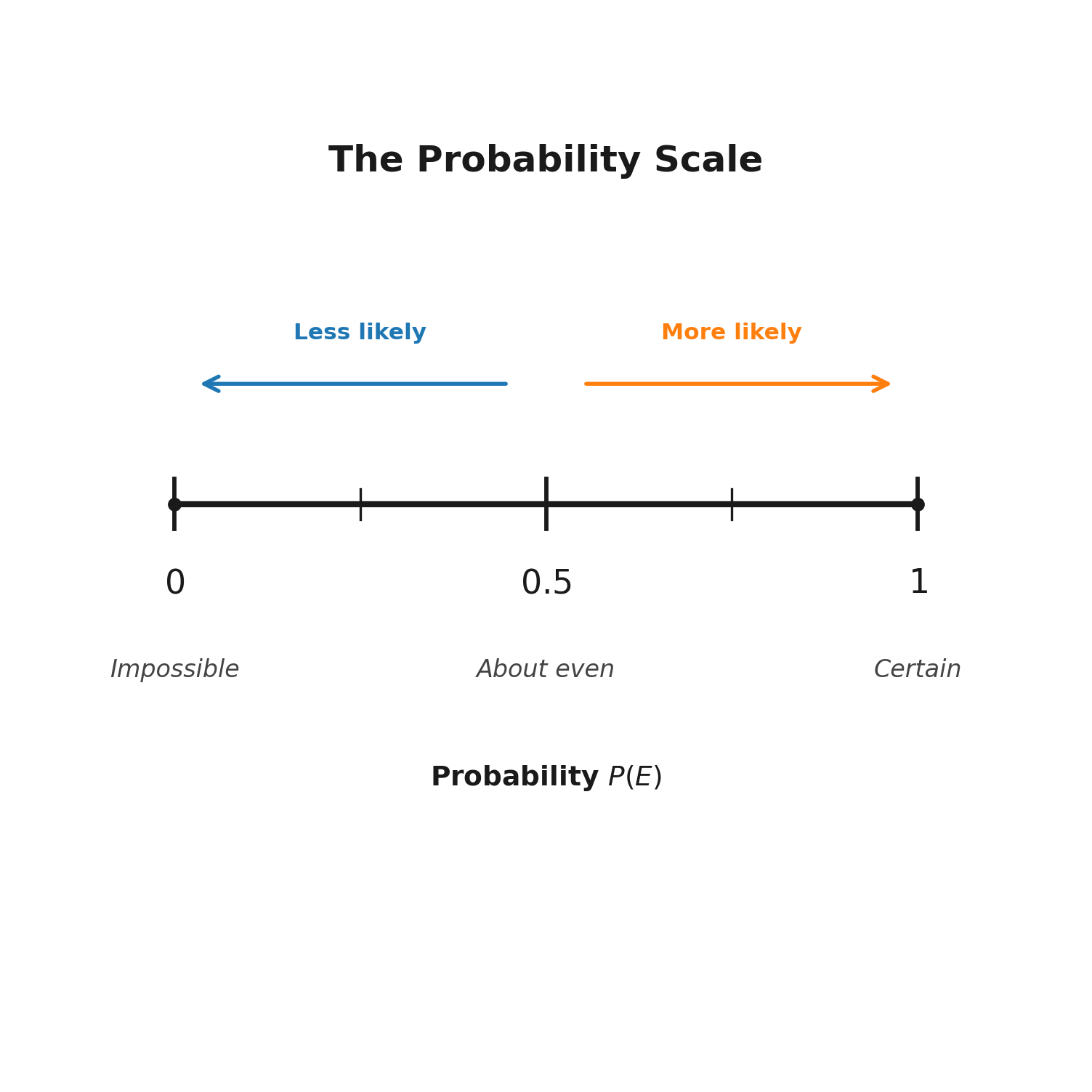
The probability scale is a number line that runs from to . The probability of an event , written as , is always a number in this range:
No probability can be less than or greater than . Here is a broad picture of the full scale:
The closer a probability value sits toward , the more likely the event; the closer toward , the less likely.
The Two Anchor Points
The two ends of the scale carry clear, precise meanings:
- — the event is impossible. It cannot happen under any circumstances. Rolling a 7 on a standard six-sided die is a good example: there is no face showing 7, so .
- — the event is certain. It is guaranteed to happen every time. Rolling some number between 1 and 6 on that same die is certain: .
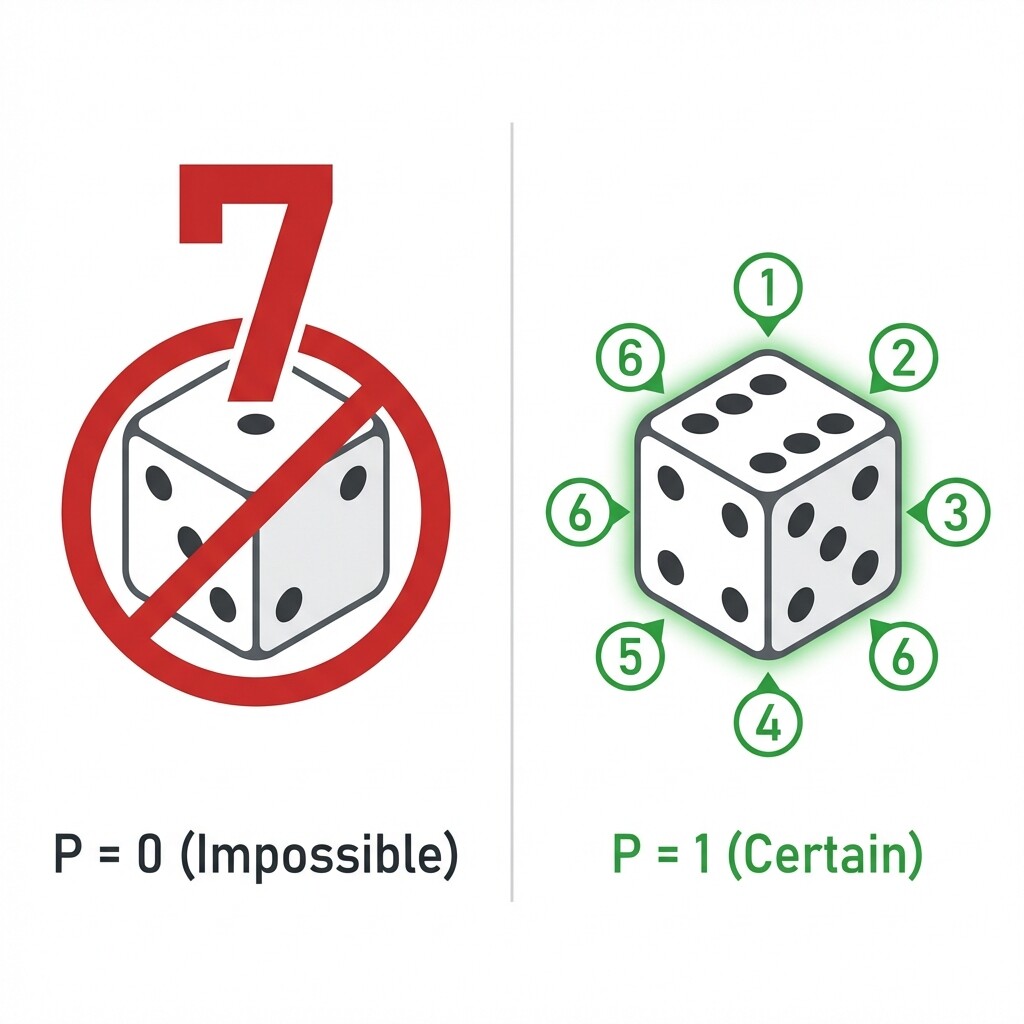
These two anchor points are our fixed reference markers. Every realistic event falls somewhere between them.
The Regions in Between
Between and , three key regions help us interpret probabilities at a glance:
| Region | Probability Range | What It Means |
|---|---|---|
| Unlikely | Close to (e.g., ) | Can happen, but rarely does |
| About even | Around (e.g., to ) | Equally likely to happen or not happen |
| Likely | Close to (e.g., ) | Will probably happen, but not guaranteed |
The midpoint deserves special attention. An event at exactly is equally likely to happen or not happen — a perfect toss-up. A fair coin flip landing heads is the classic illustration: exactly one favorable outcome out of two equally likely possibilities, giving .
Placing Real Events on the Scale
Let's bring the scale to life with a few concrete examples!
You do not need to worry about how these exact numbers are calculated yet. For now, focus on what the numbers mean on the probability scale; we will learn the calculation method in detail in future units.
- Winning a door prize when holding 1 ticket out of 200. This is possible, but very unlikely. The probability is , sitting extremely close to .
- Picking a vowel at random from the English alphabet. With 5 vowels out of 26 letters, . This still falls close to , so it belongs in the unlikely region.
- Flipping a fair coin and getting heads. As noted above, , placing this squarely in the about-even region.
- Rolling a number greater than 1 on a standard six-sided die. With five successful outcomes (2, 3, 4, 5, and 6) out of six possibilities, . This sits close to 1, placing it in the likely region.
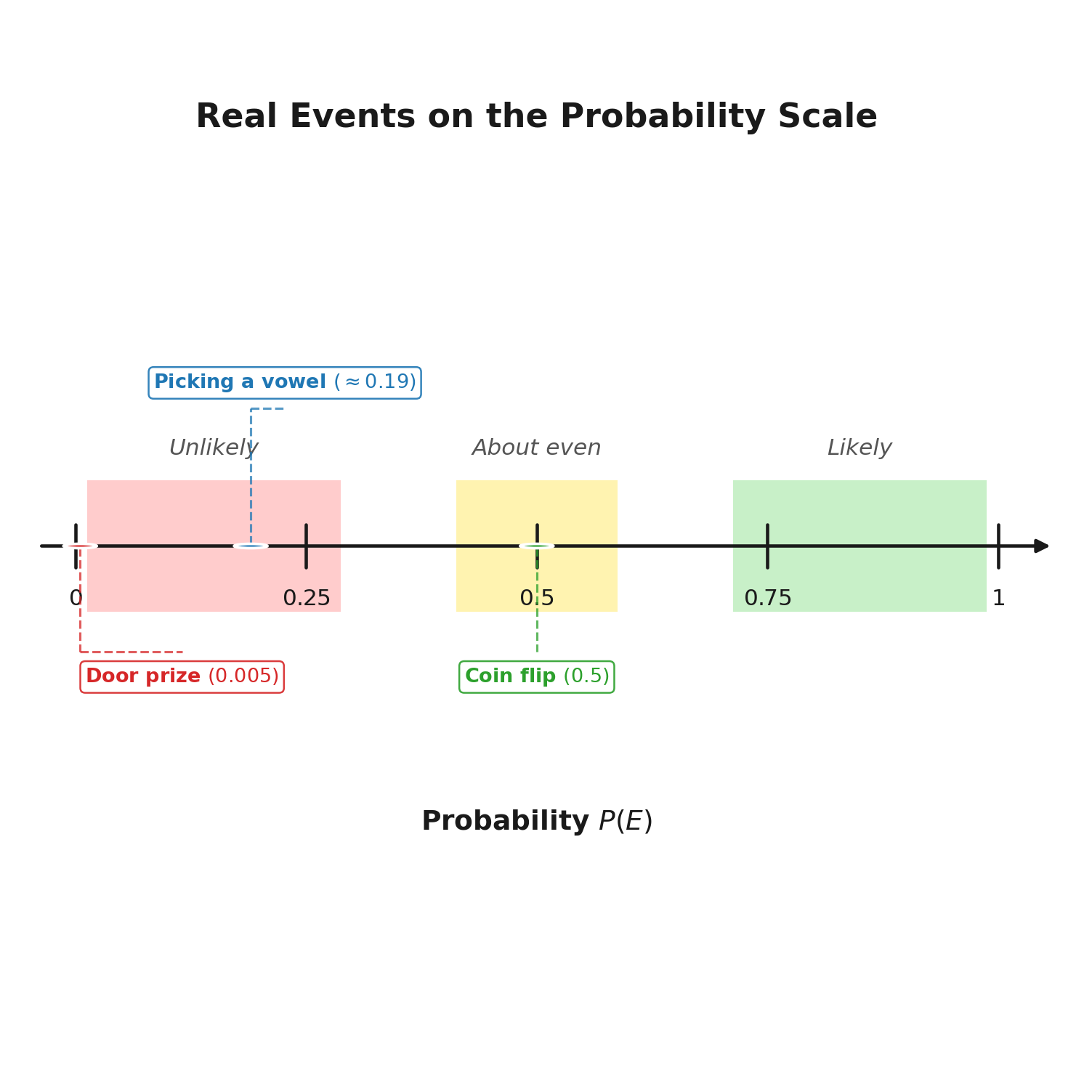
Even when we do not know the exact number, we can often identify the right region simply by reasoning about the situation. A helpful first step is always to ask: is this event impossible, rare (unlikely), about even, probable (likely), or certain?
Conclusion and Next Steps
In this lesson, we introduced the probability scale: a number line from to that assigns a precise likelihood value to every event. A probability of signals an impossible event, while a probability of signals a certain one. Values near indicate unlikely events, values near indicate events that are about equally likely to happen or not, and values near indicate likely events.
In the practice section that follows, we will put this scale to work right away, matching real-world situations to their correct regions and interpreting probability values in context. It is a great way to make these ideas feel natural and intuitive, so let's get to it!
