Events Outcomes Sample Spaces
Introduction
Welcome! We are kicking off the very first lesson of What Is Probability?, a course built to give us a solid, practical understanding of probability from the ground up. In this opening lesson, we explore three ideas that sit at the heart of all probability work: outcomes, sample spaces, and events. These three concepts form the shared vocabulary we will use throughout every lesson that follows, so let's take our time and build them up carefully.
Thinking About Chance
Every day, we encounter situations where the result is uncertain. Will the coin land heads or tails? Which prize will the raffle wheel stop on? These are all examples of chance processes: situations where we cannot know the result ahead of time with certainty.
Before we can measure or talk about probability at all, we need a precise way to describe what could happen — and that is exactly what outcomes, sample spaces, and events are for.
What Is an Outcome?
An outcome is one single, specific result of a chance process. Think of rolling a standard six-sided die: landing on the number 3 is one possible result. That result, all by itself, is a single outcome. Each outcome must be clearly defined and distinct from every other possible result.
Here are a few examples to make this concrete:
- Rolling a six-sided die: the possible outcomes are , , , , , and .
- Flipping a coin: the possible outcomes are Heads and Tails.
- Drawing one marble from a bag with a red, a blue, and a green marble: the possible outcomes are Red, Blue, and Green.
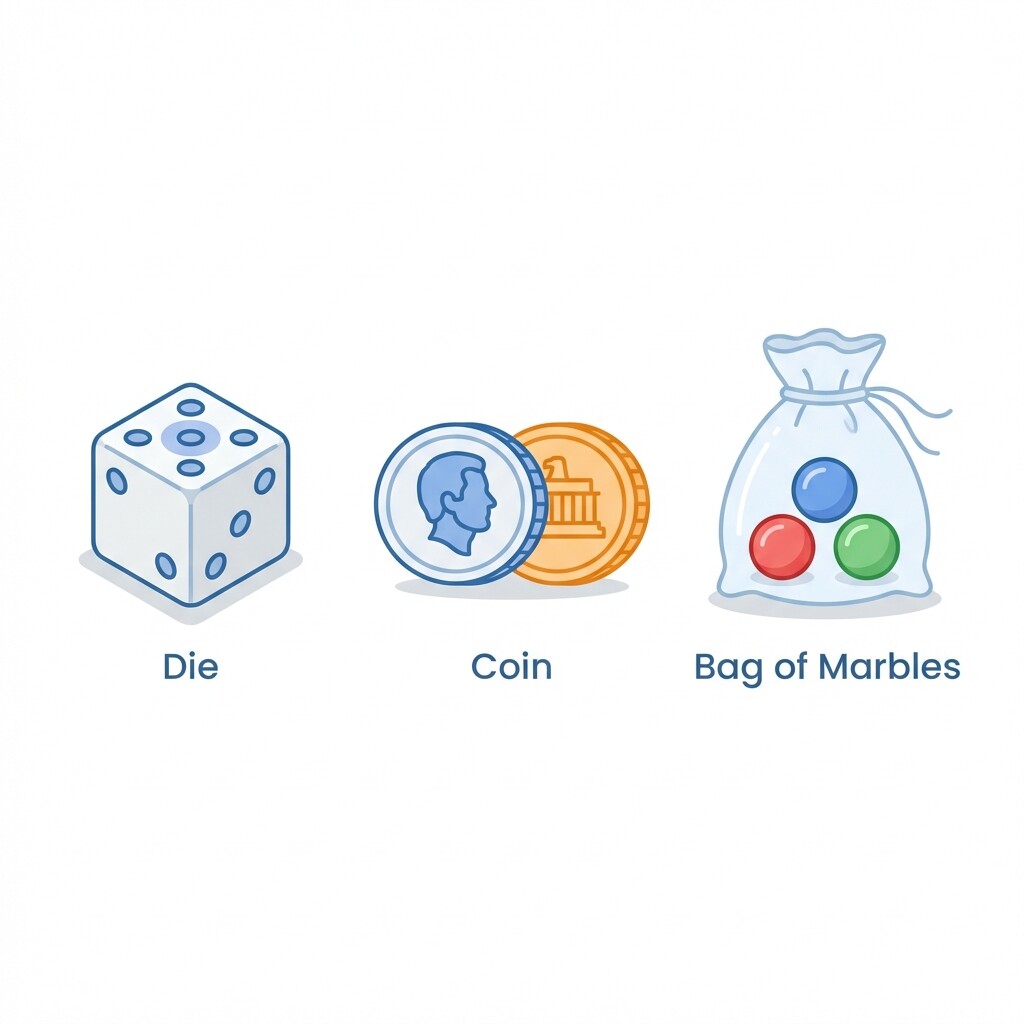
An outcome is always a single, specific result. A phrase like "rolling an even number" describes a group of results, so it is not an outcome.
What Is a Sample Space?
Once we know what a single outcome looks like, we can collect all of them together. The sample space is the complete set of all possible outcomes for a chance process. We often write it using curly braces and label it . You might know that this notation is also used for sets, which are collections of unique objects.
For a standard six-sided die, the sample space is:
For a coin flip, it is simply:
Two things to keep in mind when listing a sample space: it must be complete (every possible outcome is included) and non-duplicated (no outcome appears more than once). A missing outcome or an accidental repeat would give us an inaccurate picture of the situation.
What Is an Event?
Now that we have a sample space, we can talk about events. An event is any specific collection of outcomes that we are interested in — in other words, an event is a subset of the sample space.
For example, suppose we roll a six-sided die and ask: "Which outcomes belong to the event rolling an even number?" The event consists of , which is a subset drawn from the full sample space .
An event can range in size from a single outcome all the way up to the entire sample space. "Rolling a number greater than 5" gives us the event , which contains just one outcome, while "rolling any number at all" is an event that matches every outcome in .
All Three Concepts in Action
Let's work through a complete example that connects all three concepts. Imagine a bag containing five marbles: one red, one blue, one green, one yellow, and one white. One marble is drawn at random.
The sample space is:
Suppose someone asks: "Which outcomes belong to the event drawing a warm-colored marble?" Warm colors include red and yellow, so the event is:
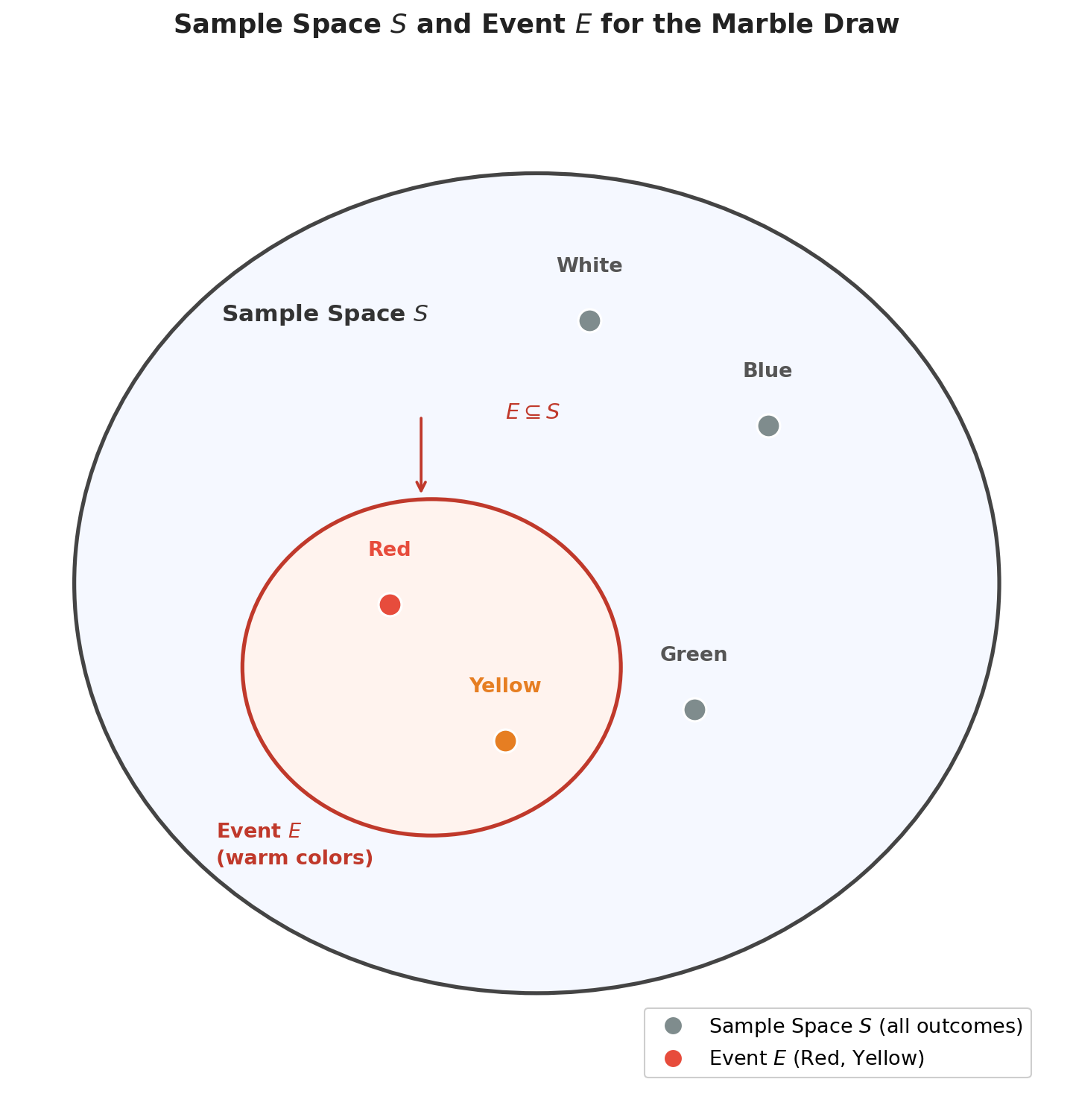
Notice that is a proper subset of : it contains some, but not all, of the outcomes in the sample space. This relationship — an event living inside its sample space — is the core idea we will build on throughout this course.
Real-World Applications
The same three concepts appear constantly outside the classroom. Here is how they look across several familiar settings:
| Real World Application | Sample Space Example () | Event Example |
|---|---|---|
| Business (Startup outcome) | Successful exit: | |
| Healthcare (Patient response) | Treatment had an effect: | |
| Education (Exam grade) | Student passes: | |
| Everyday Life (Weather) | Precipitation occurs: |
In each case, the structure is identical: a set of clearly defined outcomes forms the sample space, and an event is simply the subset of those outcomes that matches a condition we care about.
Conclusion and Next Steps
In this lesson, we established the three foundational concepts that underpin all of probability: an outcome is one single possible result of a chance process; the sample space is the complete collection of all possible outcomes; and an event is a subset of the sample space representing the results we care about. As the real-world examples show, this same structure appears across business, healthcare, education, and everyday life — wherever there is uncertainty, outcomes, sample spaces, and events are the tools we use to describe it precisely.
The practice section ahead brings these concepts to life through real-world scenarios — from spotting individual outcomes in context to matching event descriptions to their correct subsets of the sample space. We have everything we need to take them on, so let's get to it!
