Connect Volume to Base Area and Height
Introduction 🎉
Welcome back to Volume of 3D Solids! In the previous lesson, you learned how to calculate the volume of rectangular prisms and cubes using the formula . This lesson focuses on understanding volume as base area times height. You will now use what you know about this familiar three-number multiplication to understand why it is really a two-step idea: find the area of the base, then multiply by the height.
By the end of this lesson, you will have learned how to:
- Rewrite the rectangular prism volume formula as .
- Explain why the volume of a uniform solid equals the area of its base times its height using the concept of stacked layers.
- Calculate the volume of a solid given its base area and height, expressing the answer in correct cubic units.
- Describe how changing the base area or the height affects the total volume proportionally.
🥞 Thinking in Layers
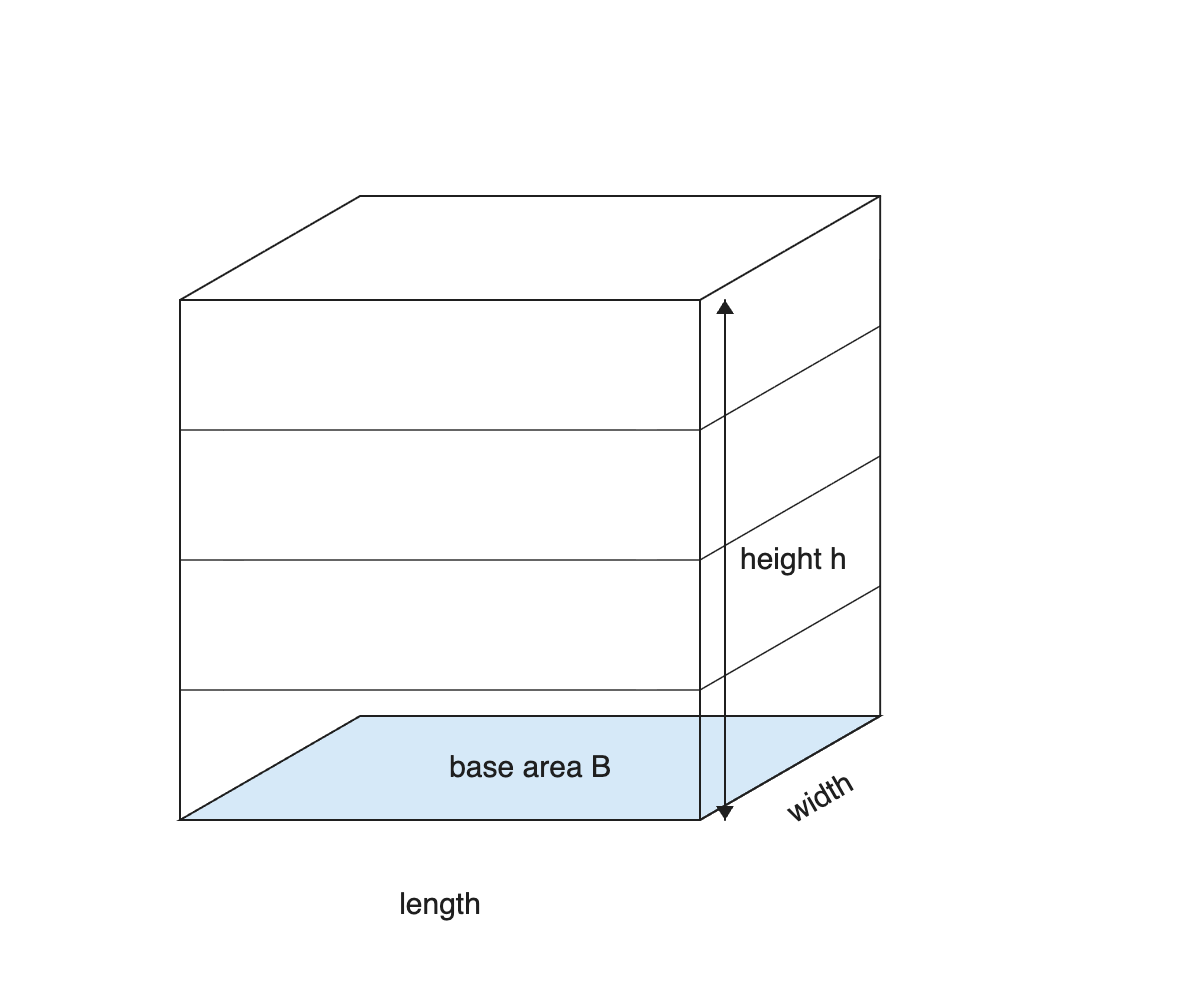
Before you touch any formulas, let's revisit a mental picture from the last lesson. Recall how you imagined filling a box with unit cubes: first, laying a single flat layer across the bottom, and then stacking identical layers until the box was full.
That bottom layer is the key. Its size is determined by the shape and area of the base of the solid, and the number of layers equals the height. Think of a stack of identical playing cards where each card represents one thin layer, and the height of the stack tells you how many cards there are. If you keep this "layers" image in mind, the rest of this lesson will feel very natural.
✍️ Rewriting the Formula You Already Know
The volume of a rectangular prism is:
Now let's group the first two factors together. The product gives you the area of the rectangular base. You'll call that quantity (for base area). The formula then becomes:
where and is the height of the prism. The math has not changed here — this simply recognizes that two of the three factors already produce a meaningful quantity: the area of one layer.
Example: Consider a rectangular prism that is 6 cm long, 4 cm wide, and 5 cm tall.
- Base area:
- Volume:
Notice how the base area is expressed in square units () because it is a flat, two-dimensional measurement. When you multiply it by the height (a one-dimensional length in cm), you get cubic units (), which is exactly what volume requires.
Let's connect this back to the stacking image. Each layer of unit cubes covers the entire base of the prism, so the number of cubes in one layer equals the base area . Stacking such layers fills the solid completely. Therefore, the total number of cubes is .
This reasoning does not depend on the base being a rectangle. Any solid whose cross-section stays the same from bottom to top — called a uniform solid or prism — follows the same rule. Keep in mind: if every horizontal slice of a solid is the same shape and size, its volume equals the area of that slice times the height.
📈 How Changing Base Area or Height Affects Volume
Understanding the formula also helps you predict what happens when dimensions change. Because volume is the product of two factors, changing either one has a direct and proportional effect.
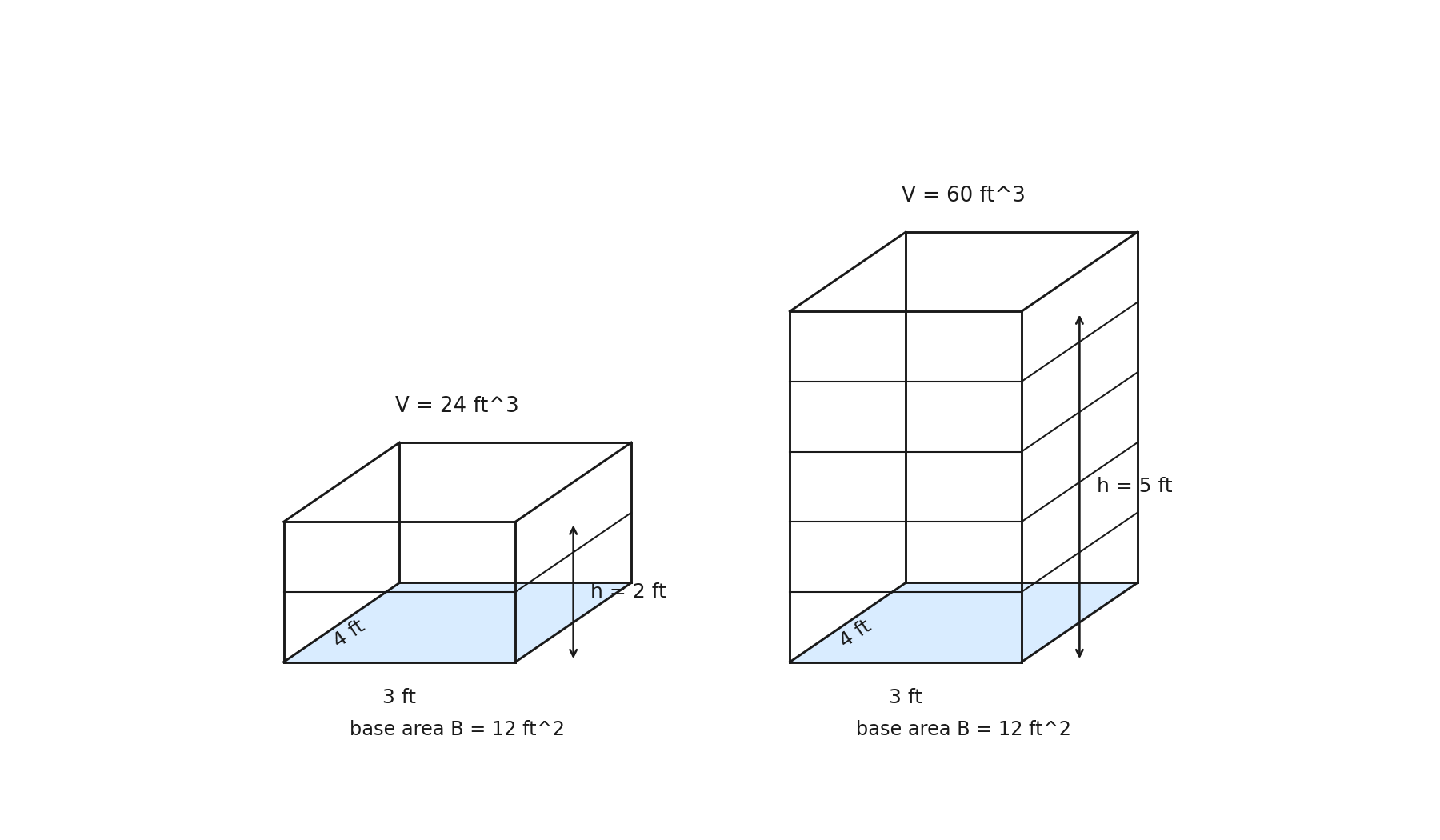
Changing the height while keeping the base area the same: Imagine two rectangular prisms that share the same 3 ft × 4 ft base (). One is 2 ft tall and the other is 5 ft tall. The shorter prism has , while the taller prism has . The taller prism holds more than double the volume because it contains more layers of the same base area. In general, if you double the height, you double the volume; triple the height, triple the volume.
Changing the base area while keeping the height the same: Now picture two prisms that are both 4 m tall, but one has a base area of and the other has a base area of . The smaller-base prism gives , while the larger-base prism gives . Doubling the base area doubled the volume because each layer now contains more unit cubes, so every stacked layer contributes more space.
The takeaway is straightforward: volume scales proportionally with both base area and height. Double either factor while holding the other constant, and the volume doubles too, in the same way doubling the number of pages in a book doubles the book's thickness if every page stays the same size.
📝 Quick Reference
Here is a compact summary of the key ideas from this lesson:
| Concept | What It Means |
|---|---|
| (base area) | Area of the flat bottom face of the solid () |
| (height) | Distance the base is extended upward () |
| Volume equals the base area times the height () | |
| Double , keep | Volume doubles |
| Double , keep | Volume doubles |
Conclusion and Next Steps
The volume formula is really a special case of the more general formula , where is the area of the base. This works because a prism's volume is built from identical layers stacked to its full height. Changing either the base area or the height changes the volume proportionally — double one factor while holding the other constant, and the total volume doubles.
Up next, you will put this understanding into practice. You will identify base regions in different solids, rewrite the familiar rectangular prism formula in the form, and reason about how prisms hold more space when they are taller, or when they have a larger base area while the height stays the same. Dive in and see how solid your new perspective really is!
