Calculate Volume of Cylinders
Introduction 🎉
Welcome to Calculate Volume of Cylinders! In the previous lessons, you mastered the volume of rectangular prisms and discovered the universal formula . Now, you will apply that same "base area times height" logic to a curved surface: the cylinder.
This third lesson focuses on measuring cylindrical volume by using what you know about circular areas. You will learn how to adapt your volume formula for objects like soup cans, water pipes, and fuel tanks. By the end, you will be able to:
- Apply the formula to calculate the volume of any cylinder.
- Convert a diameter into a radius to avoid common calculation errors.
- Manage the decimal values of to provide both exact and rounded measurements.
As you may recall from the previous lesson, any solid built from identical layers stacked to a uniform height follows the formula . You used rectangular bases last time, but the shape of the base does not always have to be a rectangle.
A cylinder is a solid whose base is a circle instead of a rectangle. Imagine stacking hundreds of thin circular discs, like a tall roll of coins. Each disc has the same circular area, and the total number of discs determines the height. The same "base area times height" logic applies perfectly, so all you need is a way to find the area of that circular base.
⭕ Recalling the Area of a Circle
Before you write the cylinder volume formula, let's do a quick refresher. As you may recall from an earlier course, the area of a circle is:
Here, is the radius (the distance from the center of the circle to its edge) and is approximately . For example, a circle with a radius of cm has an area of .
Also remember that the diameter of a circle is twice the radius, so . If a problem gives you the diameter, divide by to get the radius before using the area formula.
🥫 The Cylinder Volume Formula
Now let's combine what you know. A cylinder's base is a circle with area , and its height is . Plugging this into the general volume formula gives you:
In the diagram below, the radius is measured from the center of the circular base to the edge, and the height runs straight from one base to the other.
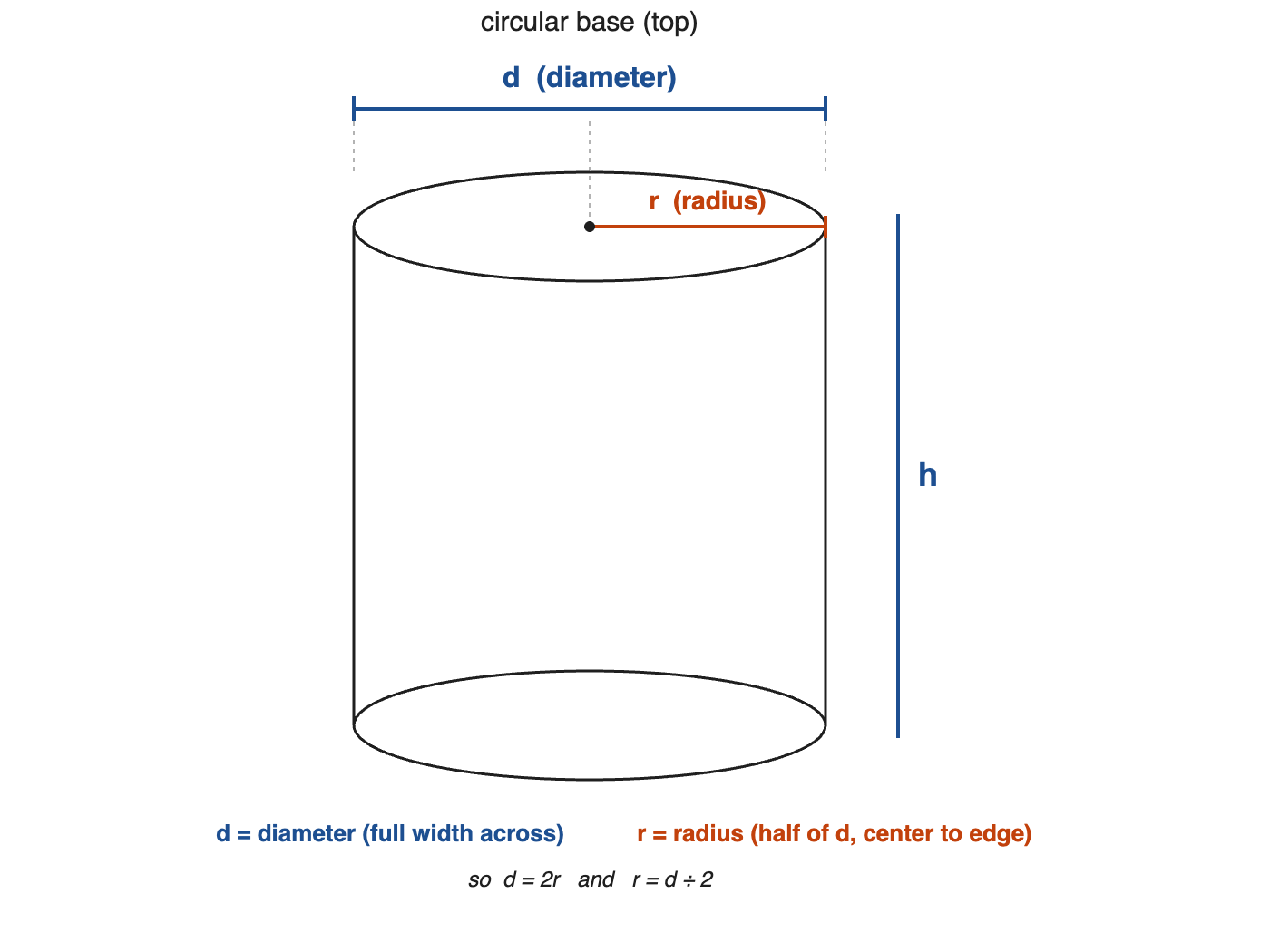
There are only three values that you will need: the radius , the height , and the constant . (Note: In this lesson, you should round your final answers to the nearest tenth, hundredth, or keep the exact product.) Let's walk through a complete example.
Example: A cylindrical water tank has a radius of ft and a height of ft. Find its volume.
- Square the radius:
- Multiply by to get the base area:
- Multiply by the height:
- Label with cubic units:
The tank holds approximately 502.4 cubic feet of water. Notice how the expressed final answer is in cubic units, just as with rectangular prisms.
↔️ Working with Diameter Instead of Radius
Sometimes a problem provides the diameter rather than the radius. Since the radius is half the diameter, you simply add one small step at the beginning.
Example: A soup can has a diameter of cm and a height of cm. What is its volume?
- Find the radius:
- Square the radius:
- Multiply by :
- Multiply by the height:
- Label:
A common mistake is to forget this conversion and plug the full diameter into . That would square a number twice as large as it should be, producing a volume four times too big. Always check: am I using the radius or the diameter?
Conclusion and Next Steps
In this lesson, you extended the formula from rectangular prisms to cylinders by recognizing that a cylinder's base is a circle with area . The complete cylinder volume formula is . When given a diameter, you divide by to find the radius first.
Up next, you will put these skills into practice by exploring how radius and height affect cylinder volume, completing step-by-step calculations, and handling diameter-to-radius conversions on your own. You will even figure out how much coffee fits inside a cylindrical canister — a perfect chance to see this formula at work in a real-world capacity scenario. Jump in and see how naturally these cylinders stack up!
