Solve Volume Problems in Everyday Situations
Introduction 🎉
Welcome back to Volume of 3D Solids! In the previous lessons, you built an impressive toolkit by calculating the volumes of cubes and rectangular prisms, and applying the "base area times height" logic to cylinders. Now, it is time to bring everything together.
This last lesson focuses on solving real-world volume problems from start to finish. You will learn how to look at practical scenarios, choose the right formula, and turn math into genuinely useful answers. By the end, you will be able to:
- Identify whether a real-world object is a cube, rectangular prism, or cylinder based on context clues.
- Choose the correct formula and accurately compute the volume of the solid.
- Interpret what the calculated number actually means in context, such as container capacity or storage space.
🤔 From Formulas to Real Decisions
In everyday life, nobody hands you a shape name and a formula. Instead, you encounter objects like fish tanks, shipping boxes, and water coolers. The real skill is looking at a situation and asking: What solid am I dealing with, and what measurements do I need?
Think of it like a chef who has learned three recipes. Knowing each recipe is important, but the bigger challenge is looking at the ingredients on the counter and deciding which recipe to use. That is exactly the step you will practice here: matching the real object to the right volume formula before we calculate anything.
Every volume problem starts with identifying the shape. Here is a simple guide to connect everyday objects to the solids you have studied:
| Real-World Object | Solid Type | Key Clue |
|---|---|---|
| Dice, ice cube, cube-shaped planter | Cube | All edges are the same length |
| Fish tank, moving box, shipping container | Rectangular prism | Has a rectangular base with distinct length, width, and height |
| Coffee can, water cooler jug, cylindrical tank | Cylinder | Has a circular base (round cross-section) |
When reading a problem, look for shape words like "round," "circular," or "cylindrical" versus "rectangular," "box-shaped," or "cube-shaped." These clues point you straight to the correct formula.
📐 The Three Volume Formulas at a Glance
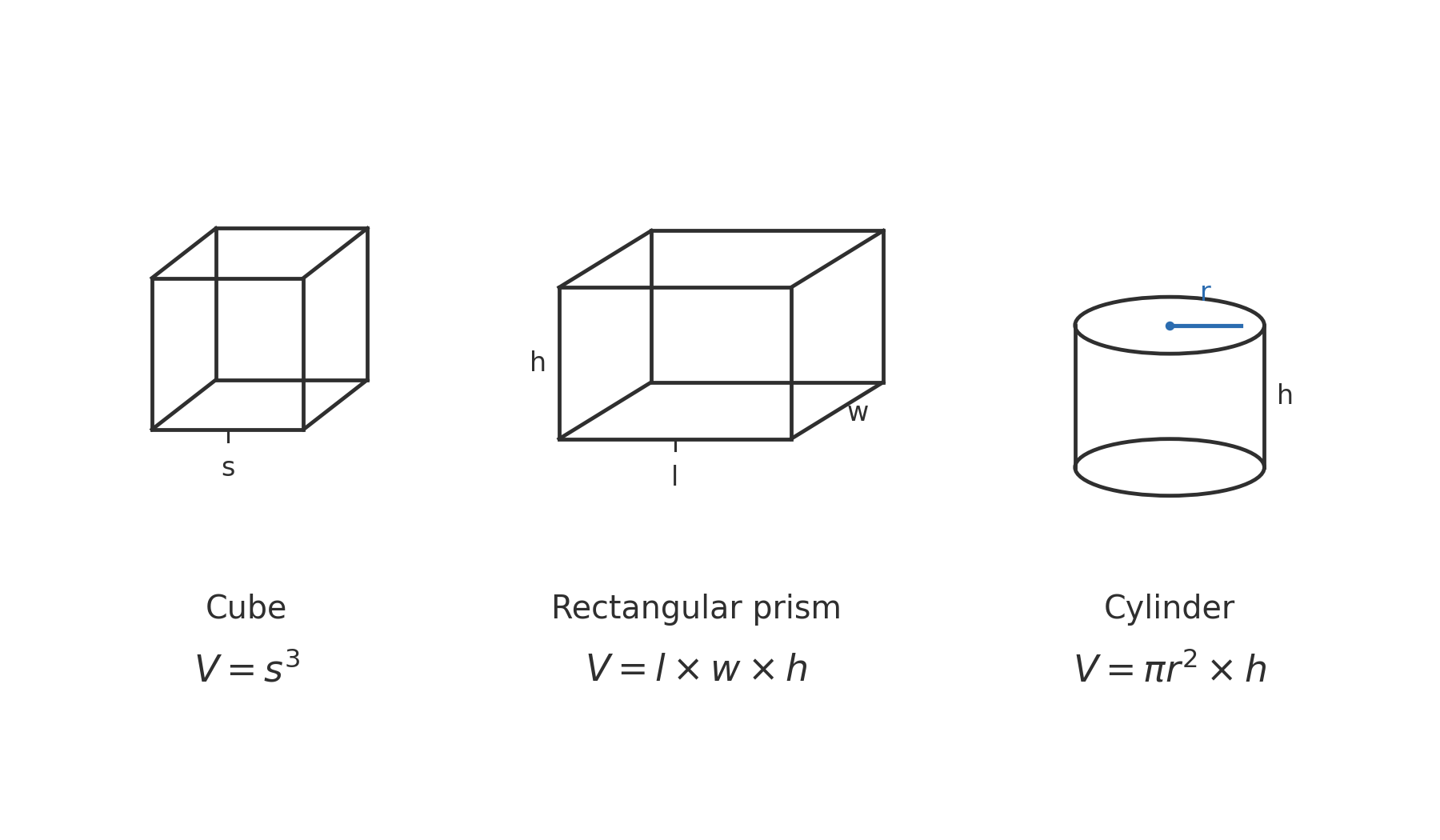
As you may recall from previous lessons, you have developed three closely related formulas. Let's gather them in one place for easy reference.
- Cube: All sides have the same length , so
- Rectangular prism: The base is a rectangle with length and width , and the solid has height , giving
- Cylinder: The base is a circle with radius , so
Notice that every formula follows the same core idea: base area times height. The only difference is how you compute the base area — for a cube, for a rectangular prism, or for a cylinder.
A quick visual can help compare the dimensions used in each formula:
🌱 Worked Example: A Cube-Shaped Planter
Let's start with the simplest case.
Scenario: You are buying soil for a cube-shaped garden planter whose edges each measure cm. How much soil do you need to fill it completely?
Step 1 — Identify the solid. The planter is described as cube-shaped, meaning all edges are the same length. This is a cube.
Step 2 — Choose the formula.
Step 3 — Calculate.
Step 4 — Interpret. You need cubic centimeters of soil. This tells you the exact volume of potting soil you need to buy from a garden center to fill the planter.
🐟 Worked Example: Filling a Fish Tank
Now let's move to a rectangular prism, which adds a bit more complexity because the three dimensions can all be different.
Scenario: You purchase a rectangular fish tank that is cm long, cm wide, and cm tall. How much water does it hold when completely filled?
Step 1 — Identify the solid. The tank is described as rectangular with three distinct dimensions, so it is a rectangular prism.
Step 2 — Choose the formula.
Step 3 — Calculate.
Step 4 — Interpret. The tank holds cubic centimeters of water — enough to comfortably house a small freshwater aquarium.
💧 Worked Example: Sizing a Cylindrical Water Cooler
Finally, let's tackle a cylinder scenario that includes a diameter-to-radius conversion.
Scenario: A cylindrical office water cooler has a diameter of cm and a height of cm. What is its capacity?
Step 1 — Identify the solid. The words "cylindrical" and "diameter" tell us this is a cylinder.
Step 2 — Choose the formula. . You are given the diameter, so you first find cm.
Step 3 — Calculate. (Using for )
Step 4 — Interpret. The cooler holds approximately of water. That is roughly the size of a large office water jug, confirming your answer is reasonable.
💡 Interpreting What Volume Means
Calculating a number is only half the job. In practical problems, you also need to explain what the result represents. Volume tells you how much three-dimensional space an object encloses, but depending on the context, that space might mean different things:
- Capacity of a container — how much liquid, grain, or soil it can hold.
- Amount of material needed to fill or build something — concrete for a pillar, wax for a candle.
- Storage space available inside a box, room, or tank.
A strong answer always ends with a sentence that ties the number back to the situation, such as: "This means the container can hold about of water" or "You would need roughly of soil to fill the planter." That final interpretation is what turns a math exercise into a genuinely useful real-world answer.
🚧 Common Mistakes to Avoid
Before heading into practice, let's highlight a few pitfalls that come up frequently when solving real-world volume problems.
- Using area instead of volume. If someone asks how much water a pool holds, they want volume (cubic units), not the surface area of the water (square units). Always check whether the problem asks about space inside or surface coverage.
- Forgetting a dimension. Multiplying only length times width gives area, not volume. Make sure all three dimensions (or the radius and height for cylinders) are included.
- Plugging in the diameter as the radius. Using the full diameter in produces an answer four times too large. Always divide the diameter by first.
- Mismatched units. If the length is in centimeters and the height is in meters, convert them to the same unit before multiplying. Mixed units produce meaningless results.
A quick sanity check at the end of a problem can catch most of these errors. Ask yourself: Does this answer make sense for the real object?
Conclusion and Next Steps
In this final lesson, you brought together everything from the course: identifying cubes, rectangular prisms, and cylinders in real-world scenarios, selecting the correct volume formula, computing the result with proper units, and interpreting what that number means in practical terms. The key insight is that all three formulas share the same logic of base area times height; the only choice is how to compute the base area for the shape at hand.
Now it is your turn to put these skills to the test. In the upcoming practice exercises, you will match everyday objects to their solid types, spot errors in sample calculations, and tackle multi-shape scenarios that bring real meaning to every cubic unit you compute. Dive in and show those volume problems who is boss!
