Build Volume with Cubes and Prisms
Introduction 🎉
Welcome to Volume of 3D Solids! Over the previous courses, you built a strong foundation in geometric measurement — from understanding what perimeter, area, and volume represent, to calculating boundary lengths and surface areas of common shapes. Now it is time to step into the third dimension and learn how to calculate the space inside solid objects.
This first lesson focuses on measuring volume by exploring how space is filled with cubic units. You will now learn how to apply a simple, reliable formula to find the volume of common 3D solids. By the end, you will be able to:
- Identify the correct cubic units used to measure volume.
- Calculate the volume of rectangular prisms and cubes accurately.
- Look at any box-shaped object and confidently determine how much space it fills.
As you may recall from earlier courses, area measures how much flat surface a shape covers, using square units like or . You found area by thinking in two dimensions: length and width. Volume takes that idea one step further by adding a third dimension: height (or depth).
Imagine placing a single flat layer of small cubes across the bottom of a shoebox. That layer covers the base area. Now stack identical layers on top of each other until the box is full. The total number of small cubes filling the box is its volume — area extended upward through space.
🧱 Cubic Units: The Building Blocks of Volume
Just as you count square tiles to measure area, you count unit cubes to measure volume. A unit cube is a small cube whose edges are each exactly one unit long. Depending on the unit of measurement, you can express volume in:
| Unit of Length | Unit Cube | Written As |
|---|---|---|
| Centimeters | 1 cm × 1 cm × 1 cm | |
| Meters | 1 m × 1 m × 1 m | |
| Inches | 1 in × 1 in × 1 in | |
| Feet | 1 ft × 1 ft × 1 ft |
The small "3" in the unit (the exponent) tells you that you are working in three dimensions. Whenever you report a volume, always include the correct cubic unit label. Without it, the answer is incomplete.
📦 Volume of a Rectangular Prism
Now that you know how volume is measured, let's put those cubic units to work. A rectangular prism is any box-shaped solid where every face is a rectangle. Think of shipping boxes, bricks, or fish tanks. To find its volume, multiply three measurements:
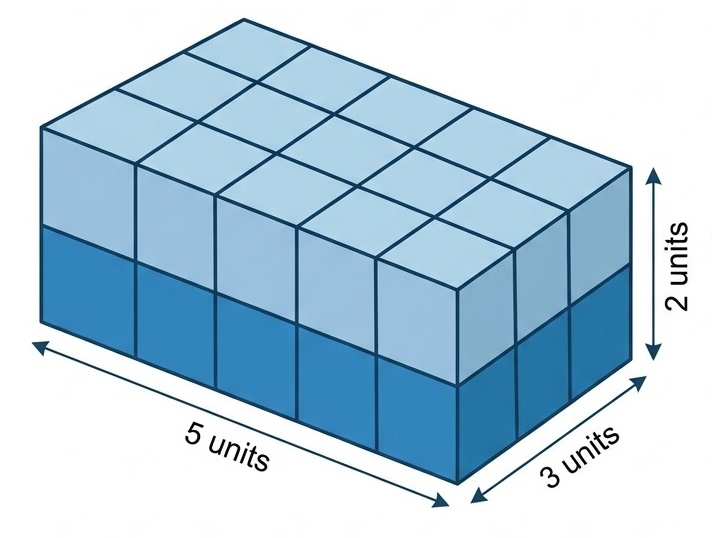
Why does this work? Think of building a solid out of physical blocks. The product gives us the number of unit cubes in one flat, bottom layer. This calculation is exactly the same as finding the area of the 2D base. Once the base is completely covered, multiplying by the height tells us how many of these identical flat layers are stacked on top of each other to reach the top of the prism. By multiplying the number of cubes in a single layer by the total number of layers, the result gives us the total count of unit cubes that perfectly fill the entire solid.
Example: A storage bin measures 5 ft long, 3 ft wide, and 2 ft tall.
That means 30 unit cubes, each one foot on every side, would fit perfectly inside the bin.
🧊 Cubes: A Special Case
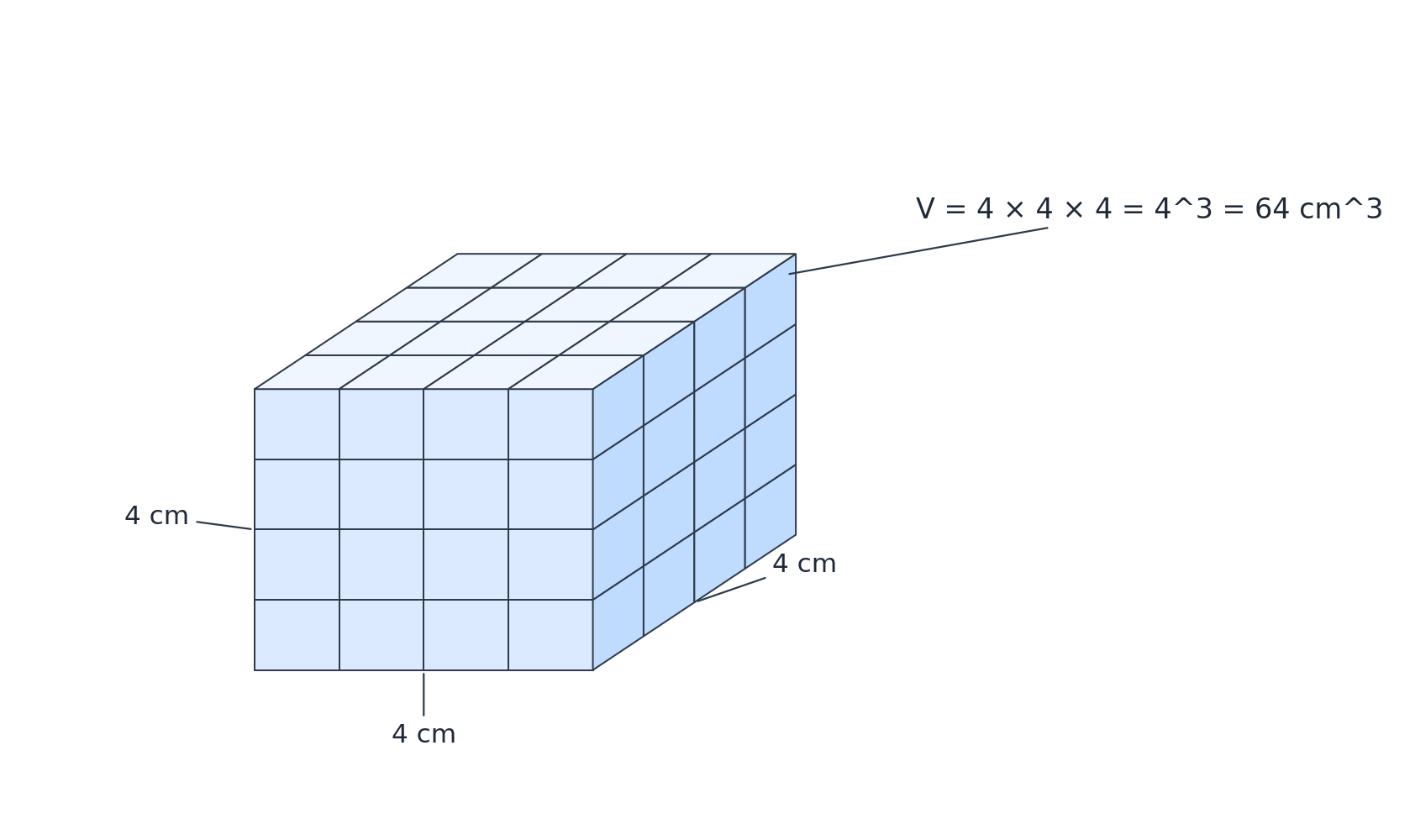
A cube is simply a rectangular prism where all three dimensions are equal. Because the length, width, and height share the same value, you can write the formula in a shorter way. If each edge has length :
Example: A toy block has edges of 4 cm.
Notice that you are not learning a brand-new formula. You are using the same length × width × height structure — just recognizing that when all three numbers are identical, the calculation simplifies to a single value cubed.
📏 Working with Decimal Dimensions
Real objects do not always have neat whole-number measurements. The good news is the formula works exactly the same way with decimals.
Example: A small jewelry box is 6.5 in long, 4 in wide, and 3.2 in tall.
You can tackle this step by step:
So . Breaking the multiplication into stages like this keeps the arithmetic manageable and reduces errors.
⚠️ Common Mistakes to Watch For
Before you wrap up, here are a few pitfalls worth keeping in mind:
- Forgetting the cubic unit. Writing instead of leaves the answer incomplete. Always attach the correct cubic label.
- Multiplying only two dimensions. If you multiply just length by width, you have calculated area, not volume. Volume always requires all three dimensions.
- Mismatched units. Make sure all three measurements use the same unit before multiplying. A box measured as 2 ft by 12 in by 3 ft needs the inches converted to feet (or vice versa) first.
Conclusion and Next Steps
Let's recap! Volume measures the amount of space a 3D object fills, and you express it in cubic units such as , , or . For any rectangular prism, the formula is , and for a cube with edge length , this simplifies to . The same approach works whether the dimensions are whole numbers or decimals.
Up next, you will get hands-on practice where you can adjust dimensions and watch volumes change in real time. After that, you will work through calculation exercises and a real-world packing scenario to solidify your skills. Jump in and start building your volume intuition!
