Understanding Cube Roots
Introduction
Welcome back to Understanding Roots and Radicals! This is lesson three of four in the course, so we are rounding the final turn. Our first two lessons explored square roots — defining them as the inverse of squaring and then estimating non-perfect ones by bracketing. Today, we step from flat shapes into the three-dimensional world and introduce cube roots. By the end of this lesson, you will be able to define what a cube root is, connect it to a real-world context involving cubes, and evaluate cube roots of common perfect cubes with confidence.
From Squares to Cubes
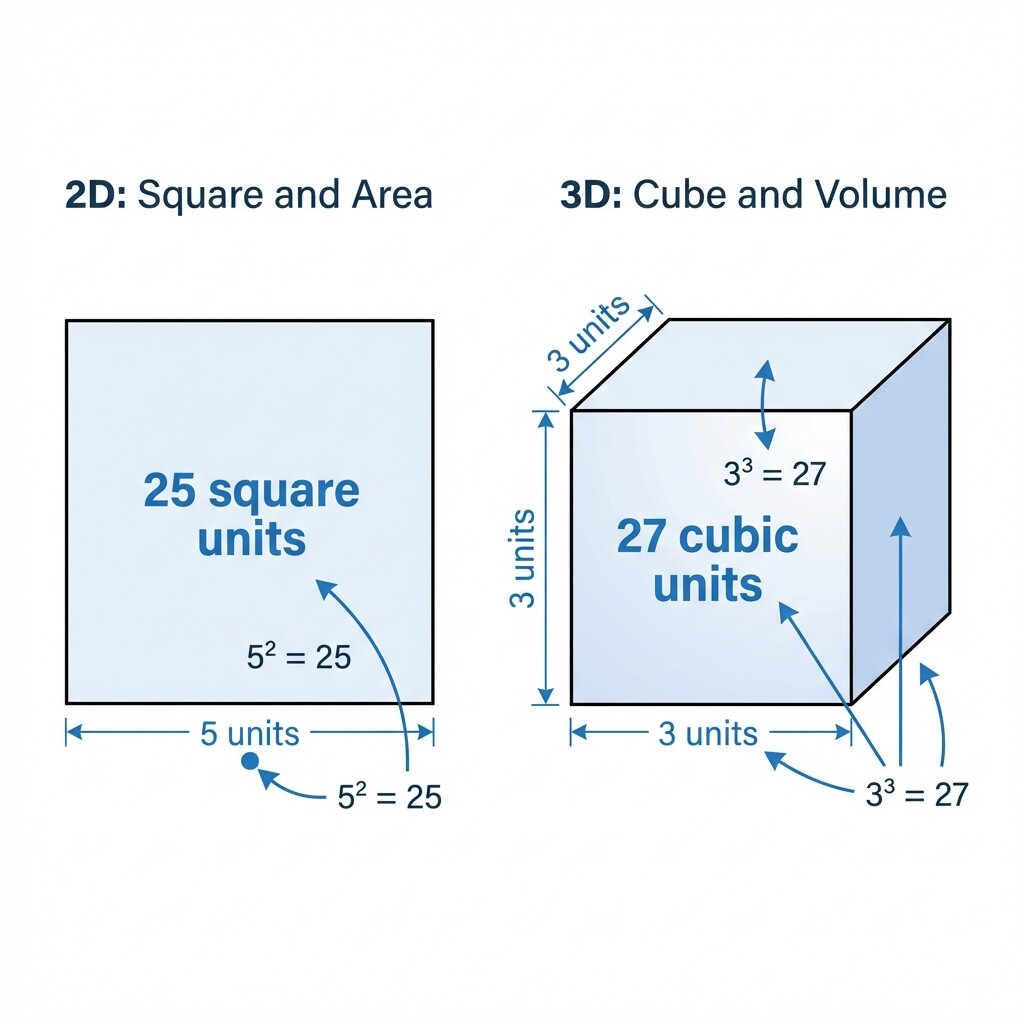
In our first lesson, we connected square roots to geometry: the square root of a number gives the side length of a square with that area. Because , the side length of a square with an area of square units must be .
Now imagine moving from flat squares to solid cubes. A cube is a three-dimensional box where every edge has the same length. If each edge is units long, the volume of that cube is cubic units. The natural question becomes: if we know the volume, how do we find the edge length? That is exactly what cube roots answer.
What Is a Cube Root?
Cubing a number means raising it to the third power — in other words, using that number as a factor three times. For example:
A cube root reverses this process. The cube root of a number asks: what value, when cubed, produces this number? More formally, if , then . We write the cube root of using the radical symbol with a small 3 (called the index) like this: . Since , we know:
The index is what distinguishes a cube root from a square root. Think of cubing and cube roots as a pair of opposite operations, just like squaring and square roots were in our first lesson.
Unlike square roots, the number under the radical sign can also be negative. Because , we have — cubing a negative number produces a negative result, so the cube root of a negative number is negative.
Evaluating Perfect Cube Roots
A perfect cube is a whole number that results from cubing a whole number. For example, is a perfect cube because , and is a perfect cube because . When we take the cube root of a perfect cube, the answer is a clean whole number.
Let's work through a few examples to build the habit:
- Since , we have .
- Since , we have .
- Since , we have .
- Since , we have .
Notice the approach: to evaluate a cube root, ask yourself, "What number did I cube to get this?" The process is like reading a cubing table in reverse.
A Handy Reference Table
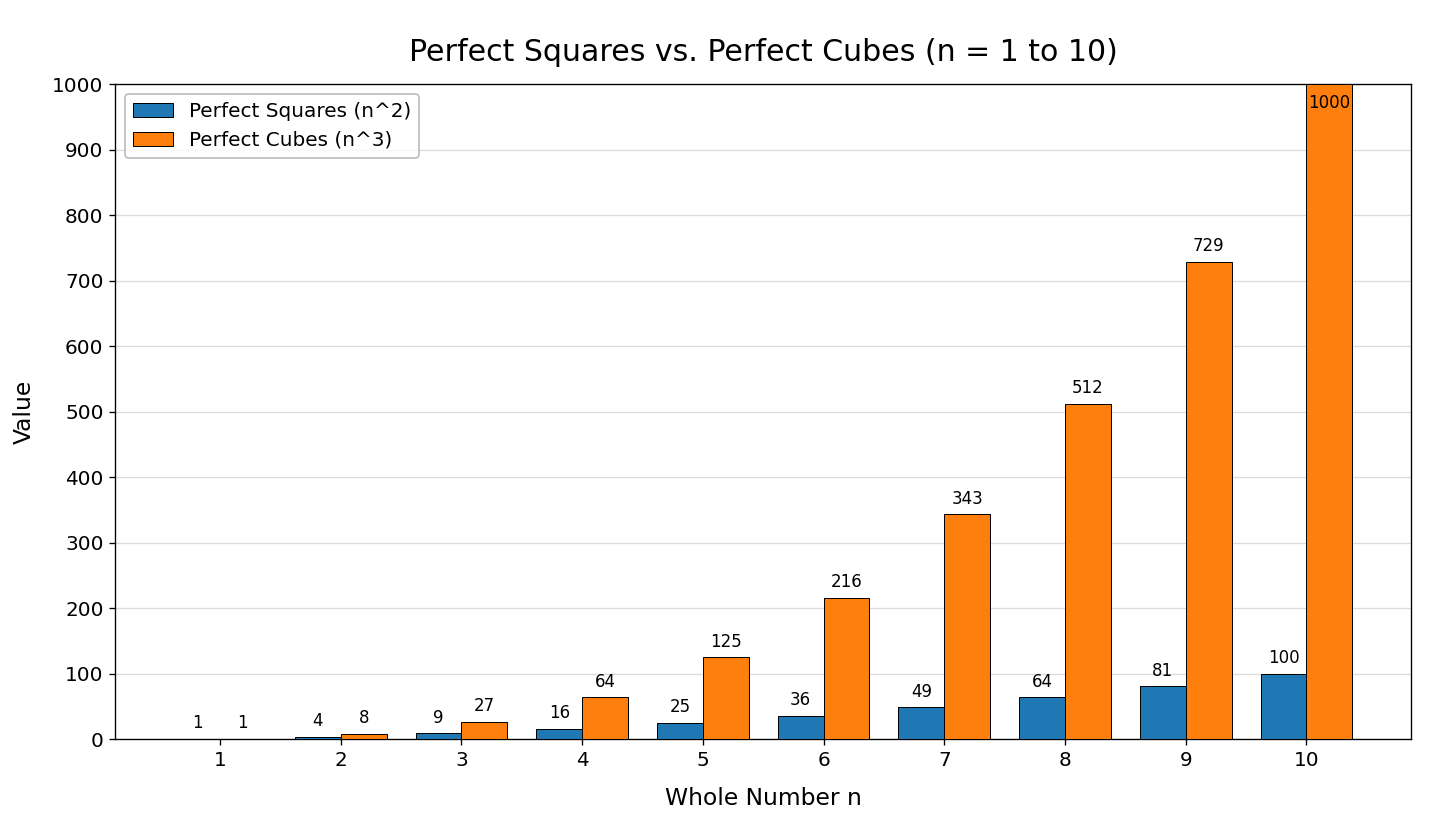
Just as we built a perfect squares table in our first lesson, it pays to have a reference for perfect cubes. Here are the cubes of whole numbers from through :
| Number | Cubed | Perfect Cube |
|---|---|---|
Getting comfortable with these pairs will make cube root evaluation fast and effortless. You will notice that perfect cubes grow much more quickly than perfect squares — and that makes sense, because we are multiplying the base by itself one additional time.
Finding the Edge Length of a Cube
One of the most natural places cube roots appear is in finding the edge length of a cube when its volume is known. The volume of a cube with edge length is:
To recover the edge length from the volume, we take the cube root of both sides:
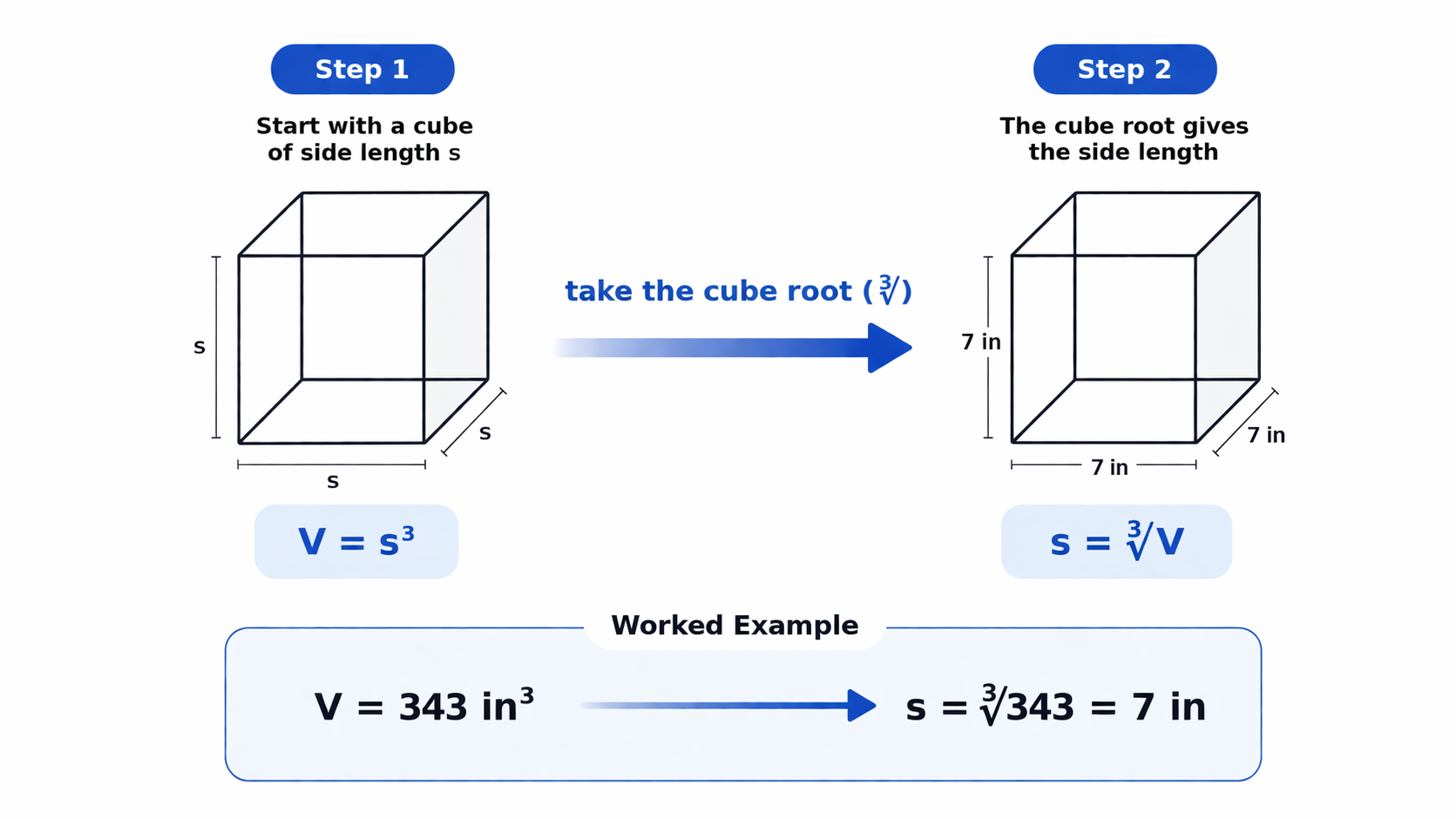
Suppose a cubic shipping box has a volume of cubic inches. To find the edge length, we evaluate . Checking our reference table, , so each edge of the box is 7 inches long.
Let's try another: a cubic planter holds cubic centimeters of soil. Since , the planter's edge length is centimeters. The same logic applies to storage containers, display cases, candle molds, or any other cube-shaped object — whenever you know the volume, the cube root gives you the edge length.
Conclusion and Next Steps
In this lesson, we defined the cube root as the inverse of cubing, built a reference table of perfect cubes from through , and connected cube roots to the practical task of finding a cube's edge length from its volume. The core idea mirrors what we learned about square roots: just as because , we now know that because .
In our next and final lesson, we will connect radicals to fractional exponents, giving us a powerful new way to write and evaluate roots. First, though, it is time to put today's concepts into action — the upcoming practice exercises will have you cracking cube roots across all sorts of scenarios, from shipping boxes to chemistry labs, so let's dive in!
