Estimating Square Roots
Introduction
Welcome back to Understanding Roots and Radicals! This is the second of four lessons in the course, and today we tackle one of the most practical skills in the entire path: estimating square roots. In our first lesson, we defined square roots as the inverse of squaring and built a handy reference table of perfect squares from through . That table works beautifully when the number under the radical is a perfect square — but real life rarely hands us perfect numbers. What about , , or ? In this lesson, you will learn how to estimate the square root of any non-perfect square by pinning it between two consecutive whole numbers.
When Numbers Aren't Perfect
Recall that a perfect square is a whole number produced by squaring a whole number, like or . Their square roots are clean, whole-number answers. In practice, though, the numbers we encounter are rarely that tidy.
Consider a square tile with an area of square inches. Its side length is , but no whole number multiplied by itself equals . Does that mean we are stuck? Not at all — even when a square root is not a whole number, we can still figure out a solid estimate by leaning on the perfect squares we already know.
The key insight is that square roots grow in order. If one number is larger than another, its square root is also larger. That means if sits between the perfect squares and , then must sit between and . This simple idea is the foundation for the technique we will use throughout the lesson.
The Bracketing Technique
The strategy is to bracket the number between two consecutive perfect squares and then take their roots. Here is the process, step by step:
- Find the largest perfect square that is less than the number.
- Find the smallest perfect square that is greater than the number.
- Take the square roots of both perfect squares. Your answer falls between these two whole numbers.
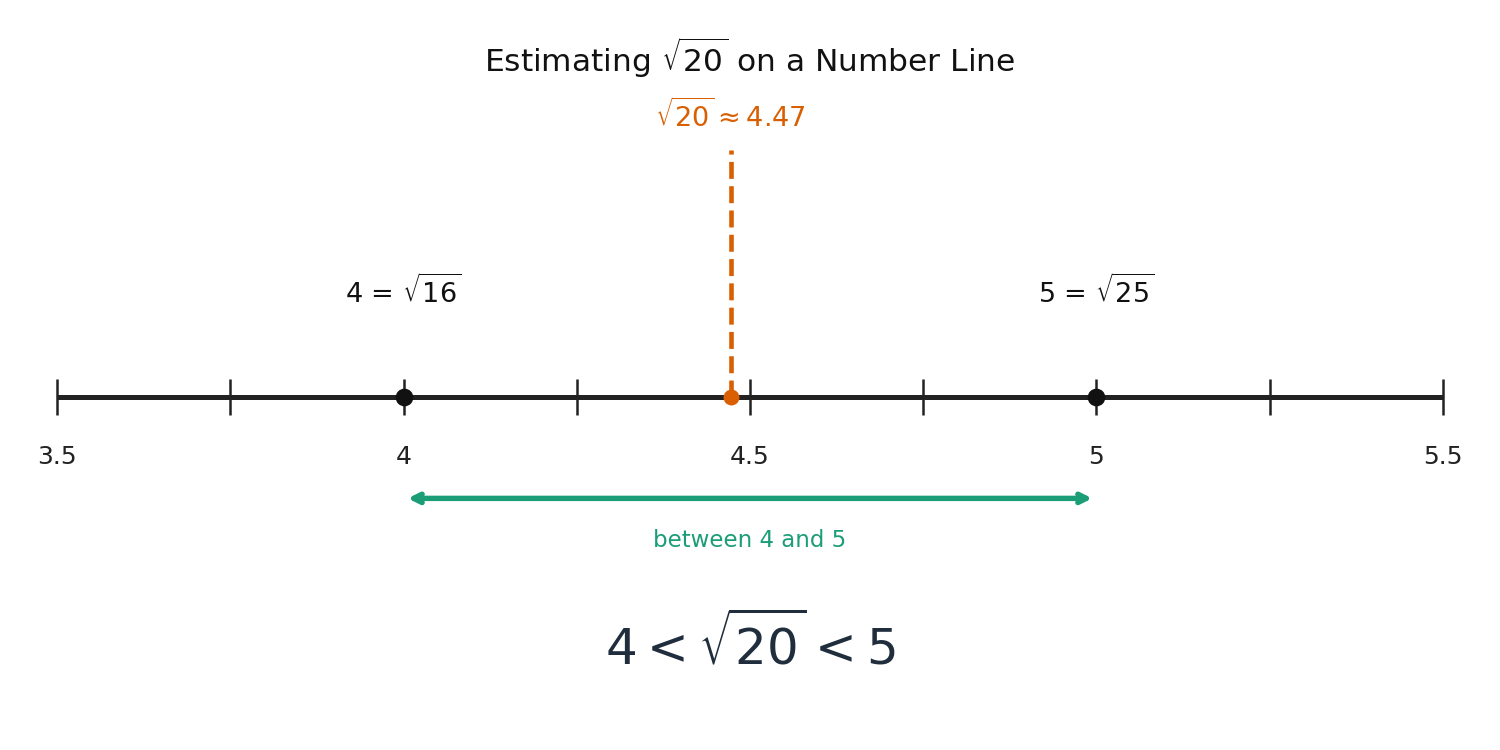
Let's try this with . We ask: which perfect squares sit on either side of 20?
The perfect square just below is , since . The perfect square just above is , since . Because , we can write:
So falls between 4 and 5. A calculator confirms this: . Our estimate is right on target.
Walking Through More Examples
The more we practice, the faster this becomes. Let's work through a few more estimates using the same bracketing approach.
Example 1: Estimate . The perfect square below is (), and the perfect square above is (). Since :
Example 2: Estimate . The perfect square below is (), and the perfect square above is (). Since :
Example 3: Estimate . The perfect square below is (), and the perfect square above is (). Since :
| Expression | Perfect Square Below | Perfect Square Above | Estimate |
|---|---|---|---|
| √50 | 49 = 7² | 64 = 8² | 7 < √50 < 8 |
| √7 | 4 = 2² | 9 = 3² | 2 < √7 < 3 |
| √90 | 81 = 9² | 100 = 10² | 9 < √90 < 10 |
Notice how knowing the perfect squares table from the previous lesson makes each of these quick to solve. That reference table is your best friend for this technique.
Applying Estimation in Real Life
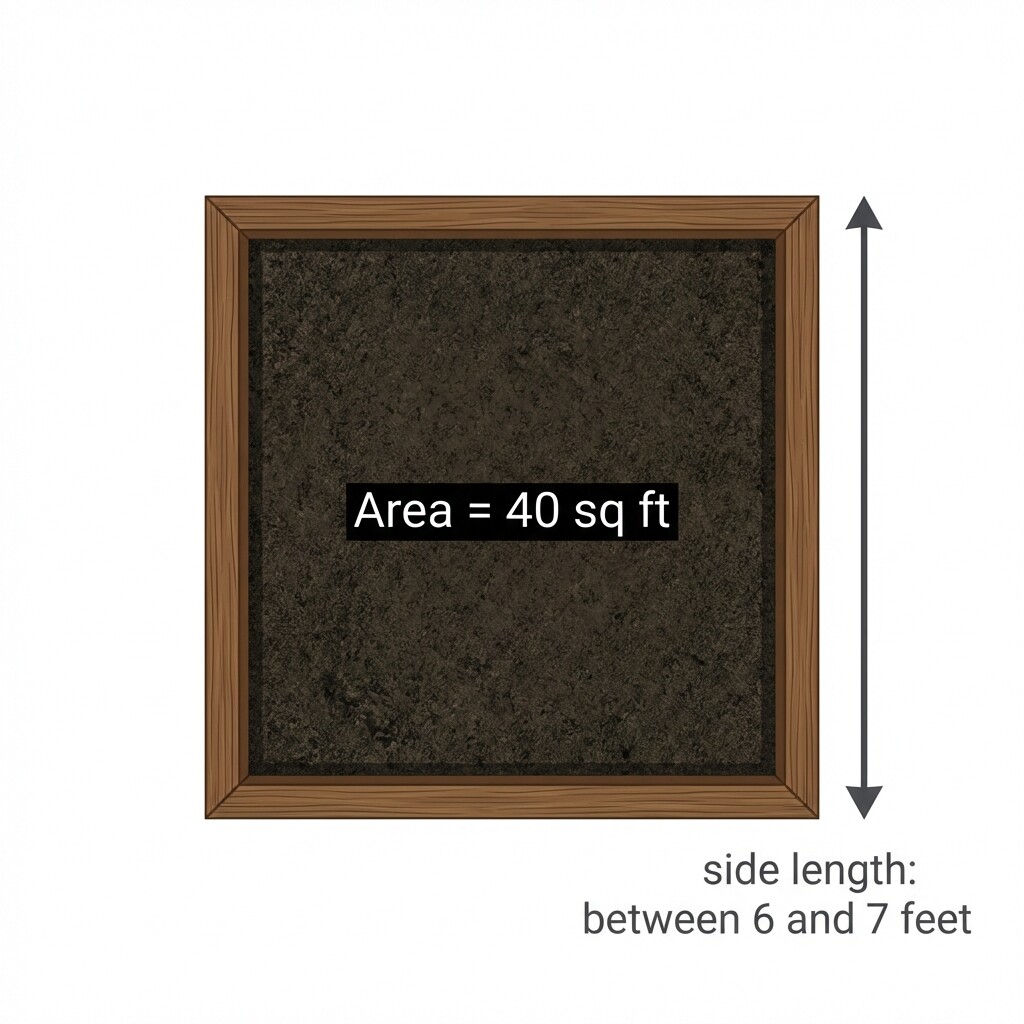
Now let's see how this skill translates to a practical scenario. Imagine you are planning a square garden bed and have exactly square feet of soil to fill it. To figure out roughly how long each side needs to be, you need .
The perfect square below is , since . The perfect square above is , since . So the side length is between 6 and 7 feet — a useful enough range to plan a trip to the hardware store without pulling out a calculator.
This kind of estimation shows up often in construction, home improvement, and design. Whenever a square area is involved and exact whole-number answers simply are not available, a quick bracket between two whole numbers gives you a working range that is good enough for many real-world decisions.
Keys to Accurate Estimates
As you build speed with this technique, keep a few pointers in mind:
- Lean on the perfect squares table. The faster you recall pairs like and , the quicker you can bracket any number.
- Your two bounding roots should always be consecutive whole numbers. If you end up with bounds like and , a perfect square was skipped — go back and check.
- The method works for larger numbers too. For , you just need to know that and , so is between and .
Conclusion and Next Steps
In this lesson, we learned how to estimate the square root of any non-perfect square by bracketing it between two consecutive perfect squares. The process is straightforward: find the perfect squares on either side of the number, take their roots, and you have the whole-number range your answer falls in. This technique strengthens your number sense and gives you a practical tool for situations where exact values are not necessary.
Up next in this course, we will extend our thinking to cube roots, where the same style of inverse reasoning applies to a brand-new operation. But first, it is time to put your estimation skills into action with practice exercises that will have you bracketing roots in everything from abstract numbers to home renovation scenarios — let's jump in!
