Understanding Square Roots
Introduction
Welcome to Understanding Roots and Radicals, the third course in our learning path! In the first two courses, we built a solid foundation with exponents and their rules. Now we are ready to explore the other side of the coin: roots. In this first lesson, we focus on square roots — what they mean, how they relate to squaring, and where they show up in everyday life. By the end, you will be able to evaluate square roots of common perfect squares quickly and confidently.
From Squaring to "Un-squaring"
As you may recall from earlier courses, squaring a number means multiplying it by itself. For example, . We take a number, apply an operation, and get a result.
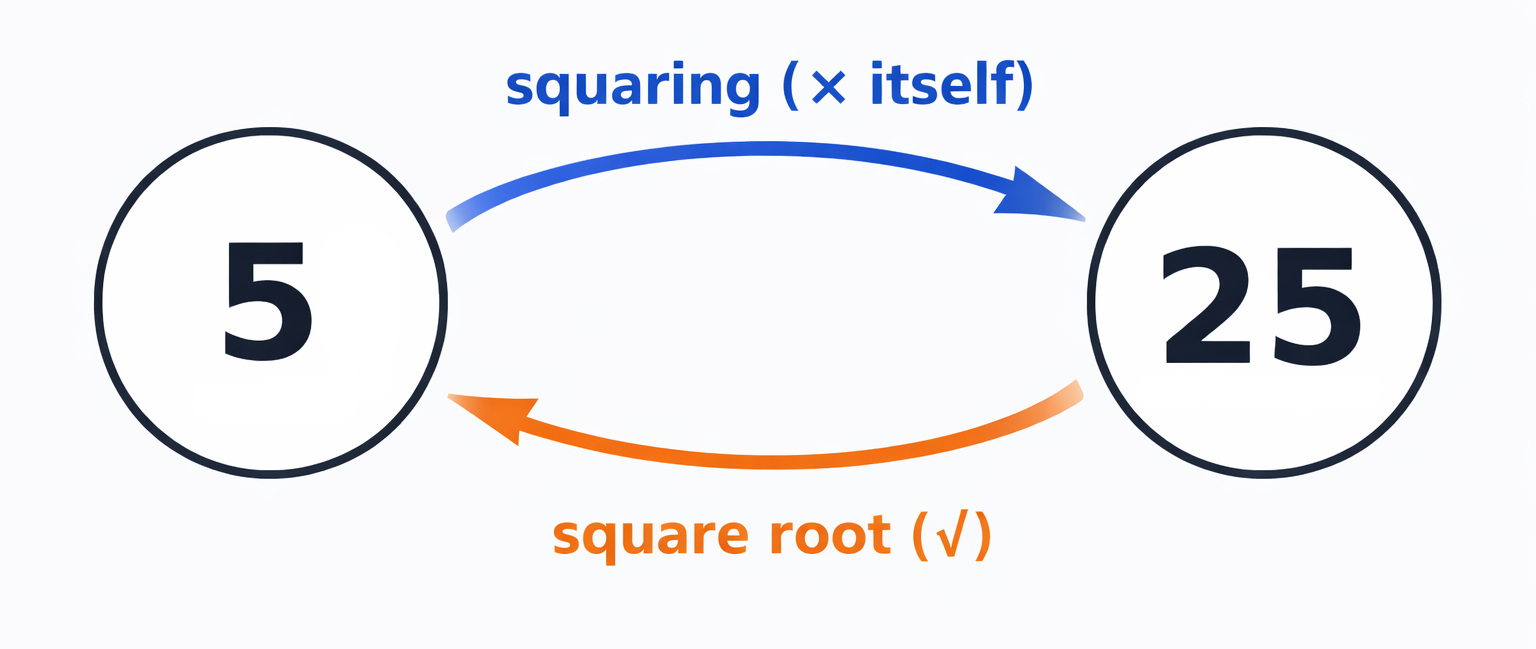
But what if we start with the result and work backward? Suppose someone tells us that a number squared equals and asks us to find that number. We need to think: "What number times itself gives 25?" The answer is . This process of "undoing" a square is exactly what a square root does.
What Is a Square Root?
The square root of a number is the value that, when multiplied by itself, produces that number. We write it using the radical symbol . For example:
In general, means . The square root and squaring are inverse operations — one undoes the other. Think of it like addition and subtraction, or multiplication and division. If squaring takes us from to , then the square root takes us back from to .
One important note: the number under the radical sign must be zero or positive. Since multiplying any real number by itself produces a non-negative result, expressions like have no real-number answer. Also, the square root symbol always refers to the non-negative (positive or zero) result. While both and satisfy , we define . This non-negative value is called the principal square root.
Common Perfect Squares
Now that we know what a square root is, let us build a quick-reference toolkit. A perfect square is a whole number that results from squaring another whole number. Recognizing these pairs makes evaluating square roots fast and almost effortless.
|
|
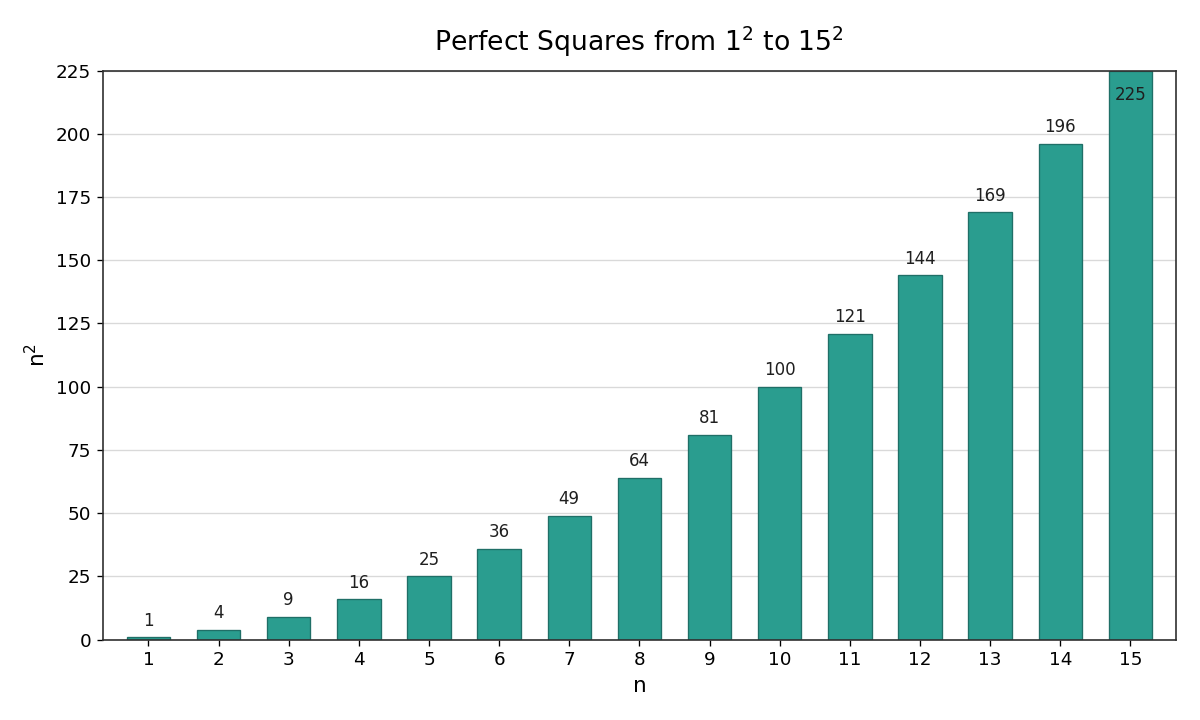
It is well worth becoming familiar with this table. The more of these pairs you can recall from memory, the more smoothly you will move through problems that involve square roots.
Connecting Square Roots to Area
One of the most natural places square roots appear is in geometry. Imagine you have a square garden bed and you know its area is square feet. Since the area of a square equals the side length times itself (), finding the side length means taking the square root of the area:
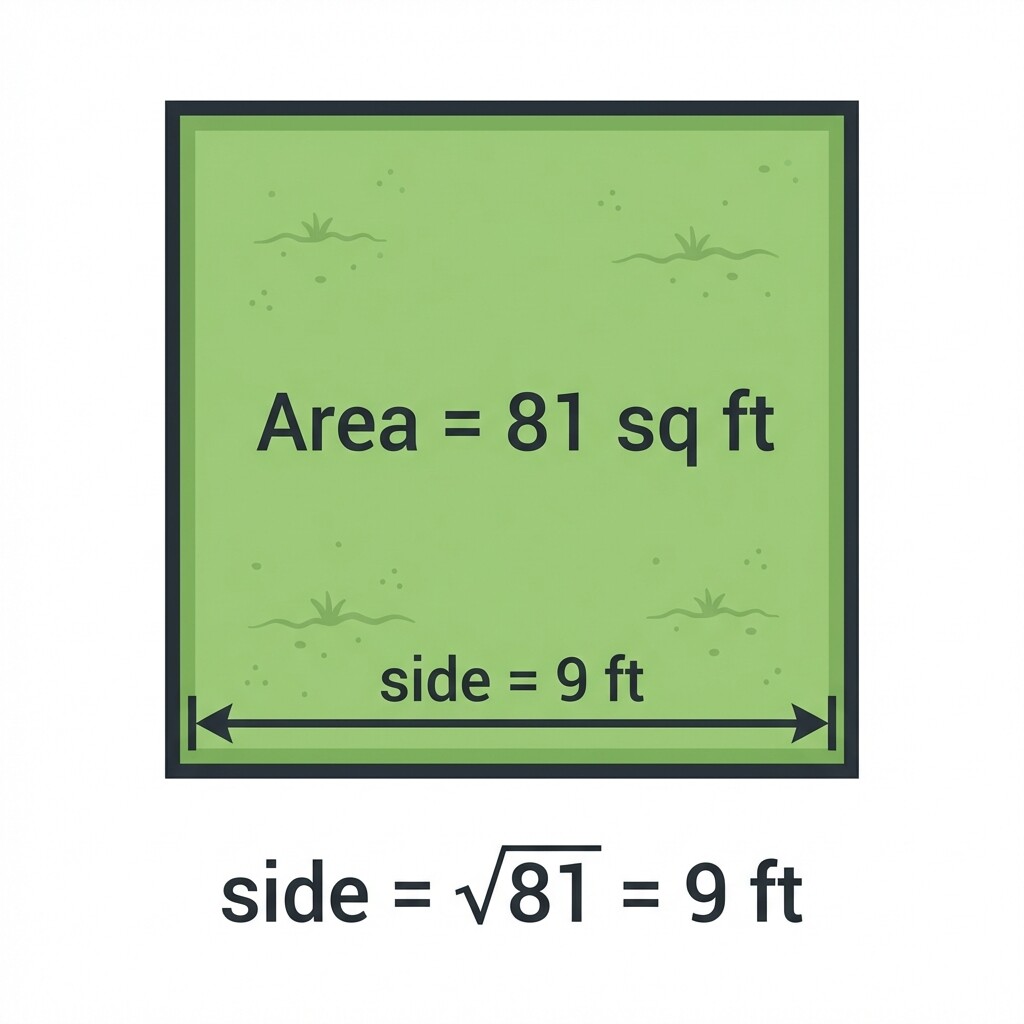
This is the geometric heart of the square root: it gives us the side length of a square when we know its area. Whether you are measuring a room, a patio, or a tile, the process is identical. A square room with an area of square feet has sides of feet. A ceramic tile with an area of square centimeters has sides of centimeters.
Tips to Keep in Mind
As you practice, a few pointers will help you stay on track:
- Work backward from squaring. If you are unsure about , ask yourself: "What number squared gives 64?" Since , you know .
- The result is never negative. By convention, equals , not . The radical symbol always returns the non-negative value.
- Not every number is a perfect square. Numbers like or do not have whole-number square roots. We will learn how to handle those in the next lesson on estimating square roots.
Conclusion and Next Steps
In this lesson, we discovered that the square root is the inverse of squaring — it answers the question "What number, multiplied by itself, gives this value?" We explored the radical symbol , built a reference table of perfect squares from through , and saw how square roots naturally connect to finding the side length of a square from its area.
Up next, you will put these ideas into practice! The exercises ahead will have you working backward from squares, matching perfect squares to their roots, and solving real-world measurement problems involving garden beds, rooms, and tiles. Let's jump in and make these square root skills second nature.
