Roots and Fractional Exponents
Introduction
Welcome to the final lesson of Understanding Roots and Radicals! Over the previous three lessons, we built a solid toolkit: we defined square roots as the inverse of squaring, learned to estimate non-perfect square roots by bracketing between whole numbers, and extended the idea into three dimensions with cube roots. In this fourth and final lesson, we bridge all of that work to a powerful new notation — fractional exponents. By the end, you will be able to translate fluently between radical notation and fractional exponent notation, recognizing them as two equivalent ways of writing the exact same operation.
Why Another Notation?
So far, we have used the radical symbol ( and ) every time we needed to express a root. That notation works perfectly well, but mathematics offers a second way to write the same idea: fractional exponents. You might wonder why we need two notations for one operation. The short answer is flexibility.
Earlier in this learning path, you practiced exponent rules such as the product rule and the power rule. Those rules make calculations with exponents very efficient. When roots are written as exponents, those same rules apply to them directly — opening the door to simpler and faster manipulations down the road. Before we get into specifics, let's build an intuition for how a fraction can sit in an exponent and still make perfect sense.
The Key Idea: Exponents Can Be Fractions
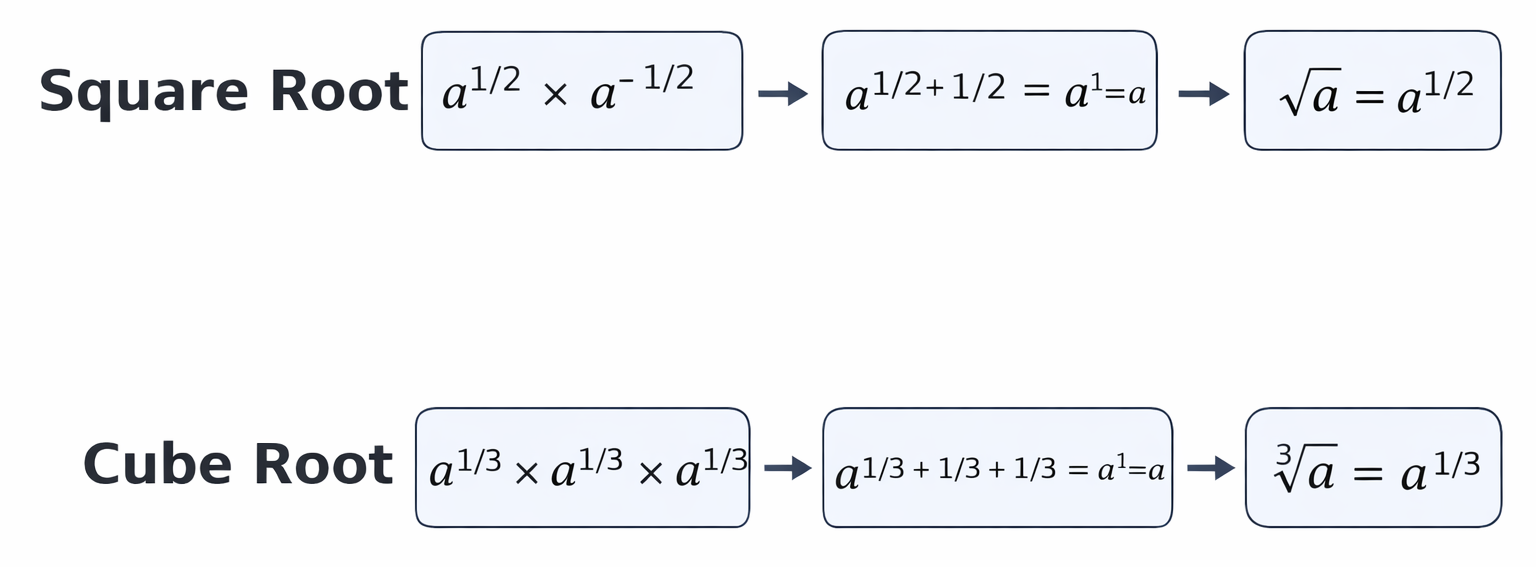
From our earlier work with exponents, we know the product rule:
Now, suppose we have a mystery exponent and we multiply it by itself:
This tells us that is the number which, when multiplied by itself, gives . That is exactly the definition of the square root! So the product rule naturally leads us to a clean equivalence (for ):
The same logic works for cube roots. If we multiply by itself three times:
So is the number which, when used as a factor three times, gives . That is exactly the definition of the cube root:
Notice the pattern: the denominator of the fractional exponent matches the index of the radical. A denominator of means square root; a denominator of means cube root.
Square Roots as Fractional Exponents
Let's see this equivalence in action with values we already know from our perfect squares table. Since , we can also write . Here are a few more familiar examples:
In every case, reading means find the number whose square is . We are simply using exponent notation instead of the radical symbol.
Cube Roots as Fractional Exponents
The pattern carries over directly to cube roots. We saw in the previous lesson that because . In fractional exponent form, that same fact looks like this:
Let's convert a few more from our perfect cubes reference:
Reading means find the number whose cube is . The index from the radical becomes the denominator in the exponent.
One important distinction from square roots: because a negative number multiplied by itself three times still gives a negative result (for example, ), the base can be negative when the denominator of the fractional exponent is . For instance, . This flexibility does not extend to square roots, which is why you saw the restriction applied to earlier in the lesson.
Quick Reference: Radical vs. Fractional Exponent
The table below places both notations side by side for some common values. It can serve as a handy reference while you build fluency.
| Radical Form | Fractional Exponent Form | Value |
|---|---|---|
Notice the rule one more time: the index of the radical always becomes the denominator of the fractional exponent, and the number under the radical stays as the base.
Converting in Both Directions
Translating between the two notations comes down to knowing where each piece goes. The table below summarizes the process for both directions:
| Radical → Fractional Exponent | Fractional Exponent → Radical |
|---|---|
| Step 1: Number under the radical becomes the base | Step 1: Base becomes the number under the radical |
| Step 2: Index becomes the denominator (numerator = 1) | Step 2: Denominator becomes the index of the radical |
| Example: | Example: |
One small convention to remember: when the index is , we typically omit it and simply write rather than . This is the same convention we discussed in our very first lesson. Similarly, becomes , where the denominator appears explicitly as the index.
Applying Both Notations to Real Measurements
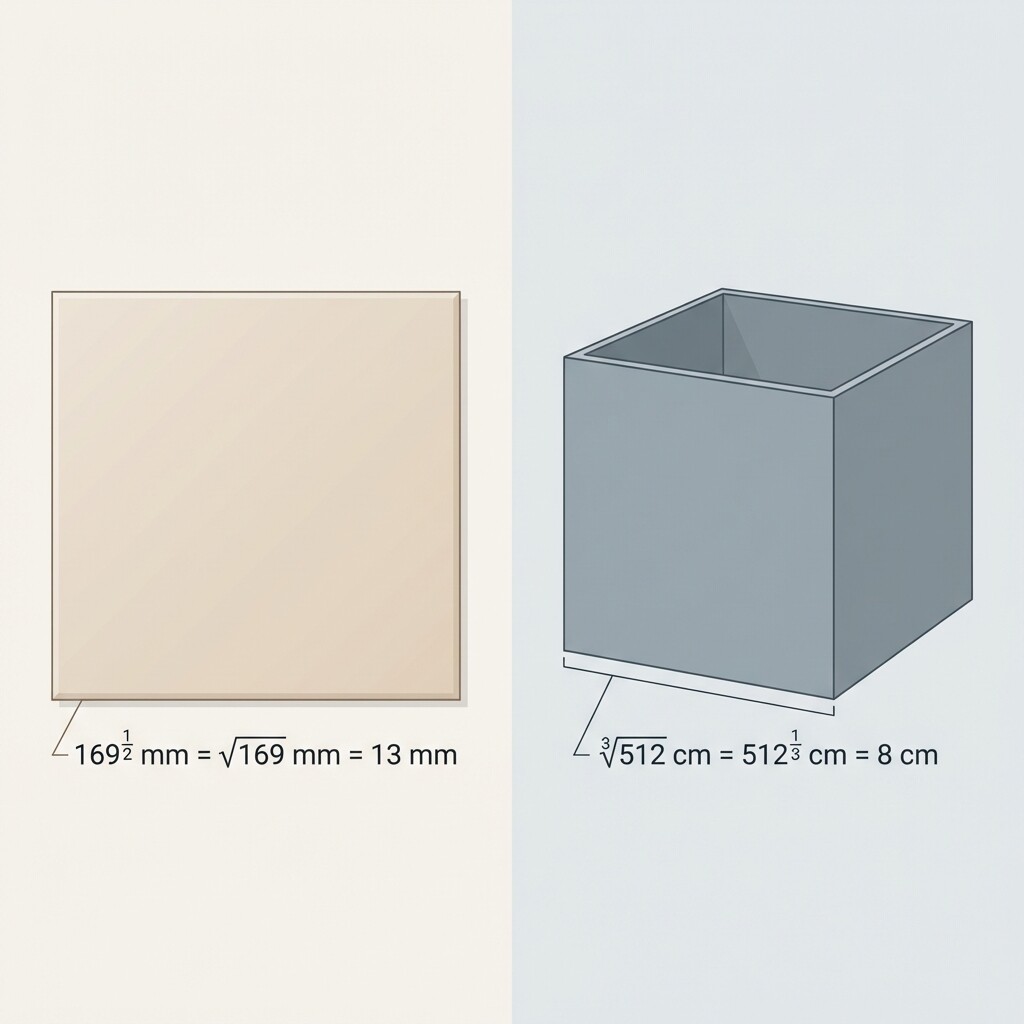
Let's walk through a couple of practical examples that mix both notations. Imagine a square ceramic tile whose side length is given as millimeters. To find the actual length, we recognize that means . Since , the side length is 13 mm.
Now picture a cubic storage bin with an edge length written as centimeters. We can convert this to fractional exponent form as . Since , the edge length is 8 cm.
Whether a specification uses a radical or a fractional exponent, we can evaluate it confidently because both notations describe the same operation. In real-world settings — engineering drawings, architecture plans, science formulas — you may encounter either form, and now you have the skills to handle both.
Conclusion and Next Steps
In this lesson, we discovered that radicals and fractional exponents are two representations of the same idea: (for ) for square roots and for cube roots. The denominator of the fractional exponent always matches the index of the radical, and converting between the two forms is a straightforward swap of notation. With this connection in place, you now have the flexibility to express and evaluate roots using whichever notation suits the situation.
Congratulations on completing all four lessons in Understanding Roots and Radicals! The upcoming practice exercises will have you converting, evaluating, and applying both notations across a variety of scenarios — from filling in missing exponents to interpreting real-world measurements — so jump in and show what you have learned.
