Leading Performers and Achievers
Leading Performers and Achievers
In the previous lesson, you explored the earlier stages of development—the Enthusiastic Beginner brimming with energy but lacking skill, and the Disillusioned Learner grappling with frustration as the Reality Wall hit. Those stages demand heavy involvement from you as a manager. Now you are moving into territory where your team members have built real, demonstrable competence. They can do the work. The question shifts from "Can they perform?" to "Will they trust themselves enough to own it?"
That distinction is the heartbeat of the final two development stages, S3 and S4, and misreading either one can lead to some of the most common—and most damaging—management mistakes. Over-managing someone who has earned autonomy drains their motivation, while abandoning someone who looks competent but is quietly drowning in self-doubt leaves them stuck in a holding pattern. Throughout this unit, you will learn to distinguish between these two stages, understand the unique leadership needs of each, and recognize the internal barrier that keeps capable performers from becoming fully self-reliant. Getting this right will help you unlock the full potential of your strongest contributors and avoid the trap of treating skilled people as if they still need training wheels.
Identifying the Capable but Cautious Performer (Style 3)
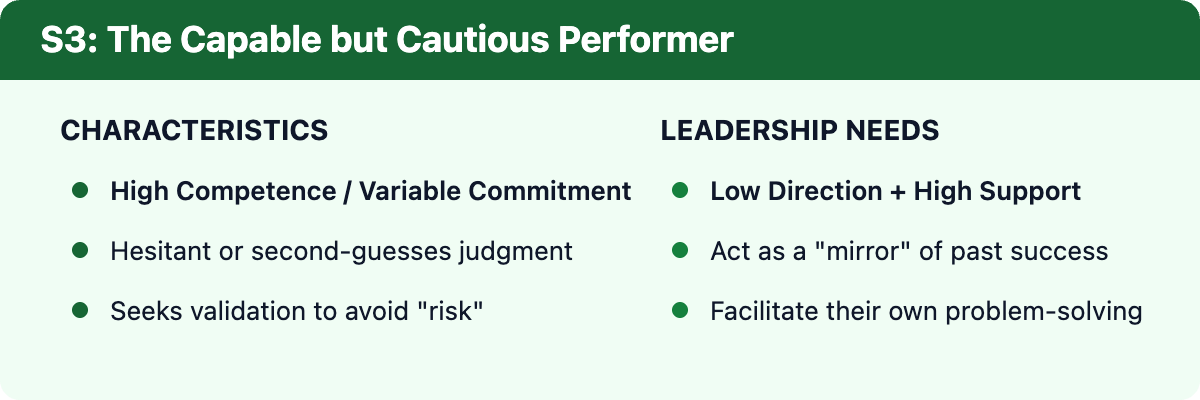
Capable but Cautious team members have the skills to produce quality results but lack the self-trust to own the process. Their competence is high, but their commitment (confidence) is variable.
- The Signs: They use hedging language ("I think this might work, but..."), seek validation for work that is already correct, and exhibit fluctuating motivation. They possess the skill but treat your direction as a psychological crutch.
- Leadership Need: High Support / Low Direction. Do not provide step-by-step instructions. Instead, listen and facilitate their own problem-solving. When they ask for the answer, redirect them: "You’ve handled this before. What’s your instinct?"
- The Risk: Continuing to provide high direction sends the message: "I don’t trust you to do this on your own." This reinforces the very doubt you are trying to eliminate.
Characteristics of the Self-Reliant Achiever (Style 4)
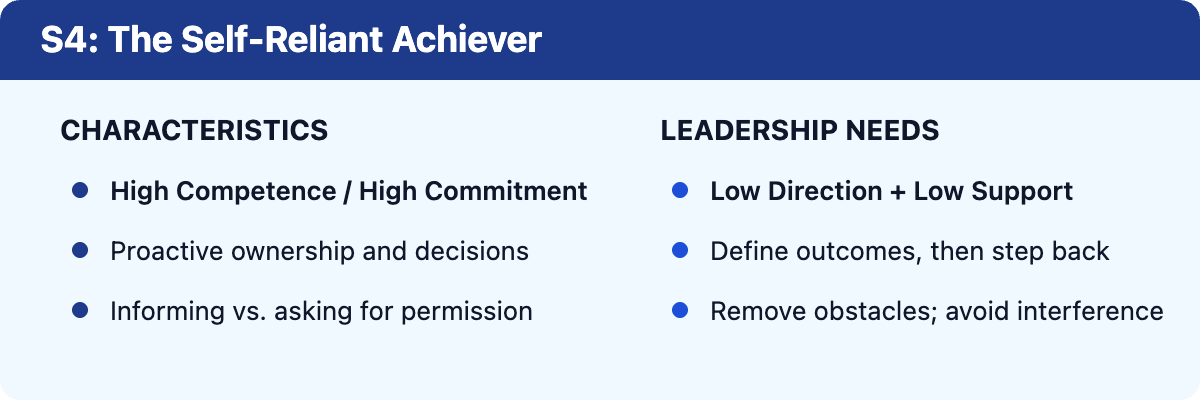
The fourth style is the target outcome of consistent and effective coaching: the Self-Reliant Achiever. These individuals possess both high competence and high commitment. They drive themselves forward without external pressure.
- The Signs: They take full ownership of outcomes, proactively solve problems, and "inform" rather than "ask." When they reach out, it is to flag strategic issues, not to request instruction.
- Leadership Need: Low Support / Low Direction (Delegating). Define the desired outcome, provide the necessary resources, and get out of the way. Your check-ins should be strategic and infrequent.
- The Risk: Unnecessary oversight is interference. If you insert yourself into an S4’s process, you communicate that their autonomy is conditional, which erodes the internal motivation that defines this stage. Remember: S4 status is task-specific—an expert in one area may be a beginner in another.
Understanding the Confidence Gap in Competent Performers
The transition from S3 to S4 hinges on closing what is best described as the Confidence Gap—the space between what a person can do and what they believe they can do. This gap is invisible in the work product. If you only look at deliverables, an S3 and an S4 may appear identical. The difference lives entirely inside the person's head, and your ability to see it depends on the quality of your conversations, not just the quality of their output.
The Confidence Gap often forms for predictable reasons. Sometimes it is the residue of the Disillusioned Learner phase—the person remembers how hard the learning curve was and carries a lingering fear of returning to that struggle. Other times, it develops because the stakes of the task have increased. A team member who confidently managed small client accounts may hesitate when asked to lead a strategic one, not because their skill has changed but because their perception of the consequences of failure has grown. Additionally, you might see the gap widen when someone compares themselves to peers they perceive as more naturally talented, even when objective performance data shows no meaningful difference.
As a people manager, closing the Confidence Gap is less about instruction and more about reflection. Your role is to serve as a mirror that helps the person see their own capability clearly. You might point to specific evidence of past success: "You handled the restructuring of that workflow last quarter with zero downtime—that required the same judgment you'd use here." You might also create low-risk opportunities for them to practice autonomy before the high-stakes moment arrives, building their confidence through graduated exposure rather than a single high-pressure leap.
To see what this looks like in practice, consider the following exchange between a manager and a team member who has the skills to lead a cross-functional initiative but keeps deferring to others.
- Natalie: Hey Ryan, I wanted to check in on the integration project. How are you feeling about leading the kickoff meeting next week?
- Ryan: Honestly, I've prepped the agenda and the timeline, but I'm not sure I'm the right person to run it. Maybe you should lead it and I can support.
- Natalie: You built that agenda from scratch, and the timeline you put together is the most detailed one we've had on a project like this. What specifically makes you feel like you're not the right person?
- Ryan: I guess I'm worried that if the stakeholders push back on the timeline, I won't know how to handle it on the spot.
- Natalie: Do you remember when the marketing team challenged your resource estimates on the last rollout? You adjusted the plan in real time and they walked away fully on board. That's the same skill you'd use here.
- Ryan: That's true. I didn't really think of it that way.
Notice what Natalie does not do in this conversation. She does not take the meeting back, she does not give Ryan step-by-step instructions for handling pushback, and she does not dismiss his concern with a generic "You'll be fine." Instead, she asks him to articulate the specific source of his doubt, then reflects concrete evidence of his past competence directly back to him. This is the high-support, low-direction approach that helps an S3 begin to close the Confidence Gap on their own terms.
One subtle but powerful technique—illustrated in this exchange—is to change when you give feedback. With an S3, if you review their work before it goes out the door, you reinforce the idea that your approval is a necessary checkpoint. If instead you let the work go out and then debrief afterward, you accomplish two things at once. You confirm that they succeeded, and you prompt them to articulate the reasoning behind their success, which deepens their self-trust.
The Confidence Gap is also where your own comfort zone gets tested. If you are someone who naturally leans toward being involved, handing over control to an S3 and watching them operate without your safety net can feel risky. But every time you resist the urge to intervene and the person succeeds, you build a data point (for both of you) that independence works. Moreover, when they occasionally stumble, the way you respond matters enormously. Treating a mistake as a learning event rather than a justification for pulling back control is what separates managers who develop S4 achievers from those who keep capable people permanently dependent.
Coming up next, you will step into a role-play where you practice building confidence with a highly skilled team member who is hesitant to step into the spotlight. They have the ability to lead, but they are not yet convinced of it. Your challenge will be to support without directing, drawing out their own competence rather than lending them yours.
