Leading Beginners and Learners
Leading Beginners and Learners
In the previous lesson, you learned to evaluate your team members along two dimensions—competence and commitment—and you discovered that these assessments must happen at the task level, not the person level. Now it is time to put that framework into practice by exploring the first two development stages in detail. These are the stages where your leadership has the most immediate and visible impact, because the people in them are either just getting started or hitting their first major wall.
Understanding the difference between an Enthusiastic Beginner and a Disillusioned Learner will transform the way you onboard, train, and retain your people. Get these two stages wrong, and you risk either abandoning someone who needs structure or smothering someone's early energy. Get them right, and you accelerate growth while building deep trust. Throughout this unit, you will break down what each stage looks like, learn to read the behavioral signals that distinguish one from the other, and explore the critical transition point that connects them.
Characteristics of the Enthusiastic Beginner (Style 1)
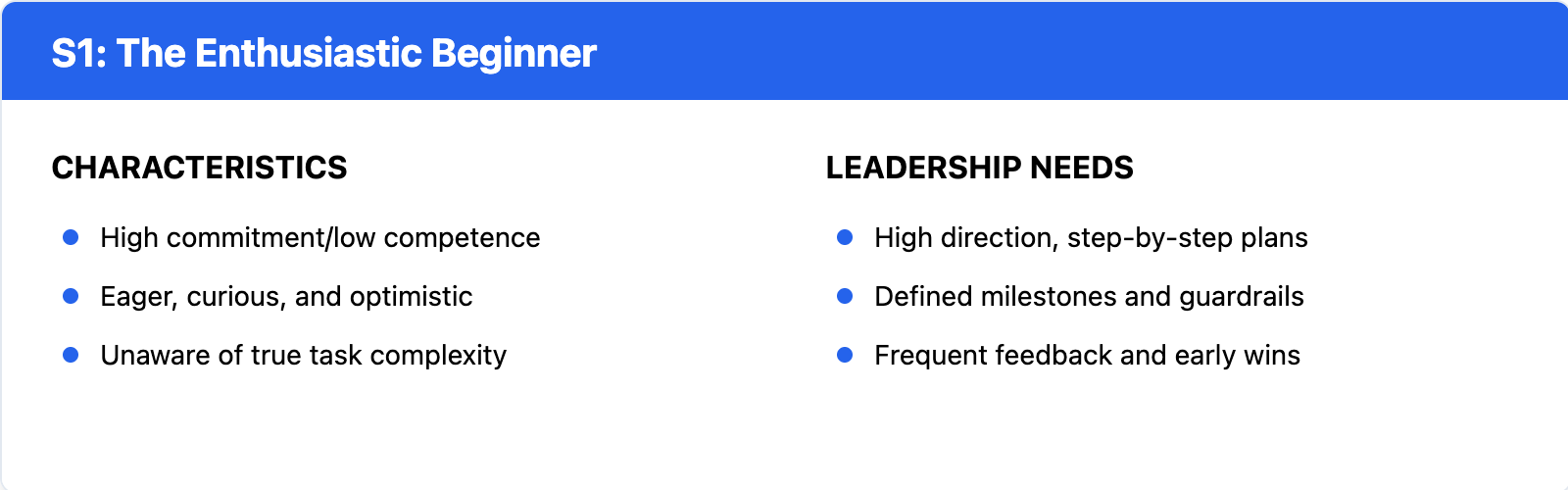
The Enthusiastic Beginner is defined by high commitment paired with low competence. These individuals are buzzing with energy and a genuine desire to succeed, but they "don't know what they don't know."
- The Signs: They are eager to volunteer, optimistic about ramp-up time, and display high energy. While their motivation is high, their actual task-specific skill set is minimal or non-existent.
- Leadership Need: High Direction / Low Support. They thrive on structured guidance, explicit expectations, defined milestones, and frequent check-ins. Providing high direction channels their energy and prevents avoidable failures.
- The Risk: Mistaking enthusiasm for readiness. If you fail to provide structure, you risk letting them fail unnecessarily, which can crush their early momentum and confidence.
Identifying the Disillusioned Learner (Style 2)
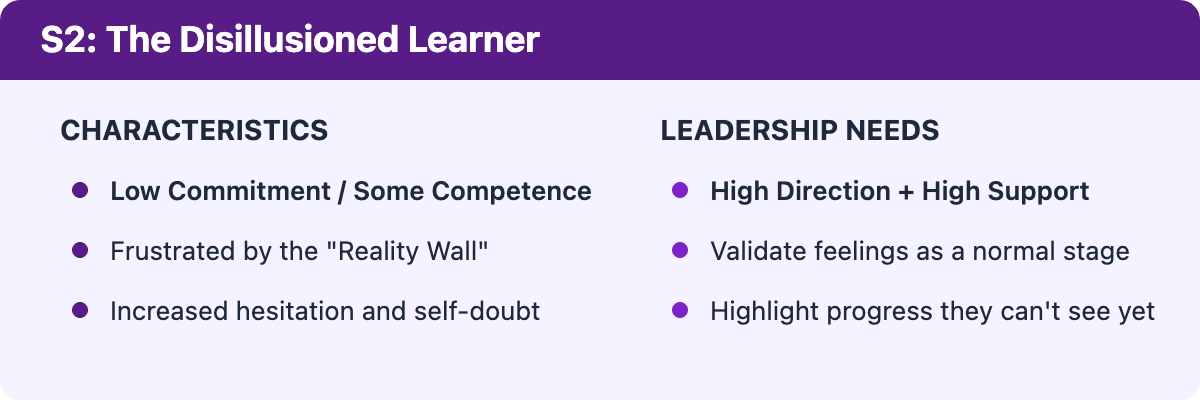
The Disillusioned Learner emerges when commitment drops or fluctuates while competence begins to grow. This is an uncomfortable phase where the initial excitement evaporates, replaced by the realization of how much there is still to learn.
- The Signs: Frustration, self-doubt, or a sudden dip in energy. They have gained enough experience to see the true complexity of the task and the gap between their current skills and mastery.
- Leadership Need: High Direction / High Support. Because their competence is still developing, they still need structure. However, they now also need you to validate their struggle and normalize the difficulty of the learning curve.
- The Risk: Misdiagnosing a commitment dip as an "attitude problem." If you provide pure direction without empathy—or back off thinking they need "space"—you risk accelerating their decline.
Recognizing the "Reality Wall"
The transition from S1 to S2 is so common and so predictable that it deserves its own name: the Reality Wall. This is the moment when the honeymoon phase ends and the real work of learning begins. Every person who takes on a meaningful new challenge will hit this wall at some point—the only variables are when it happens and how hard it hits.
Importantly, the Reality Wall is not a sign of failure. It is a sign of progress. It means the person has moved beyond surface-level understanding and is now grappling with genuine complexity. Think about it in your own experience: recall a time you started something new with total excitement—a new role, a new skill, a new software platform—and then hit a point where the difficulty spiked and your motivation plummeted. That was your Reality Wall. You did not become a less capable person in that moment. You simply entered the part of the learning curve where growth feels like regression.
As a people manager, your ability to anticipate and name this transition is enormously powerful. When you can see the wall coming before your team member hits it, you can prepare them. You might say something like "In about two weeks, this is going to start feeling a lot harder. That doesn't mean anything is wrong—it means you're getting into the real depth of the work." Setting that expectation in advance does not eliminate the frustration, but it reframes it. Instead of thinking "I'm failing," the team member thinks "This is the stage my manager told me about."
To see how this plays out in practice, consider the following conversation between two managers discussing a team member who has just hit the Reality Wall.
- Jessica: I'm worried about Chris. When I assigned him the quarterly forecasting model three weeks ago, he was so excited. Now he barely talks in our check-ins and yesterday he told me he doesn't think the project is a good fit for him.
- Dan: Has his work actually gotten worse, or is he just frustrated?
- Jessica: That's the thing—his early drafts are improving. He's catching errors he didn't even notice before. But his energy is completely gone.
- Dan: It sounds like he's hit the Reality Wall. He's building real competence, but his commitment has dropped because the task turned out to be harder than he expected. What are you doing differently now compared to week one?
- Jessica: Honestly, nothing. I've been giving him the same structured check-ins and task breakdowns. Should I back off and give him more space?
- Dan: Actually, the opposite. Keep the structure—he still needs it. But now you also need to add support. Acknowledge that the difficulty is normal, show him the progress he can't see himself, and make sure he knows that struggling at this stage doesn't mean he's failing.
Notice what Dan helps Jessica see in this exchange. Chris is not disengaged because of a character flaw or a poor attitude—he is in a predictable developmental shift from S1 to S2. His competence is growing, but his commitment has dipped because the work is harder than he anticipated. Jessica's instinct to either stay the course or back off entirely would both miss the mark. Instead, she needs to add emotional support on top of the direction she is already providing.
Recognizing the Reality Wall also protects you from making a dangerous diagnostic error. When a previously enthusiastic team member suddenly appears disengaged or negative, it is tempting to label it as an attitude problem or a lack of work ethic. In most cases, however, what you are seeing is a commitment dip driven by the natural difficulty of skill acquisition, not a character flaw. Responding with criticism or impatience rather than support and continued guidance risks accelerating their decline rather than helping them through it.
The managers who handle this transition well share a few consistent habits. They check in more frequently during the period when the wall is likely to hit. They separate effort from results in their feedback, praising persistence even when the output is not yet polished. Furthermore, they share their own stories of hitting similar walls, normalizing the experience without minimizing it. The goal is never to lower the bar—it is to keep the person climbing toward it even when the climb feels impossible.
Coming up next, you will step into an exercise where you will practice responding to a team member who has clearly hit the Reality Wall. Your challenge will be to validate where they are emotionally, help them see the progress they have made, and maintain high expectations.
