The Development Spectrum
Welcome to the Course
Welcome to Understanding Development Stages, where you will learn one of the most powerful skills a people manager can develop: the ability to accurately diagnose what each team member needs from you, right now, for a specific task. In the previous course, you built the adaptive mindset and self-awareness to lead flexibly. Now, you will sharpen the lens through which you assess your people, moving far beyond gut instincts or broad generalizations.
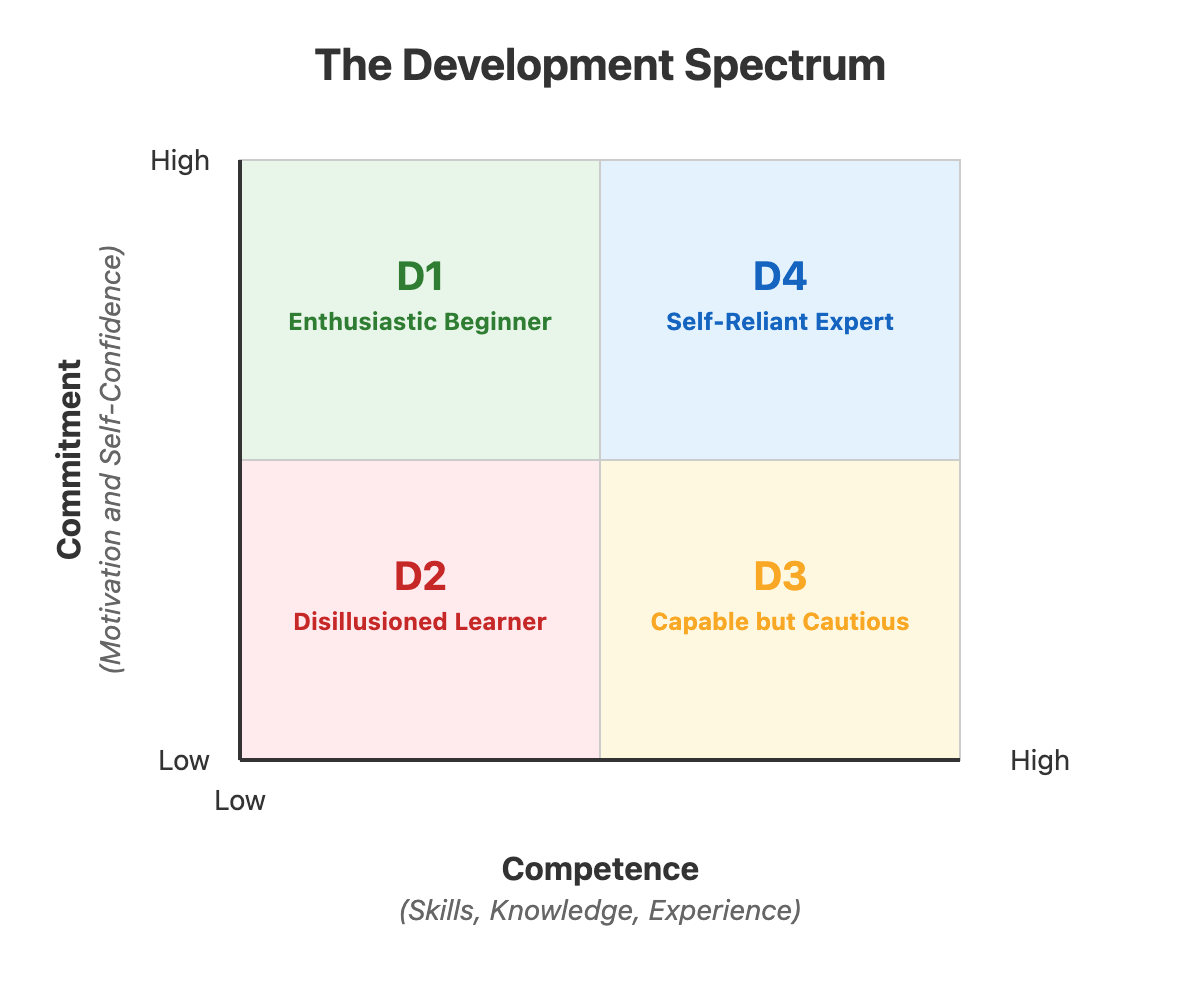
Throughout this course, you will master a framework built on two critical dimensions—competence and commitment—and learn to evaluate every team member at the task level rather than the person level. From there, you will explore the four development stages, starting with the eager newcomer and progressing all the way to the self-reliant expert, uncovering the unique challenges that emerge at each point along the journey. You will also confront the assessment errors that trip up even experienced managers, including how personality types can disguise a person's true development needs.
Once you master the skills in this course, you will stop accidentally over-managing your stars, under-supporting your learners, or misreading enthusiasm as readiness. Instead, you will make precise, fair, and effective leadership decisions grounded in observable evidence. Let's begin with the foundation of it all: the development spectrum.
Defining Competence: Skills, Knowledge, and Experience
When you look at a team member's ability to perform a task, you are evaluating their competence. Competence is not a single trait—it is a combination of three distinct components working together: skills, knowledge, and experience.
Skills are the demonstrated, transferable abilities a person brings to a task. Consider the difference between someone who knows how a presentation should be structured and someone who can actually build a compelling deck under a tight deadline. Knowledge, by contrast, is the theoretical understanding—the kind of foundation someone builds by studying documentation, attending trainings, or completing certifications. Meanwhile, experience is the track record: how many times has this person done something similar, and what lessons did they draw from it?
Understanding these distinctions matters enormously in your day-to-day leadership. Imagine a team member says, "I've never done this before, but I've watched the training videos." That person has some knowledge but virtually no skill or experience to back it up. Now compare that to someone who tells you, "I handled three similar projects at my last company." That person likely has all three components working in their favor, and your approach to leading them should reflect that difference.
A common trap is assuming that because someone is intelligent or has adjacent experience, they are automatically competent at a new task. Intelligence is not competence. Competence is demonstrable ability tied to the specific work in front of them. Before you decide how much direction someone needs, you must develop a clear-eyed view of whether they actually possess the skills, knowledge, and experience required to deliver. This honest assessment is the first half of the development spectrum, and it sets the stage for everything that follows.
Defining Commitment: Motivation and Self-Confidence
The second dimension of the development spectrum is commitment, which combines a person's motivation and self-confidence for a given task. If competence answers the question "Can they do it?", then commitment answers "Will they do it—and do they believe they can?".
Motivation speaks to desire and engagement. Is the person energized by this work? Do they see its value? Are they willing to invest discretionary effort? Self-confidence, on the other hand, reflects their internal belief in their own ability to succeed. These two elements do not always move in the same direction. A team member might be highly motivated to lead a client meeting but simultaneously terrified they will fumble it. That combination—high motivation paired with low confidence—produces a very different leadership need than someone who is confident but simply does not care about the task at hand.
As a people manager, your ability to read the signals makes all the difference. A motivated team member might say things like "I'd love to take that on" or proactively ask for stretch assignments. A confident one might tell you, "I've got this—just point me in the right direction." Conversely, someone with low commitment might show up as disengaged, hesitant, or overly dependent on your approval before taking any step. You might hear "Are you sure I should be the one doing this?" or notice patterns of procrastination and avoidance creeping in.
The critical insight here is that commitment is not a character flaw—it fluctuates based on the task, the context, and the person's history with similar work. A team member who is fiercely committed to data analysis might be completely unmotivated by stakeholder presentations. Your role is to diagnose commitment accurately, without judgment, so you can respond with precisely the right level of support.
Why Development Is Task-Specific, Not Person-Specific
This is where everything clicks—and where most managers get it wrong. It is tempting to label a team member globally, saying something like "She's a high performer" or "He's still pretty junior." However, development is not about the person as a whole. It is about the person in relation to a specific task.
Consider a senior team member who is a self-reliant expert at managing budgets but a complete beginner when it comes to facilitating cross-functional workshops. If you treat them as an expert across the board, you will leave them unsupported in the area where they genuinely need guidance. Conversely, if you treat a newer employee as inexperienced at everything, you might micromanage them on the very tasks where they already have strong competence from a previous role. Both mistakes erode trust and waste your leadership energy.
To see this concept in action, let's look at a conversation between two managers discussing a team member's development needs.
- Natalie: I'm not sure what to do with Jake. He's been on my team for a year and he's brilliant at client reporting—completely self-sufficient. But I just assigned him to lead vendor negotiations, and he's struggling badly.
- Ryan: How are you managing him on the negotiations?
- Natalie: The same way I manage him on everything else. I give him the objective and let him run with it. He's a senior person—I don't want to micromanage.
- Ryan: But has he ever actually led a vendor negotiation before?
- Natalie: Well… no. But he's so sharp, I assumed he'd figure it out.
- Ryan: That's the issue. He's an expert on reporting, but on negotiations he's essentially a beginner. He probably needs a lot more direction on that specific task, even though he doesn't need it anywhere else.
Notice what happens in this exchange. Natalie has fallen into the trap of labeling Jake globally as a high performer and applying the same hands-off approach across all his responsibilities. Ryan helps her see that Jake's development level shifts depending on the task. On client reporting, Jake needs autonomy. On vendor negotiations, he needs structured guidance. The leadership response must match the task, not the person's overall reputation.
The development spectrum asks you to evaluate competence and commitment per task, creating a much more granular and accurate picture. One person might be high competence and high commitment on Task A, but low competence and high commitment on Task B, and high competence with low commitment on Task C. Each of those combinations demands a different leadership response from you, and recognizing that is what separates adaptive leadership from traditional management. Instead of putting people into fixed boxes, you are constantly re-evaluating based on what is actually in front of you.
This task-specific approach also means you need to have genuine, ongoing conversations with your team members to understand where they stand—not just during formal performance reviews, but in the day-to-day flow of their work. The payoff is significant: you give people exactly what they need, exactly when they need it, without over-managing or under-supporting.
Coming up next, you will put this diagnostic skill into practice in a role-play session where you will interview a team member about a new project assignment. Your goal will be to ask the right questions to separate their actual competence from their perceived confidence—a distinction that will sharpen your ability to lead adaptively from day one. Let's get started!
