Practicing Accurate Task Assessment
Task Assessment and Assessment Errors
Over the previous three lessons, you built a comprehensive understanding of the four development stages—from the Enthusiastic Beginner all the way through the Self-Reliant Achiever. You now know what each stage looks like, what drives competence and commitment, and how the Confidence Gap can keep skilled performers from stepping fully into autonomy. But knowing what the stages are is only half the equation. The other half—and arguably the harder half—is accurately diagnosing which stage a person is actually in for a given task. This is where many people managers get it wrong, not because they lack the framework, but because their own perception gets in the way. Throughout this unit, you will learn how to systematically assess development levels using a structured matrix, how two of the most common cognitive biases distort your evaluations, and how the personality styles of your team members can actively mislead your diagnosis. Getting this right is the difference between leadership that accelerates growth and leadership that accidentally holds people back—or pushes people too far, too fast.
Mastering the Task Assessment Matrix
The Task Assessment Matrix is your diagnostic tool for placing a team member in the correct development stage on a specific task. It works by evaluating two dimensions independently—Competence and Commitment. One of the most frequent errors managers make is allowing their read on one dimension to contaminate the other. A person who is highly motivated does not automatically have the skills to match, and a person who seems disengaged may actually be deeply competent but bored.
To use the matrix, you must first isolate the task. A team member might be an S4 on budget forecasting but an S1 on stakeholder presentations. Once isolated, you assess Competence (transferable skills, knowledge, and demonstrated experience) and Commitment (motivation and confidence) separately to find the intersection.
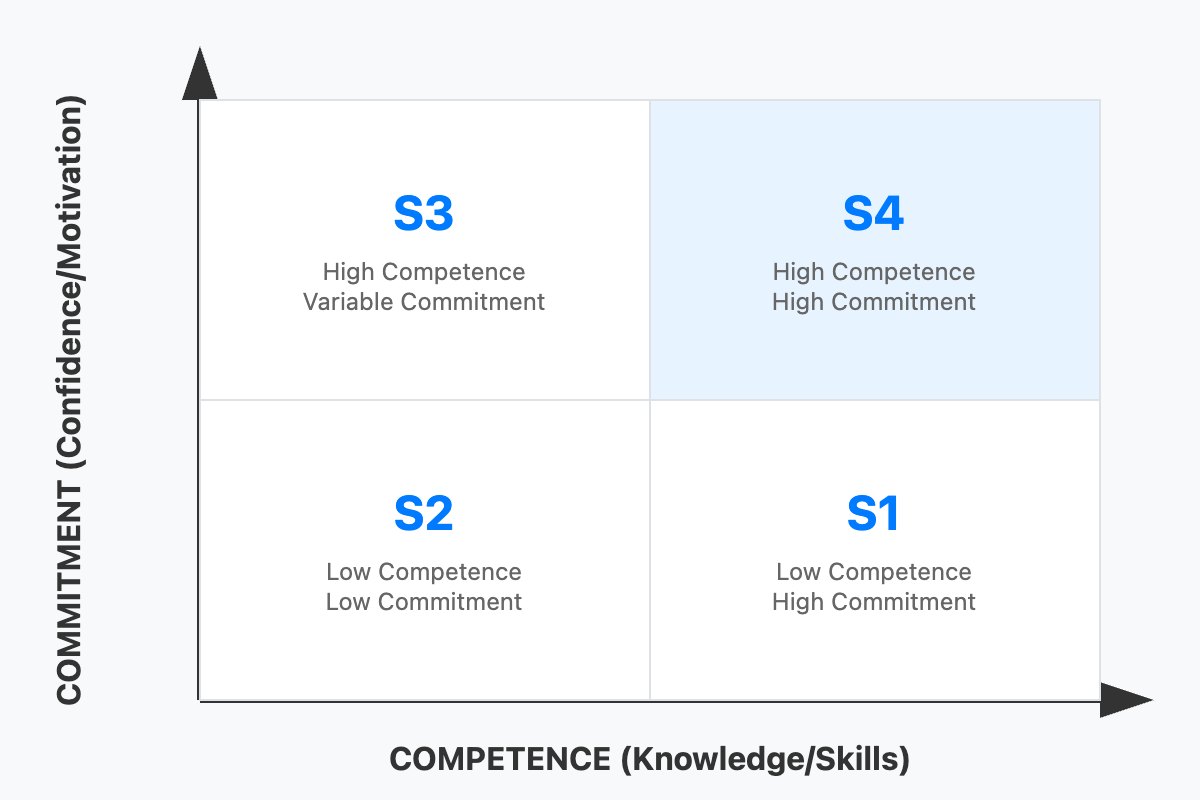
A practical habit to build is the two-minute diagnostic. Before a one-on-one, jot down the specific task and quickly rate competence and commitment. This exercise forces you to think in two dimensions instead of defaulting to a single, vague impression.
Avoiding the Halo Effect and Recency Effect in Evaluations
Even with a solid matrix in hand, your assessments are only as good as the data feeding them. Two cognitive biases pose the greatest threat to accurate evaluation: the Halo Effect and the Recency Effect. Both are well-documented in behavioral research, both are pervasive in management settings, and both are surprisingly difficult to catch in yourself.
The Halo Effect occurs when a positive impression in one area spills over and inflates your assessment in unrelated areas. If a team member consistently excels at client communication, you may unconsciously assume they are equally strong at project planning, data analysis, or team collaboration—even without evidence. The reverse is equally dangerous: a person who struggles with one visible task may be unfairly judged as underperforming across the board, a phenomenon sometimes called the Horn Effect.
In development-stage terms, the Halo Effect leads you to label someone as an S4 globally because they are an S4 on one high-profile task. The result is that you delegate work they are not ready for, they fail, and both of you end up confused about what went wrong. You can counteract this bias by forcing yourself to evaluate each task in isolation. When you catch yourself thinking "She's great, she'll figure it out", pause and ask: "What specific evidence do I have that she has the skills for this particular task?" If the answer is "Well, she's just really smart and capable", that is the Halo Effect talking, not data.
The Recency Effect is equally insidious. It causes you to weigh recent events disproportionately when forming an overall assessment. If a team member delivered an outstanding presentation last week, you may rate their development stage higher than it truly is, overlooking months of inconsistent performance that preceded that single win. Conversely, one recent mistake can overshadow a long track record of excellence, causing you to pull back autonomy from someone who has earned it. Imagine telling a Self-Reliant Achiever "I'd better review your work more closely for a while" because of a single error on an otherwise flawless record. That response, driven by recency rather than pattern, can feel punitive and erode the trust you have spent months building.
The antidote to the Recency Effect is maintaining a running log of performance observations over time. This does not need to be elaborate—a brief note after each project milestone or key interaction is enough. When it comes time to assess someone's development stage, you review the full record rather than relying on whatever is freshest in your memory. The pattern over weeks or months is almost always more accurate than the snapshot from last Tuesday.
To see how these biases surface in everyday management conversations, consider the following exchange between two peer managers discussing a staffing decision.
- Jessica: I'm thinking of putting Karim in charge of the new compliance audit. He absolutely crushed the client retention campaign last quarter.
- Dan: That's impressive, but has he ever run a compliance audit before? Those are pretty different skill sets.
- Jessica: No, but he's one of the strongest people on my team. If he can manage that campaign, he can handle this.
- Dan: That sounds like you're letting his win on retention color how you see him on a completely different task. What if you assessed his actual experience with audits separately?
- Jessica: Hmm. You're right—if I'm honest, he's probably closer to an S1 on compliance work. I'd need to direct him heavily at the start rather than just hand it off.
Notice how Jessica's initial instinct—driven by the Halo Effect—would have led her to delegate a task to someone who genuinely needed a Directing style. Dan does not challenge Karim's talent; he simply redirects Jessica to evaluate competence on this specific task rather than borrowing confidence from an unrelated success. This is exactly the kind of peer check that prevents a mismatched leadership approach before it causes real damage.
Both of these biases become especially pronounced during formal reviews, but they do their most damaging work in the informal, day-to-day decisions you make about how much direction or support to provide. Every time you decide whether to check in on someone's progress, whether to offer guidance or step back, you are making an implicit assessment of their development stage. If that assessment is biased, your leadership style will be mismatched—and you may never realize it, because the bias feels like sound judgment.
How DISC Personality Types Mask Their True Development Stage
Beyond cognitive biases, a person’s DISC personality profile can mask their true development stage. Personality describes behavioral tendencies, not competence or commitment. Certain styles naturally project traits that mimic development stages, leading to misdiagnosis.
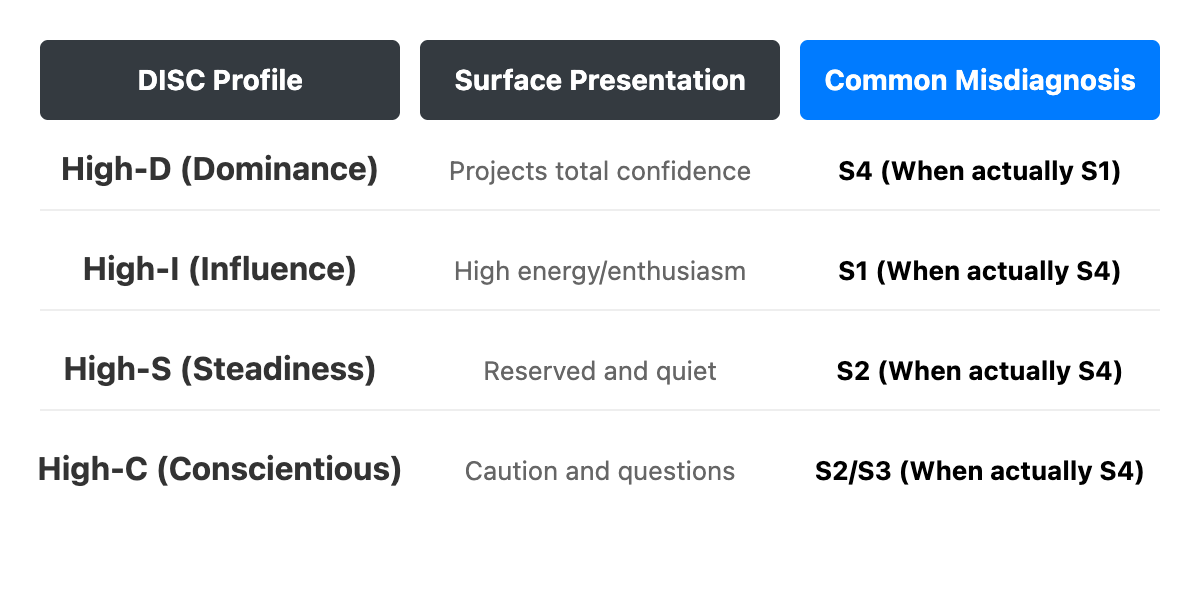
To bypass these masks, shift from asking preference-based questions ("How do you feel about this project?") to evidence-based questions ("Walk me through the last time you did this—what was the outcome?"). This filters out the personality-driven presentation and reveals the actual competence and commitment levels required for an accurate diagnosis.
Understanding the Task Assessment Matrix and identifying the cognitive traps that skew your judgment is the first step toward becoming a more effective leader. However, diagnosis is a skill that requires active practice. In the following exercises, you will be presented with various team member profiles and task-specific scenarios. You will need to apply the Matrix, account for potential DISC "masks," and avoid common biases to correctly identify each individual's development stage.
