Understand Limits and Ranges
🎉 Introduction
Welcome to Understand Limits and Ranges! So far, you have practiced computing or estimating a single answer from a model. That skill helps you answer questions like, “What happens when I plug in this value?” Now you are ready for a practical next step: figuring out which values are allowed when a real-world situation has a limit. By the end of this lesson, you will have learned how to:
- Find a boundary by testing values in a model and noticing where the rule changes from allowed to not allowed.
- Determine the acceptable range by deciding which side of the boundary satisfies the constraint.
- Explain whether endpoints are included or excluded and describe the range in plain, everyday language.
Limits matter because many real-world situations are not about hitting one exact number. Think about packing a carry-on bag for a flight. The airline does not tell you to pack exactly 15 pounds. It tells you to pack no more than 25 pounds. Any weight from 0 up to 25 pounds is fine, but the moment you go above 25, the bag gets rejected. This is the core idea of the lesson: a boundary is the cutoff point, and the acceptable range is the set of values that stay on the allowed side of that cutoff. Boundaries and ranges show up everywhere — budgets, age requirements, shipping limits, and maximum occupancy signs — and you will learn how to read them using the substitution and estimation skills you already have.
Finding the Boundary by Testing Values 🧪
You already know how to substitute a value into a model and read the result. To find a boundary, you use that same idea repeatedly: plug in different values and watch when the constraint switches from satisfied to violated.
Suppose a rideshare app charges a $5 base fare plus $2.75 per mile, and your budget requires the total to stay under $40. The model is:
Let's test a few values of (the number of miles) and see what happens.
| (miles) | Under $40? | |
|---|---|---|
| 10 | Yes | |
| 12 | Yes | |
| 13 | No |
At the fare is $38, safely under budget. At the fare jumps to $40.75, which is over. So the boundary sits somewhere between 12 and 13 miles. To get a closer estimate, notice there is $2 of room left at 12 miles and each extra mile adds $2.75. Since , the boundary is roughly miles.
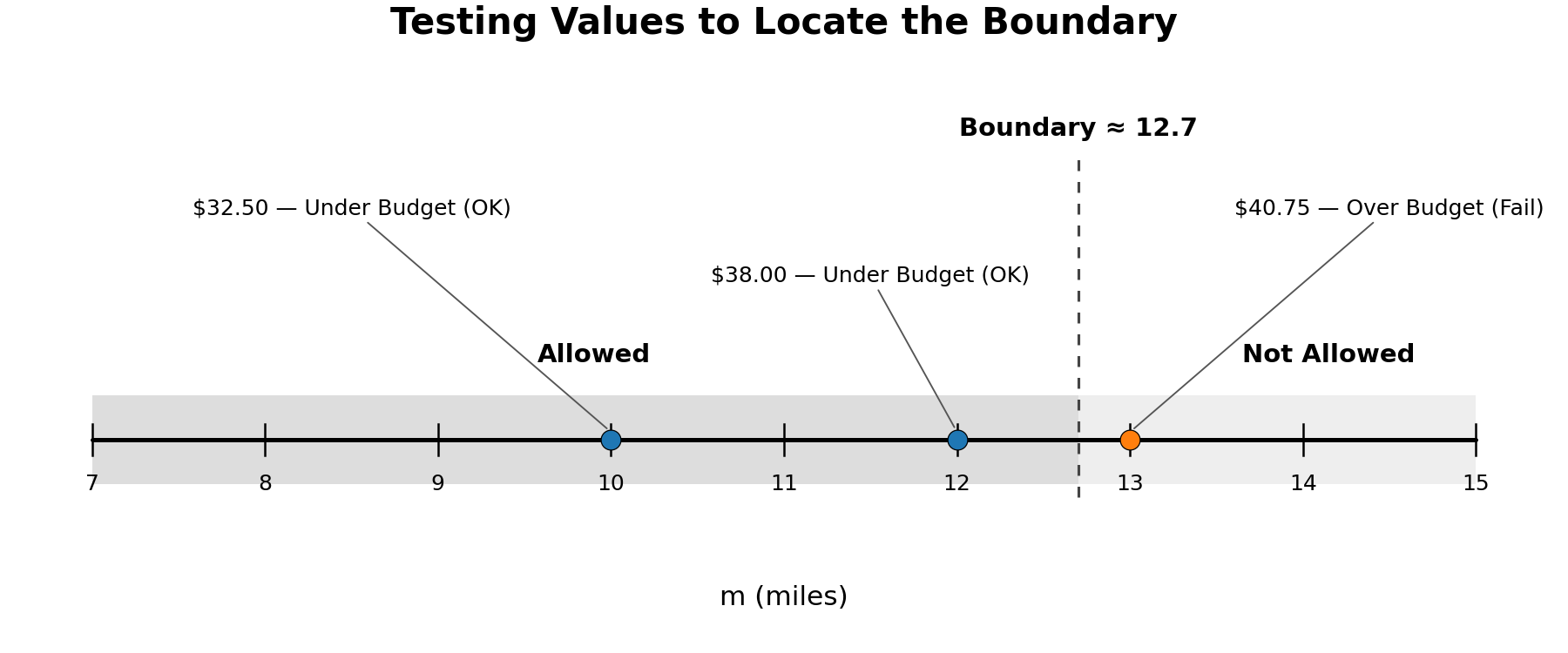
Notice how we used the substitute-and-compute skill from the first lesson and the estimation mindset from the second lesson. No formal solving required. Just test values, observe what happens, and narrow in.
Which Side Is Allowed? ↔️
Once you locate the boundary, the next question is: which values satisfy the constraint? For the rideshare example, the inequality says the fare must be less than $40. Our table showed that smaller values of kept us under budget, while larger values pushed us over. So the allowed region is everything below the boundary:
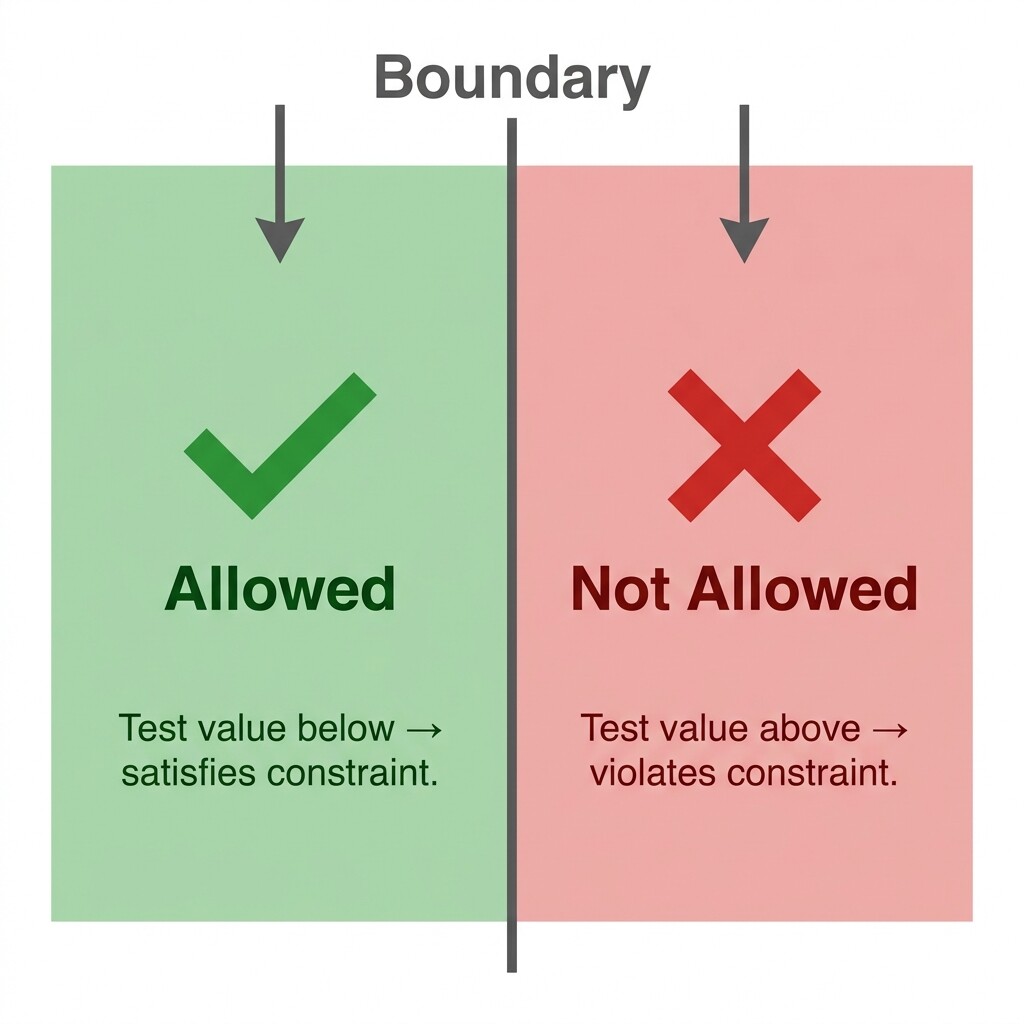
After you estimate the boundary, imagine it as a dividing line. Values on one side of the line will satisfy the rule, and values on the other side will break the rule. To figure out which side is allowed, you do not need to test every possible value. You just need to choose one clear test value on each side of the boundary and see what happens.
Here is a reliable way to decide which side is allowed:
- Pick a test value clearly below the boundary. Substitute it into the model. If it satisfies the constraint, that means the lower side is allowed.
- Pick a test value clearly above the boundary. Substitute it into the model. If it satisfies the constraint, that means the upper side is allowed.
The word satisfies just means "makes the rule true." In this example, the rule is that the fare must be less than $40.
In our case, the boundary is roughly miles. A value below that is :
Since $32.50 is less than $40, satisfies the constraint. So values below the boundary are allowed.
A value above the boundary is :
Since $40.75 is greater than $40, does not satisfy the constraint. So values above the boundary are not allowed.
That confirms the acceptable range is on the lower side of the boundary: you can travel up to about 12.73 miles before the fare reaches the budget limit.
Is the Boundary Itself Included? 🎯
There is one more detail that can change a real-world decision: does the boundary value itself count as allowed? The answer depends entirely on the inequality symbol.
| Symbol | Meaning | Boundary Included? |
|---|---|---|
| strictly less than | No | |
| less than or equal to | Yes | |
| strictly greater than | No | |
| greater than or equal to | Yes |
Our rideshare model uses (strictly less than), so the fare must be under $40, not exactly $40. That means a ride costing exactly $40.00 would not be within budget. In contrast, if the model had been , then hitting $40.00 on the nose would still be acceptable.
A helpful way to remember: if the symbol has a small line underneath (the "or equal to" part), the boundary counts. If it does not, the boundary is excluded.
Compound Inequalities: Two Boundaries 🚧
Sometimes a real-world rule sets both a lower and an upper limit at the same time. For example, a community program might require participants to be at least 18 years old but under 65:
This is called a compound inequality. It has two boundaries — 18 on the low end and 65 on the high end — and the allowed values are everything between them. Let's read the symbols carefully:
- means must be 18 or higher, so 18 is included.
- means must be strictly less than 65, so 65 is not included.
In plain language: someone who is exactly 18 qualifies, but someone who is exactly 65 does not. The acceptable ages run from 18 through 64.
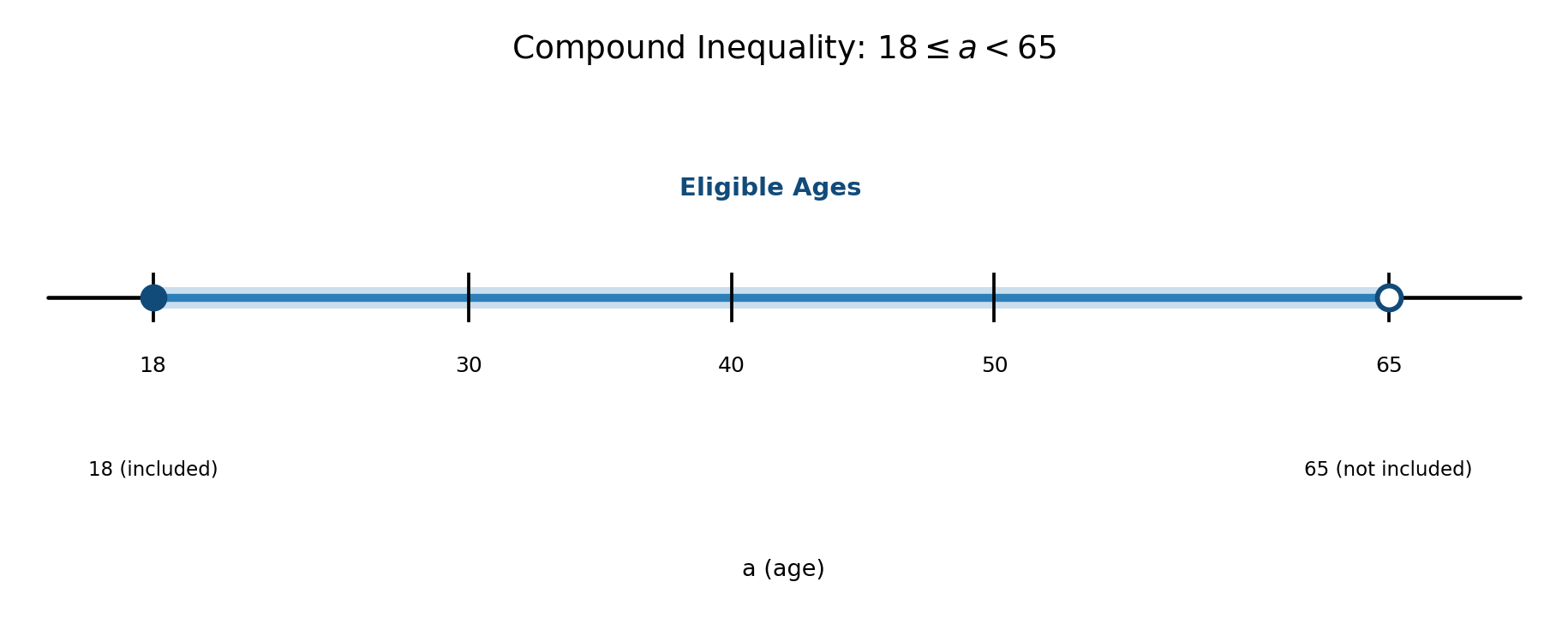
When you encounter a compound inequality, the same testing approach works. Pick a value in the middle (say ) and confirm it satisfies both sides. Then check each endpoint to see whether it is included or excluded based on its symbol.
Describing Ranges in Plain Language 🗣️
Finding the boundary and the allowed side is only half the job. In real life, you often need to communicate the result to someone who is not looking at the math. The goal is to translate the range back into the language of the original situation, so anyone can understand it.
A simple template works well for this:
"[Quantity] can be roughly [lower bound] to [upper bound], [including / not including] the endpoint(s)."
For the rideshare example, that becomes: "You can travel roughly 0 to about 12.73 miles and stay under budget, not including the exact boundary." For the age requirement: "Eligible ages are 18 through 64, including 18 but not including 65."
Notice that each description names the real-world quantity (miles, ages), gives approximate numbers, and clarifies whether the endpoints count. This matters because numbers alone can be easy to misread: "12.73" is less helpful than "about 12.73 miles, not including the exact boundary." It also helps prevent small but important mistakes, like assuming a maximum value is allowed when it is actually excluded. That is all someone needs to make a practical decision. Whether you are explaining a shipping limit to a coworker or an eligibility rule to an applicant, this pattern keeps your explanation clear and complete.
Conclusion and Next Steps
In this lesson, you moved from computing single answers to reasoning about entire ranges. You learned how to locate a boundary by testing values, determine which side of that boundary satisfies the constraint, check whether the boundary itself is included or excluded, and read compound inequalities that set two limits at once. You also practiced translating all of this into plain language that anyone can understand.
Up next, you will put these skills to work through a series of hands-on exercises. You will estimate boundaries for budgets and capacity limits, decide which direction the allowed values fall, and explain eligibility rules in your own words. Let's see how well you can read the limits!
