Estimate to Check Your Thinking
🎉 Introduction
Welcome to Estimate to Check Your Thinking! In the previous lesson, you practiced the substitute-and-compute process: turning general models into specific numbers and interpreting what those numbers mean. That skill helps you get precise answers. Now you are ready for a practical partner skill: checking whether a precise answer actually makes sense. In this lesson, you will learn to:
- Round numbers to friendly values that are easier to work with mentally.
- Estimate the value of an expression using quick arithmetic.
- Compare an estimate to a stated result and decide whether the result is reasonable, too high, or too low.
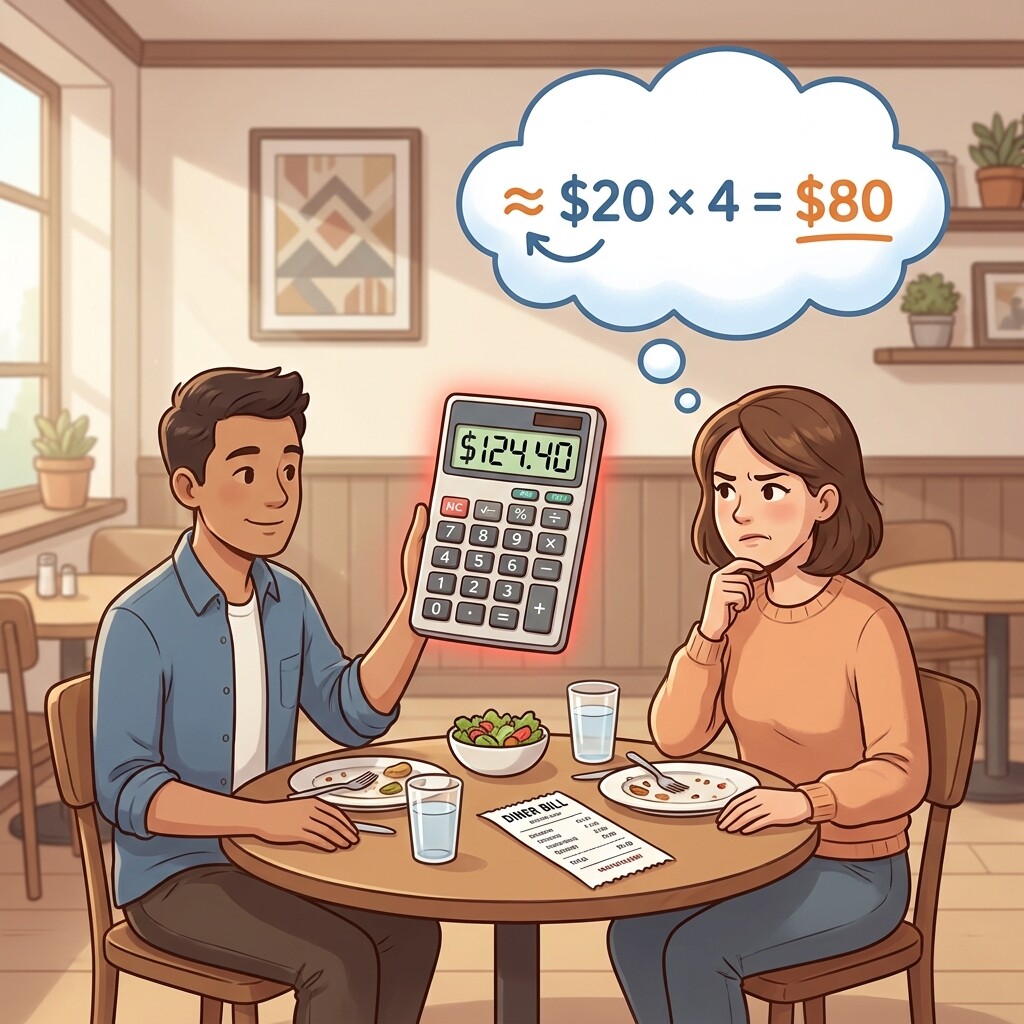
Estimation matters because exact-looking answers are not always correct. Imagine you order 4 entrees at a restaurant, each priced at $19.85, and a friend announces that the food total is $124.40. Without doing exact arithmetic, you can reason that each entree is close to $20, and , so the total should be near $80, not $124. Something is off — maybe an extra item was added, or maybe there was a typo. This is the core idea: an estimate is a quick, rough answer that helps you catch errors and build confidence in a result.
The Rounding-First Approach 🔢
The easiest way to estimate is to round the numbers before you calculate. That means you replace a number that is awkward to use, like $19.85 or 47, with a nearby number that is easier to think about, like $20 or 50. The rounded number is not exactly the same, so your answer will not be exact either. But it will usually be close enough to help you check whether a result makes sense. In estimation, the goal is to get a quick, reasonable answer you can do in your head.
Here are a few common rounding moves:
| Original Number | Rounded To | Why It Helps |
|---|---|---|
| $19.85 | $20 | Multiplying by 20 is easy mental math. |
| 0.18 | 0.20 | One-fifth of something is simpler to compute. |
| $11.95 | $12 | Clean whole number, close to the original. |
| 47 | 50 | A round number that makes multiplication fast. |
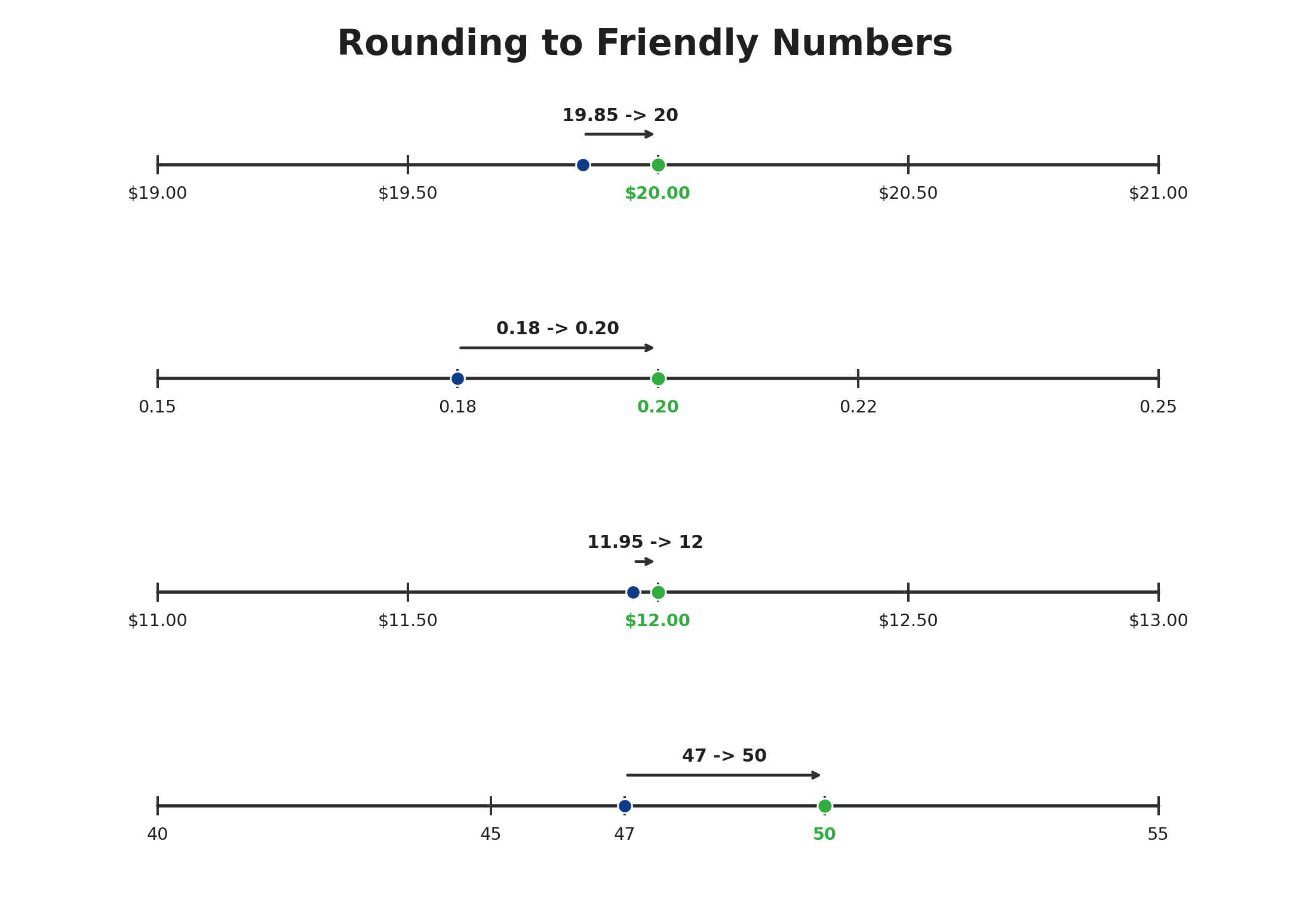
The general rule is to round each number to the nearest whole number or to a close "easy" number. For most everyday situations, rounding to the nearest dollar or the nearest ten is plenty accurate. The small amount you lose in precision, you gain back in speed and clarity.
Estimating Expressions Step by Step 🪜
Let's walk through the estimation process with a concrete example. Suppose you go out to dinner, and the bill before tip is $47. You want to leave an 18% tip and find the total amount. The expression is . This means "find 18% of the bill, then add that tip back to the original bill."
Step 1 — Round. Replace with , because 18% is close to 20%. Replace with , because $50 is easier to use in mental math than $47.
Step 2 — Compute mentally. Now use the rounded expression:
Since means 20%, you can think of this as "20% of 50, plus 50." 20% of 50 is 10, so:
Step 3 — State your estimate. The total with tip should be around $60. This does not mean the exact total is $60. It means $60 is a quick, reasonable estimate you can use to check your thinking.
Notice that we rounded both numbers up in this example, so our estimate will be a little higher than the true value. That is perfectly fine for a quick check. The goal is a ballpark, not a bullseye.
Comparing Estimates to Reported Results ⚖️
Now comes the real payoff: using an estimate to judge a stated result. Once you have a quick estimate in hand, compare it to the number from someone else, a calculator, or a receipt. The comparison leads to one of three conclusions:
- Reasonable — the stated result is close to your estimate.
- Too high — the stated result is noticeably above your estimate.
- Too low — the stated result is noticeably below your estimate.
Let's see this in action. A friend says a cloud storage service that charges $14.75 per month will cost $132.75 for 6 months. Check it:
Round: $14.75 becomes $15.
Estimate:
Compare: The stated total of $132.75 is far above the estimate of $90. That result looks too high. Perhaps the friend accidentally used more than 6 months, or an extra charge was included. Either way, the estimate flags the number as suspicious and worth a second look.
On the other hand, if the friend had said $88.50, that would sit comfortably close to the $90 estimate, and the result would be reasonable.
The Complete Estimation Routine 🧭
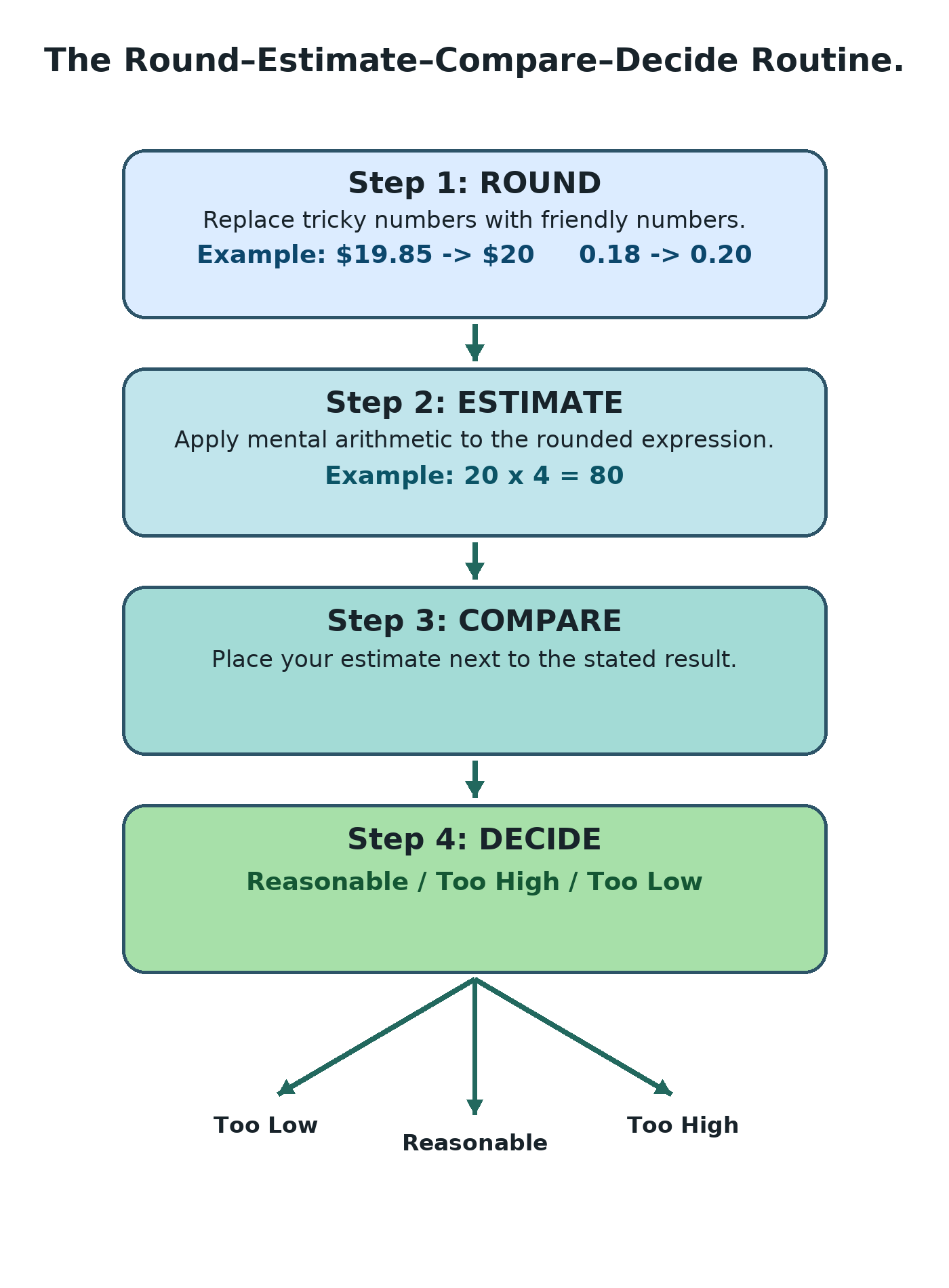
Let's combine everything into one clean routine you can use any time you need a sanity check:
- Round each tricky number in the expression to something friendly.
- Estimate the result using mental arithmetic.
- Compare the estimate to the stated or computed result.
- Decide if the result is reasonable, too high, or too low.
One helpful tip: you do not always need to round every number. If one number in the expression is already simple (like a whole number or a multiple of 10), leave it as is and only round the awkward one. The fewer changes you make, the closer your estimate stays to the true value.
Conclusion and Next Steps
In this lesson, you learned a practical routine for checking your math: round the numbers, estimate the result with mental arithmetic, and compare that estimate to whatever value is being claimed. This simple habit helps you catch errors, question suspicious totals, and feel more confident about the numbers you encounter every day.
Up next, you will put this skill to the test through a series of hands-on exercises. You will practice rounding and estimating step by step, make rapid mental estimates, judge whether stated results are reasonable, and even write your own explanations in a realistic shopping scenario. Let's see how sharp your number sense has become!
