Plug In Values and Interpret Results
🎉 Introduction
Welcome to Understand and Use Math Models in Real Life! Over the previous three courses, you built a solid toolkit: identifying variables, translating situations into expressions, and setting up equations and inequalities. Now, you are ready for the next natural step: learning to use these models. In this first lesson, we will focus on algebraic expressions. By the end of this lesson, you will be able to substitute a specific number into an expression, compute the result, and explain what that result means in the real world. Specifically, you will be able to:
- Identify the variable and given value in an algebraic expression.
- Substitute and compute carefully using the correct order of operations.
- Interpret the result in context by explaining what the number represents and including appropriate units.
From Models to Numbers 🌉
Think about a model like , which might represent a plumber's total bill where is the number of hours worked. On its own, the expression is general — it describes every possible bill the plumber could send. But the moment a customer asks, "How much do I owe for 6 hours of work?", we need a specific number.
That is exactly where substitution comes in. Substitution is the bridge between a general model and a concrete answer. It turns an algebraic expression into a single number you can act on, whether that means paying a bill, checking a budget, or deciding between two plans.

The Substitute-and-Compute Process 🔁
Substitution follows a simple, repeatable pattern:
- Identify the variable and the value it should take.
- Replace every instance of the variable with that value.
- Compute using the standard order of operations (multiply/divide first, then add/subtract).
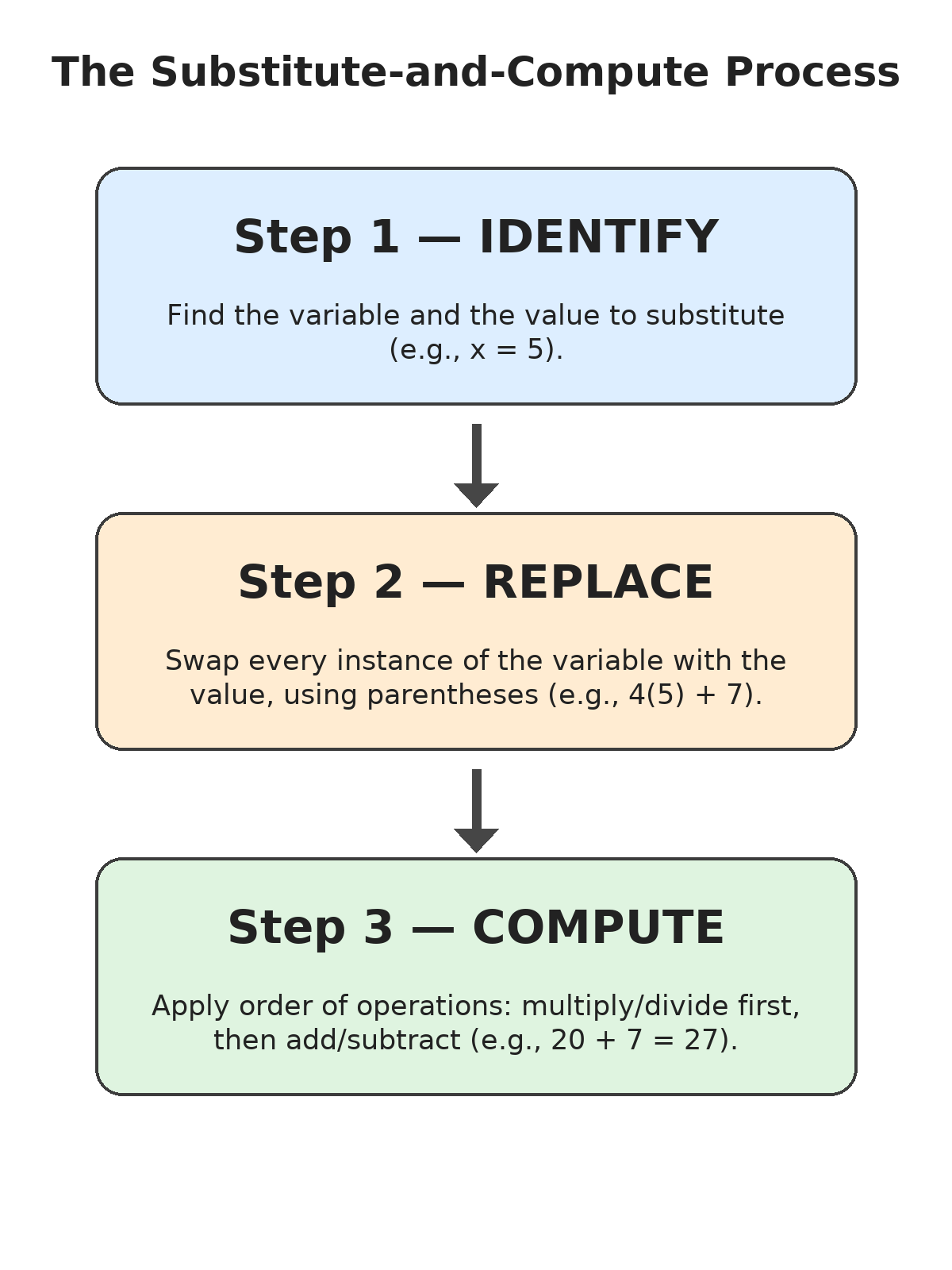
Let's walk through an example. Suppose you have the expression and you are told .
Replace with :
Multiply first:
Add:
The result is . Notice how each step is small and manageable. Writing out intermediate results like this helps avoid mistakes, especially as expressions get longer.
Working with Decimals and Compound Expressions 🧾
Real-life models often include decimals because prices, rates, and measurements are rarely whole numbers. The good news is that the process stays exactly the same. You just need to be a little more careful with the arithmetic.
Consider a model for a café order: , where is the number of muffins purchased. If a customer buys muffins, substitute :
The result is . Whether the numbers are whole or decimal, the rhythm is the same: replace, multiply, then add (or subtract, depending on the model).
Here is one more example with a slightly different context. A tutoring center charges a flat booking fee plus an hourly rate. The model is , where is the number of hours. For :
The result is . As expressions grow, just keep following the order of operations one step at a time.
Interpreting Your Result in Context 💬
Computing a number is only half the job. A result like means nothing until you connect it back to the situation it came from. Interpretation answers the question: "What does this number tell us?"
Let's revisit the earlier examples and add that final, crucial step:
| Model | Substitution | Result | Interpretation |
|---|---|---|---|
| , | The output is 27 units (context would specify what those units are). | ||
| , | The café order costs $14.95 for 4 muffins. | ||
| , | The tutoring session costs $101 for 3 hours. |
A strong interpretation does three things. It states the number with appropriate units (dollars, miles, minutes). It names what the number represents (a total cost, a distance, a weight). And it ties the answer to the specific input ("for 3 hours," "for 4 muffins"). These details help someone understand the result without needing to look back at the original model. A good interpretation should sound like a useful real-world sentence, not just a math answer.
For instance, rather than saying "the answer is 101," a complete interpretation would be: "A 3-hour tutoring session costs $101 in total, including the $35 booking fee." This kind of sentence is what turns raw arithmetic into useful information.
Keeping Your Work Accurate ✅
Now that you know the full substitute-compute-interpret cycle, a few small habits will help you stay error-free as the models get more complex:
- Use parentheses when you replace a variable. For example, if you substitute into , writing clearly shows multiplication. If you just write the numbers next to each other without parentheses, you might accidentally read it as the two-digit number .
- Write every intermediate step. Skipping steps is the number-one source of arithmetic slips.
- Check units at the end. If the model represents dollars but your answer has no dollar sign, pause and add it. Units are part of the answer.
These habits may feel slow at first, but they quickly become automatic and will save you time in the long run.
Conclusion and Next Steps
In this lesson, you learned the three-part rhythm that powers every math model: substitute the given value, compute step by step, and interpret what the final number means in context. This simple process turns a general algebraic expression into a specific, actionable answer — whether you are calculating a bill, checking a budget, or understanding a rate.
Up next, you will practice this skill hands-on with a set of guided exercises. You will start by filling in intermediate substitution steps, build up to evaluating expressions with decimals, and finish by writing your own real-world interpretations of computed results.
