Understanding Cumulative Risk
Introduction 🎉
Welcome to Understanding Cumulative Risk! So far, you have built up a solid toolkit: Lesson 1 showed you how to convert tiny probabilities into tangible expected counts, and Lesson 2 revealed how absolute and relative framing can make the very same data feel dramatically different. Now you will add one more crucial dimension: time and repetition. A single small risk might barely seem worth noticing, but repeated over days, months, or years, it can quietly grow into something much more meaningful. By the end of this lesson, you will be able to:
- Calculate how repeated small risks build up over time by using to find the chance that an event happens at least once.
- Estimate cumulative risk quickly and compare repeated risks to one-time risks by using the shortcut when it is appropriate and recognizing how frequency can outweigh a larger single-event risk.
- Decide when cumulative risk should influence behavior by weighing the total probability, the seriousness of the outcome, and whether exposure can be reduced easily.
💧 One Drop at a Time
Think about a single drop of water landing on a stone. Nothing visible happens. But a steady drip, repeated thousands of times, eventually wears a groove. Risk can work the same way.
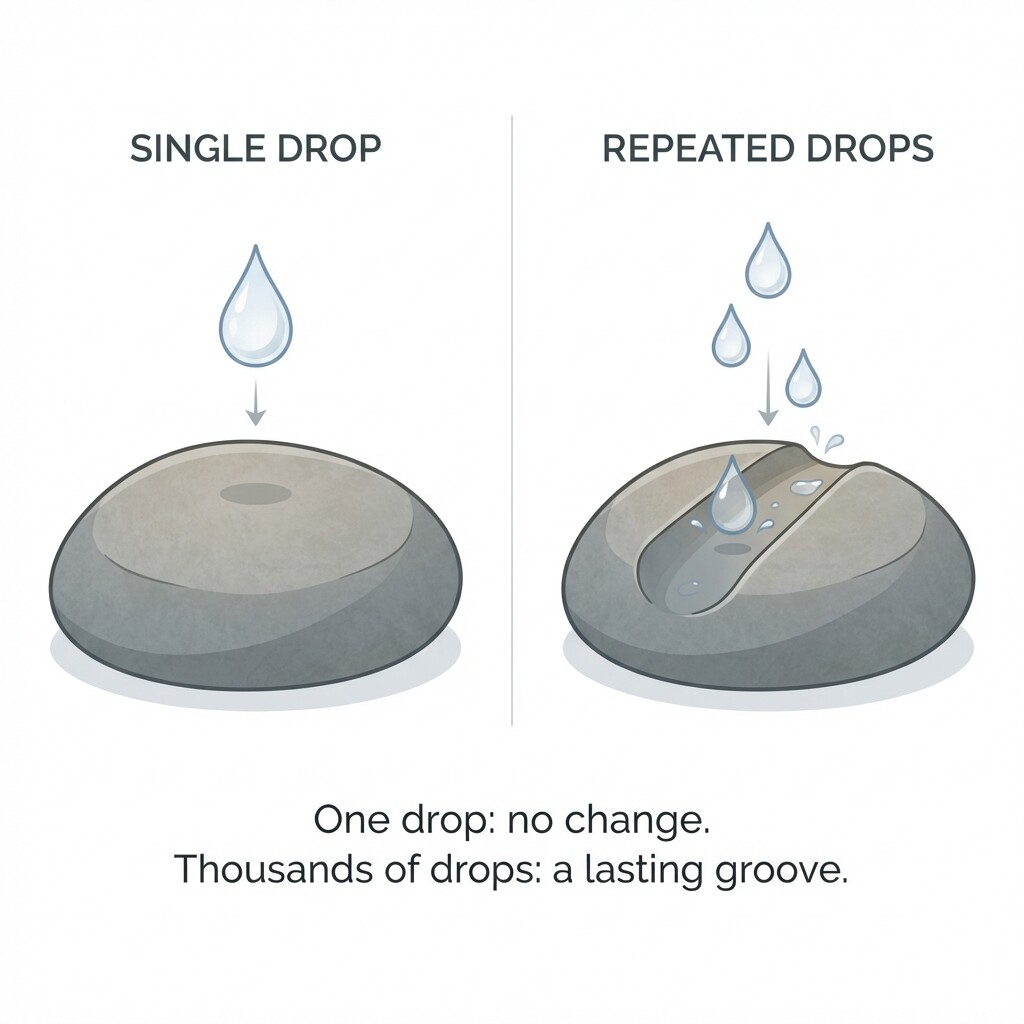
A 1-in-10,000 chance of something going wrong on any given day sounds tiny — and it is. Yet over a full year of daily exposure, you are rolling that metaphorical 10,000-sided die 365 times. Intuitively, repeating an event many times increases the overall chance of experiencing it at least once — but by how much? Now it is time to turn that intuition into a reliable formula and see just how far the numbers can move.
🎯 The Math Behind "At Least Once"
The key question with cumulative risk is: What is the probability that something happens at least once over many repeated exposures?
The easiest approach is to start from the opposite direction. Instead of counting all the ways the event could happen, we calculate the chance it never happens and subtract from . If the probability of the event on a single exposure is , then the probability it does not happen on that exposure is . For independent exposures, the chance it never happens in any of them is:
So the probability it happens at least once is:
Now let’s use a real example. Suppose a household cleaning product has a 1 in 5,000 chance of causing mild skin irritation each time you use it. That means:
If you use it every day for a year, then the number of uses is:
Plug those numbers into the formula:
Next, calculate . This is approximately:
So:
That means the chance of getting skin irritation at least once during the year is about 0.0704, or 7%.
⚡ A Quick Approximation for Mental Math
Using the full formula every time can be a bit cumbersome, especially when you just want a fast estimate. Luckily, there is a simple shortcut that works well when the risk per exposure is very small and the total buildup is still fairly small:
In other words, for small risks, you can often estimate the cumulative chance by multiplying the number of exposures by the risk on each one.
In our cleaning-product example:
So the shortcut gives an estimated cumulative risk of 7.3%. The exact answer from the full formula was 7.04%, so this estimate is very close.
Why does this work? When is tiny and is still small, the chance of the event happening multiple times is very low. That means the small per-use risks almost add together.
But this shortcut gets less accurate as the total buildup grows. For example, if , the shortcut gives 50%, while the exact formula gives about 39.3%. That is a noticeable gap.
A good rule of thumb is: use for quick mental estimates when the product is below about , and use the full formula once it gets larger.
🔁 When Repeated Small Risks Outweigh a One-Time Risk
Cumulative thinking reveals a twist that often surprises people. Consider two scenarios side by side:
| Scenario | Per-event risk | Exposures | Cumulative risk |
|---|---|---|---|
| A: One-time adventure activity | in | ||
| B: Daily city commute | in per trip | round trips/year |
Scenario A has a per-event risk that is ten times larger than Scenario B. Yet after just one year of commuting, the cumulative risk in Scenario B is nearly fifty times larger than the one-time risk in Scenario A. Over five years of commuting (2,500 trips), it climbs to roughly .
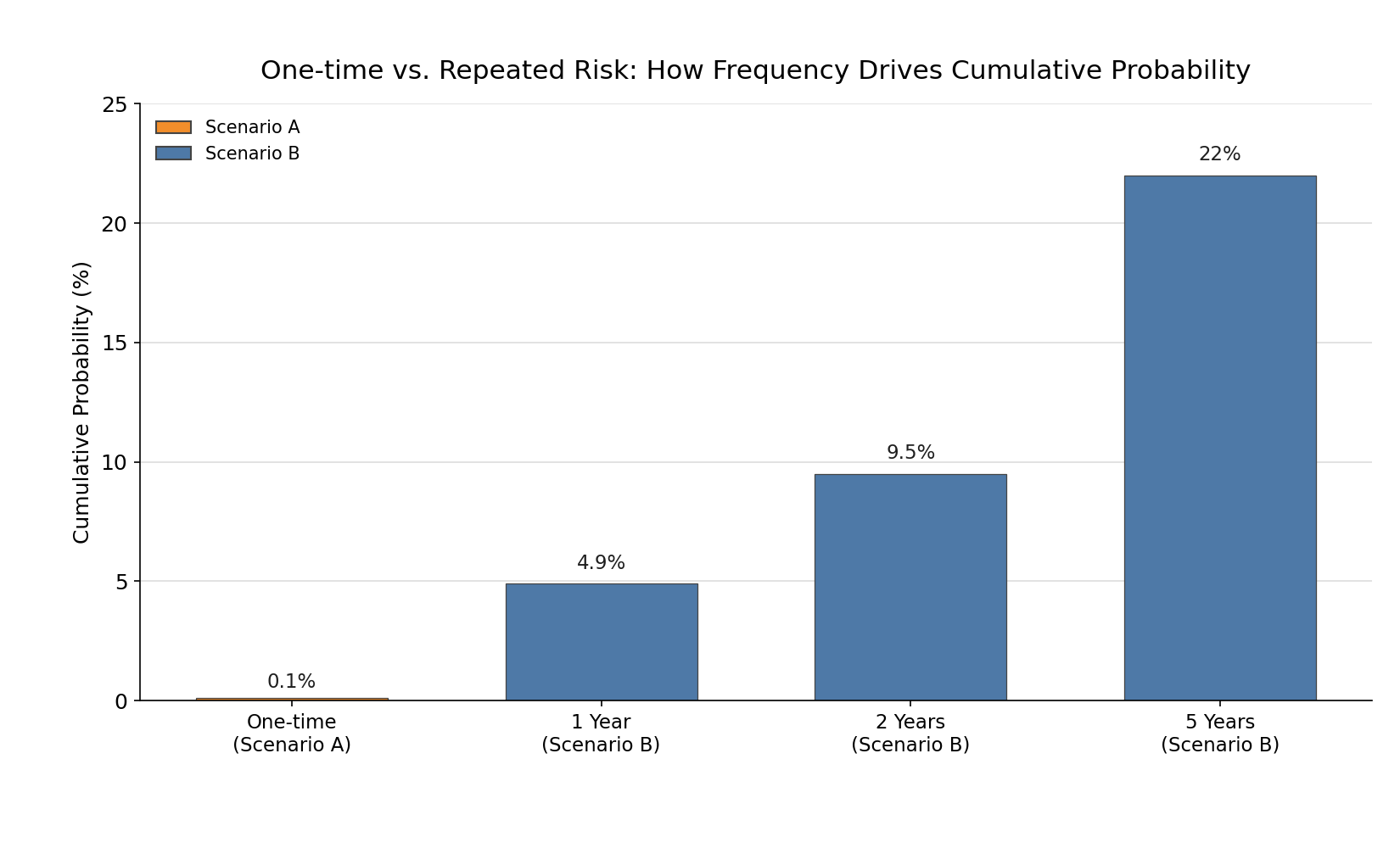
The takeaway is straightforward: frequency can matter more than the size of a single event. A risk you repeat hundreds or thousands of times deserves more attention than a bigger risk you face only once — even if the single event feels scarier in the moment.
⚠️ Deciding When Cumulative Risk Deserves Attention
We encounter countless small repeated risks every day, and it would be exhausting — and pointless — to worry about all of them. So how do you decide when the buildup is actually worth acting on? A practical approach is to ask three questions:
- How large is the cumulative probability? Use the formula or the shortcut to get a number. If it stays well below , it may not be worth changing anything.
- How serious is the outcome? A cumulative chance of mild skin irritation calls for a very different response than a cumulative chance of a serious injury. Higher stakes justify more caution even at lower probabilities.
- Can the exposure be reduced easily? If a simple change — wearing gloves, choosing a safer route, switching products — cuts the number of exposures significantly, the cumulative risk drops fast.
When the cumulative probability is noticeable and the outcome is serious and a practical adjustment exists, that is exactly when repeated small risks should genuinely influence your decisions. On the other hand, if any one of those conditions is missing — the buildup is trivial, the consequence is minor, or there is no realistic way to reduce exposure — the rational move is usually to accept the risk and move on.
Conclusion and Next Steps
In this lesson, you saw that a small risk repeated many times can quietly grow into a meaningful probability. The formula gives us the exact cumulative risk, and the shortcut offers a fast mental estimate when the numbers are small. You also discovered that frequent low-risk activities can overtake rare higher-risk ones in overall danger, and you built a three-question framework for deciding when cumulative risk is worth acting on.
Now it is time to put these ideas into practice. In the upcoming exercises, you will estimate how daily habits accumulate risk over time, compare one-time and repeated exposures head to head, and write your own recommendation about whether a real-world cumulative risk should change someone's behavior. Let's see how sharp your cumulative-risk thinking has become!
