Separate What's True from What It Means
Separate What's True form What It Means 🧾
When something happens, it’s easy to mix up what actually happened with what we think it means. But being able to tell the difference is a key skill for solving problems and working well with others.
Facts are things that anyone could see or check. They are what a camera or recorder would capture.
Interpretations are the stories or explanations we make up about those facts.
Values are what we care about or think is important.
For example, imagine you text a friend and they don’t reply for two days.
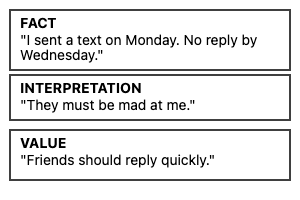
It’s normal to have interpretations and values, but problems start when we treat our guesses as if they are facts. If you believe your friend is mad without checking, you might feel upset or act differently around them—even if you don’t know the real reason.
Here's a practical way to separate these three elements in your daily life. When something happens that triggers a strong reaction, pause and ask yourself three questions. First, consider what actually happened that a video camera would have recorded. This gives you the facts. Second, identify what story you're telling yourself about what this means to reveal your interpretation. Third, examine what you think should happen or what you wish were different. This shows your values.
✅ Check Your Assumptions
Sometimes, we believe our own stories so much that we forget to check if they’re true. These are called assumptions—things we believe without proof. Everyone makes assumptions constantly; the key is catching them before they lead you astray.
Assumptions feel like facts because your brain treats them as reliable information. Let’s say you see someone leave a group chat right after you share an idea. You might assume, “They didn’t like my idea.” But is that a fact? Not really—it’s just a guess.
To check your assumptions, you can use assumption testing. Here’s how:

- Write down your assumption.
- Ask yourself, “What evidence do I have?”
- Look for facts that support or challenge your assumption.
For example:
- Assumption: “Nobody liked my idea.”
- Evidence for: “No one replied to my message.”
- Evidence against: “Last week, someone said they liked my ideas. Maybe people were just busy this time.”
You can also think of other possible reasons. Maybe the person left the chat because their phone battery died, or they had to go somewhere. By checking your assumptions, you avoid jumping to the wrong conclusion and can solve problems more calmly.
Use the 3-Step Thinking Check to Avoid Arguments 🪜
Many conflicts happen because people confuse facts with their own interpretations and values. The 3-step thinking check can help you sort things out before things get heated:
- Identify the facts—what actually happened.
- Recognize your interpretations—what you think the facts mean.
- Acknowledge your values or goals—what you care about in this situation.
When you can clearly state all three, you understand your own position. When you help others do the same, you understand theirs.
Here’s how a simple conversation might go:
- Milo: This team never includes me in important decisions!
- Jessica: That sounds frustrating. Can we break this down a bit? What exactly happened?
- Milo: The team had a planning meeting yesterday about the new project, and I wasn't invited. They obviously don't value my input.
- Jessica: Okay, so the fact is you weren't invited to yesterday's planning meeting. Your interpretation is that they don't value your input. What's most important to you here?
- Milo: I want to be treated as a full member of this team. My experience should matter.
- Jessica: That makes sense. Before we assume they don't value you, could there be other explanations for why you weren't invited? Maybe the invite got lost?
Notice how Jessica helped Milo separate the fact (not being invited) from his interpretation (they don't value him) and identify his underlying value (being respected as a team member). This separation creates space to explore other possibilities and find constructive solutions rather than jumping to hurt feelings and conflict.
By using this 3-step check, you can talk about what really happened, understand each other’s feelings, and find ways to solve the problem together. This makes it easier to work with others and keeps small problems from turning into big arguments.
You've now learned to distinguish between facts, interpretations, and values, to test your assumptions against reality, and to use the 3-step thinking check to avoid unnecessary conflicts. In the next activities, you’ll get to practice telling facts from interpretations, checking your assumptions, and using the 3-step thinking check in real-life situations. These skills will help you solve problems and get along better with everyone you work with.
