Consider the Impact of Others
See Problems from Different Points of View 👀
When you solve a problem, it’s important to think about how your choices affect other people—not just yourself. Sometimes, a decision that seems simple to you can make things harder for someone else. For example, if you change a meeting time, it might work better for you, but it could make it hard for someone else to join if they have another commitment.
In this lesson, you’ll learn how to see problems from different points of view so you can make better decisions for everyone involved. One way to do this is to pause and ask yourself, “Who else is affected by this?” Try to imagine what might be easy or hard for other people. It also helps to talk to others and ask how they feel about the problem or your idea. By taking these steps, you’ll start to notice things you might have missed and find solutions that fit the whole group.
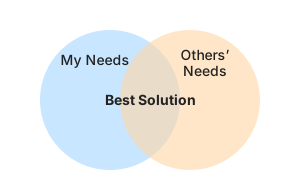
This overlap shows how the best solutions come from considering both your own needs and the needs of others.
🧑🤝🧑 Find Out Who Is Affected and How
Before you decide what to do, make a list of stakeholders: everyone who might be affected by the problem or your solution. Sometimes it’s easy to see who is involved, but other times, you might miss someone if you don’t look carefully.
Here’s a simple way to create a stakeholder map—a guide to understanding whose needs, concerns, and perspectives matter when finding a solution:
- Start with the people who are directly involved. For instance, if you’re deciding what to serve at a group dinner, think about everyone who will be eating.
- Next, consider people who might be affected in smaller ways. Maybe someone is helping to prepare the food, or there are guests with special dietary needs.
- Finally, don’t forget about people who could be affected later, like someone who might take home leftovers or join the group at the last minute.
By thinking through each of these groups, you can make sure your decision works well for everyone involved.
Let’s look at a basic example:
- Milo: I think we should use a new app to organize our group’s notes.
- Jessica: That could help us! But do you think everyone knows how to use it?
- Milo: Good point. Maybe we should check if anyone needs help learning it.
- Jessica: Also, does the other group we share notes with use this app? We should ask them too.
In this conversation, Milo and Jessica think about how their idea affects not just themselves, but also their teammates and another group. This helps them avoid problems and make a better plan.
Sometimes, it’s easy to overlook people who might be affected by your decision, especially if they aren’t directly involved or don’t usually speak up. These are called “missing perspectives.” To make sure you don’t miss anyone, try asking yourself, “Who might be affected that I haven’t thought about yet?” This simple question can help you spot people who might otherwise be left out.
For example, if you’re organizing a group project, you might focus on the main team members, but forget about someone who can only meet at certain times, or someone who is quiet and doesn’t usually share their ideas. You might also overlook people who will use the finished project later, like another group. By stopping to ask, “Who else could be affected?” you can include these missing perspectives and help your project succeed for everyone involved.
Think About Now and Later ⏳
Every decision has effects right away and effects that show up later. It’s easy to focus on what happens immediately, but it’s also important to think about what could happen in the future. This is why it is important to consider both short-term and long-term impacts.
Short-term impacts are the immediate and noticeable reactions to your decision. These effects are often strong and easy to see. Long-term impacts, on the other hand, show up slowly over time and can be harder to notice. By the time these long-term effects appear, it’s easy to forget what caused them in the first place.
To tell the difference between short-term and long-term impacts, try asking yourself:
- “What will happen right after we make this change?”
- “What could happen a few weeks or months from now because of this?”
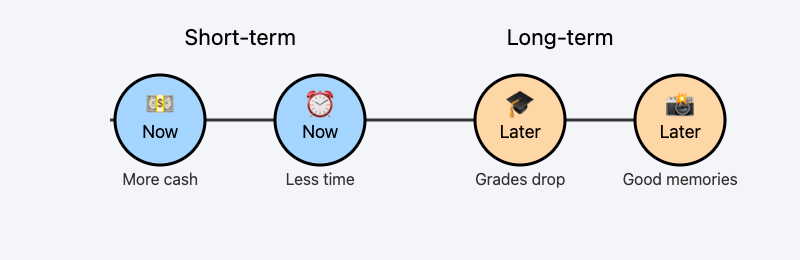
Here is a scenario: A student decides to take on extra shifts at work to afford a spring break trip. In the short term, their bank account grows, study time shrinks, excitement about the trip builds, and exhaustion from the packed schedule takes its toll. Looking further ahead, however, the impacts shift dramatically. The trip creates memories that last forever, enriching their life experience. Yet those lower grades from missed study sessions might affect scholarship eligibility next semester.
By thinking about both the short-term and long-term effects, you can make better choices that help everyone.
When you look at problems from different points of view, check who is affected, and think about both now and later, you’ll find solutions that work better for everyone. These skills prepare you for the upcoming practice activities where you'll apply these concepts through real-world scenarios.
