Frame the Problem
Spot the Real Problem, Not Just the Surface 🕵️♀️
Before you try to solve a problem, it’s important to make sure you really understand what’s going on. Many people jump in and try to fix what they see right away, but sometimes what you see is just a symptom, not the real issue underneath.
Think about when you feel tired. You might grab a coffee to wake up, but maybe you’re tired because you didn’t sleep well, or you skipped breakfast. The tiredness is a symptom—the real problem could be something else. The same pattern appears in countless situations: we see something wrong and immediately jump to fixing what's visible rather than understanding what's really happening underneath. This lesson will teach you to slow down and frame problems properly before rushing toward solutions.
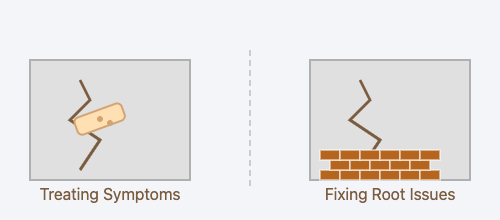
The difference between symptoms and root issues determines whether you solve problems temporarily or permanently. Symptoms are what you can see, feel, or measure directly. They're the visible signs that something is wrong. In contrast, root issues are the underlying causes that create those symptoms. When you treat only symptoms, problems keep returning in different forms, but when you address root issues, you create lasting change.
When you look for the real cause, you can find better solutions that actually work, instead of just covering up the problem for a little while. Consider this scenario: Your team keeps missing deadlines. The symptom is late deliveries. But what's the root issue? It could be unrealistic time estimates, unclear requirements, too many simultaneous projects, lack of necessary skills, poor communication, or even personal conflicts disrupting collaboration. If you simply demand "work faster" or "stay later," you're treating the symptom. The deadlines might temporarily improve through sheer effort, but the underlying problem remains, eventually causing burnout or turnover.
❓ Ask “Why?” to Dig Deeper
A great way to find the real problem is to keep asking “why?”—not just once, but a few times in a row. This is called the “5 Whys” method. Each time you ask, you get a little closer to the root cause.
Let’s see how this works:
- Milo: I'm so frustrated—I keep getting interrupted all day and can't finish anything!
- Jessica: That sounds tough. Why do you think people keep interrupting you?
- Milo: Because everyone needs help with their questions and I'm the only one who knows the answers.
- Jessica: Why are you the only one who knows the answers?
- Milo: Because I've been here the longest and handled all these situations before.
- Jessica: But why hasn't that knowledge been shared with others?
- Milo: Actually... we've never documented our processes. Everything's just in my head.
Through this brief exchange, Jessica helped Milo move from the symptom ("too many interruptions") to the root cause ("no documented knowledge sharing"). The solution isn't to stop helping people; it's to create documentation so others can find answers independently.
When you use the 5 Whys, try to focus on the process or situation, not blaming people. This helps everyone feel safe to share and work together on a solution.
Make the Problem Clear and Manageable 🎯
Once you know what the real problem is, it’s important to make it clear and not too big. If your problem is too broad, it’s hard to know where to start or when you’re done. Scope gives you focus, tells you where to direct your energy, and helps you know when you've succeeded.
A well-defined problem scope answers these three critical questions:
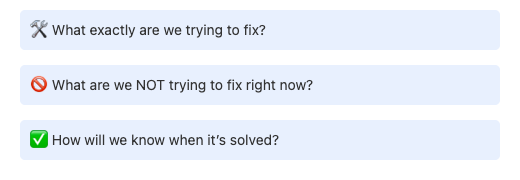
Here’s an example:
- Too broad: “We need to make things better around here.”
- Clear and focused: “We want to make sure everyone has the supplies they need at the start of each week. This doesn’t include equipment repairs or ordering new items. We’ll know it’s fixed when everyone has their supplies by Monday morning.”
If you’re working with others, talk together to agree on what’s included and what’s not. Defining what's not included in your problem scope proves just as important as defining what is included. This prevents scope creep, the tendency for problems to gradually expand until they become unmanageable. This helps keep everyone on the same page and makes the problem feel less overwhelming. It's better to fully solve a narrower problem than to partially address a broader one.
By spotting the real problem, asking “why?” to dig deeper, and making the problem clear and focused, you’ll be ready to find solutions that actually work. The next activities will help you practice these skills step by step!
