Define Critical Thinking
Welcome to the Course 🎉
Welcome to Solve Problems with Critical Thinking! Critical thinking isn't just an academic concept—it's a practical toolkit that helps you see clearly through confusion, make better choices under pressure, and solve problems more effectively. By learning to slow down your mental process when it matters most, you'll develop the ability to gather the right information before jumping to conclusions while considering perspectives you might normally miss. In this lesson, you’ll learn:
- What critical thinking really means (and what it doesn’t)
- How to pause and think before reacting
- Simple ways to use critical thinking in everyday situations
These foundations will help you feel more confident when you face new problems, make choices, or work with others.
🤔 What is Critical Thinking?
Critical thinking means pausing to think before you react. Instead of just going with your first feeling or what everyone else says, you take a moment to ask questions and look for more information. This helps you make better choices and avoid mistakes.
For example, imagine someone cuts you off while driving in traffic. Your first reaction might be to think, "What a jerk! They did that on purpose!" That is called reacting. With critical thinking, you pause and ask yourself "Maybe they didn't see me" or "Perhaps they're rushing to an emergency." By looking for other explanations, you avoid jumping to conclusions.
Here’s how this might look in a conversation:
- Milo: I think the manager ignored my idea on purpose.
- Jessica: That sounds frustrating. Do you know if they saw your message?
- Milo: I’m not sure. Maybe they missed it.
- Jessica: Maybe you could ask if they had a chance to read it?
Jessica helps Milo slow down and think about other reasons, instead of just reacting. This is what critical thinking looks like in real life.
What Critical Thinking is NOT:
- It’s not about arguing just to win or prove someone wrong.
- It’s not about overthinking every little thing.
- It’s not just “going with your gut” or doing what everyone else does.
Critical thinking is about being curious, careful, and open-minded. It helps you avoid mistakes and make choices you can feel good about.
Everyday Ways to Use Critical Thinking 🌟
Critical thinking isn't reserved for major life decisions or complex work projects. Instead, you'll discover countless opportunities to apply these skills throughout your daily life, and recognizing these moments represents the first crucial step toward building better thinking habits. Let's take a look at some everyday examples.
Shopping provides an excellent arena for practicing critical thinking, where these skills can save you both money and frustration. When encountering a product with glowing reviews, critical thinking prompts you to investigate further: "Are these reviews authentic?" or "What aren't they telling me?" Similarly, when an item displays a "70% off—today only!" banner, you might research whether this sale happens every week or if the original price was inflated just to make the discount appear more substantial.
Your social interactions offer another opportunity for applying critical thinking principles. When a friend shares dramatic news or gossip, instead of immediately spreading it further, pause to consider: "Is this the whole story?" or "Should I verify this before reacting?" Furthermore, when someone seems upset with you but won't explain why, rather than assuming you know the reason, you explore other possibilities: "What else might be bothering them?" or "Am I missing important context?"
You can think about applying critical thinking in everyday situations by using these three simple steps:
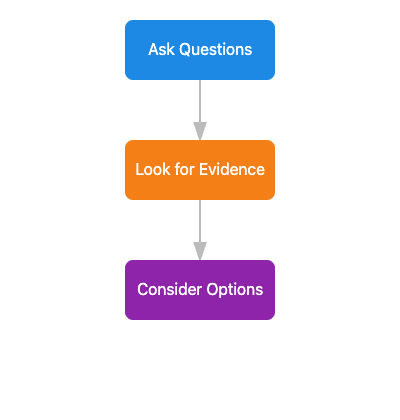
- Ask questions: Don’t just accept things right away. If someone says, “Everyone does it this way,” you can ask, “Why?”
- Look for evidence: Check if there are facts or examples to support what you hear.
- Consider other options: Think, “Is there another way to see this?” or “What else could be true?”
When you do this, you give yourself space to make better choices, instead of just reacting on autopilot.
When you practice these habits, you’ll find it easier to solve problems, work with others, and handle new situations with confidence. In the next activities, you’ll get to try out these skills in real-life scenarios, so you can start using critical thinking every day.
