Interpret Bound Language
🎉 Introduction
Welcome to Interpret Bound Language! In the previous lesson, you learned to write equations for situations where a computed quantity must hit an exact target. But plenty of real-world rules are not about hitting one exact number.
Consider a few rules you might encounter in a single day: a voting registration form says you must be at least 18 years old, a grocery store express lane is for fewer than 10 items, and an airline sets a maximum weight for a carry-on bag. None of these rules name a single correct number. Instead, each draws a boundary line and says everything on one side of that line is acceptable. The math tool for expressing this kind of rule is an inequality. By the end of this lesson, you will be able to:
- Understand the difference between strict and inclusive bounds to determine whether a boundary value itself is excluded or allowed.
- Translate everyday bound language (like "at least," "no more than," and "fewer than") into the correct inequality symbol (, , , or ).
- Recognize tricky phrasing like "no more than" or "exceeds" to consistently choose the right symbol without hesitation.
The Four Inequality Symbols ⚖️
You will work with exactly four inequality symbols throughout this lesson. The table below shows each symbol and how it is read aloud.
| Symbol | Read as |
|---|---|
| "is less than" | |
| "is greater than" | |
| "is less than or equal to" | |
| "is greater than or equal to" |
The symbols and are called strict because they exclude the boundary value. The symbols and are called inclusive because they include it. That one-word difference — strict versus inclusive — is the key to choosing the right symbol, and it is exactly what we will unpack next.
Strict vs. Inclusive: The Key Distinction 🔑
This is the single most important idea in the lesson, so let's make sure it is crystal clear.
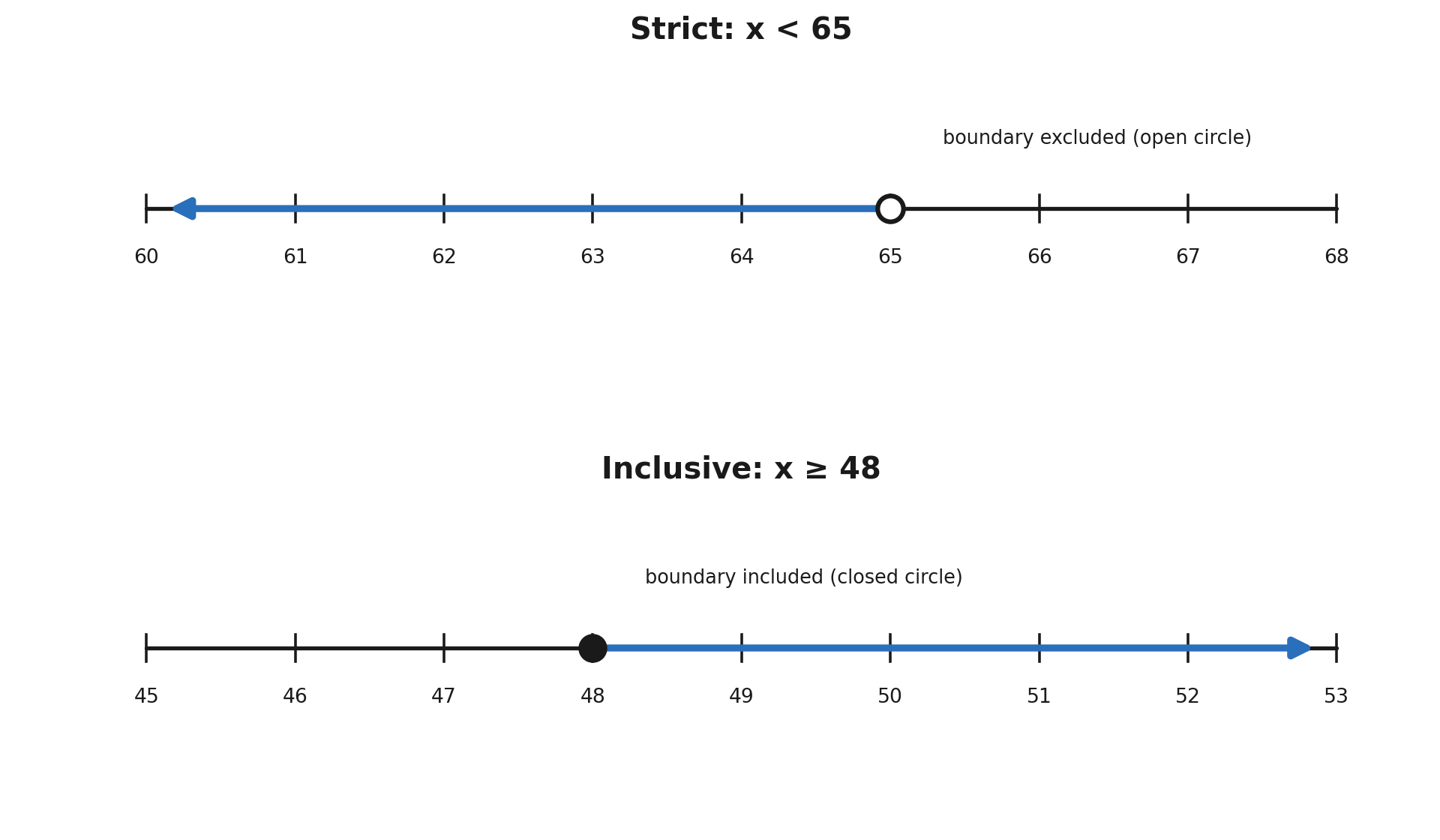
A strict bound means the boundary value itself is not allowed. If a sign says the speed limit is less than 65 mph, then exactly 65 mph is already too fast. Strict bounds use or .
An inclusive bound means the boundary value is allowed. If a roller coaster requires riders to be at least 48 inches tall, then exactly 48 inches is tall enough to ride. Inclusive bounds use or .
Whenever you read a real-world phrase, ask yourself one simple test question: "Is the boundary number itself okay, or not?" If the boundary number is acceptable, choose an inclusive symbol. If it is excluded, choose a strict one. This single check will guide you correctly in the vast majority of cases.
Everyday Phrases and Their Symbols 💬
Now that you understand the strict-versus-inclusive distinction, let's map the most common phrases to their matching symbols. Study the table below closely — these translations come up again and again whenever you model real-world rules.
| Phrase | Symbol | Strict or Inclusive? |
|---|---|---|
| "more than" | Strict | |
| "greater than" | Strict | |
| "over" (as in "over 100") | Strict | |
| "fewer than" | Strict | |
| "less than" | Strict | |
| "under" (as in "under 50") | Strict | |
| "at least" | Inclusive | |
| "no less than" | Inclusive | |
| "a minimum of" | Inclusive | |
| "at most" | Inclusive | |
| "no more than" | Inclusive | |
| "a maximum of" | Inclusive | |
| "up to" | Inclusive |
A quick note on the convention. The symbols in this table assume you write the variable on the left and the boundary value on the right. For example, "at least 18" matches when the inequality is written as . The very same rule can also be written with the variable on the right as — the meaning is identical, but the symbol "flips" because the order has been reversed. So the shortcut "at least → ≥" works as long as you put the variable first. If you ever swap the order of the two sides, swap the symbol direction too.
Notice a helpful pattern. Phrases containing the word "than" on its own (more than, fewer than, less than) tend to be strict. Phrases built around "at least" or "at most", and phrases starting with "no less" or "no more", tend to be inclusive. Keeping this pattern in mind gives you a quick shortcut when you need to decide.
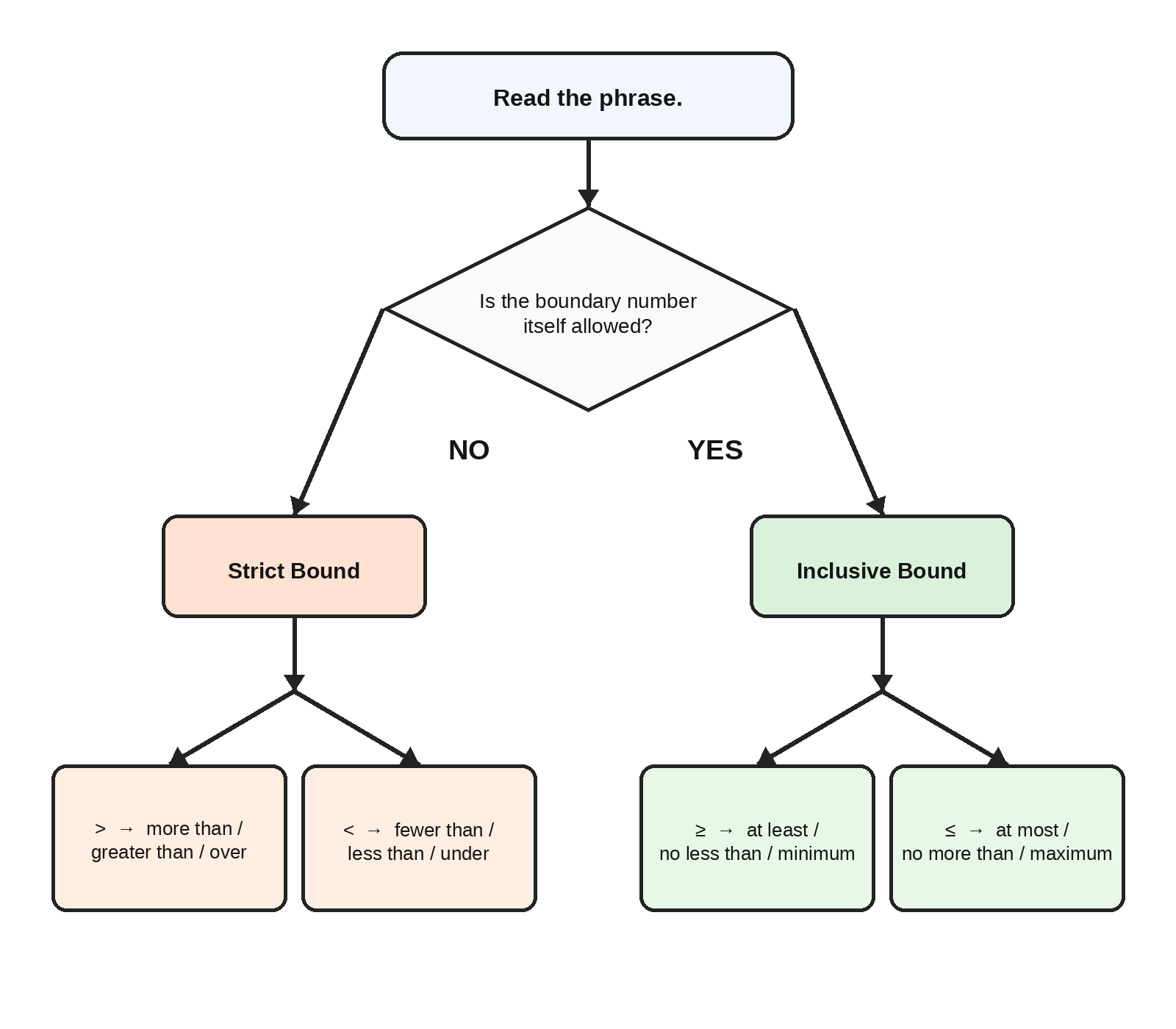
Let's put the phrase table to work with a few quick real-world examples. In each case, watch how to identify the key phrase, decide strict or inclusive, and pick the symbol.
Example 1: "You must be at least 18 years old to vote."
The phrase "at least" means 18 itself is acceptable, making it inclusive. If represents a voter's age:
Example 2: "The express checkout lane is for fewer than 10 items."
The phrase "fewer than" means exactly 10 is too many, making it strict. If represents the number of items:
Example 3: "Each carry-on bag must weigh no more than 22 pounds."
"No more than" tells us 22 pounds is still allowed but anything above is not, making it inclusive. If is the bag's weight:
Example 4: "To qualify for free shipping, your order must be more than $35."
"More than" excludes exactly $35, making it strict. If is the order total:
In all four examples above, notice that the variable is written first. That's why the phrase-to-symbol shortcuts from the table apply directly. If you wrote instead, the meaning would be the same, but the symbol would point the other way.
The process is the same every time: spot the bound phrase, ask whether the boundary number is included or excluded, and write the matching symbol.
Watch Out for Tricky Phrasing 👀
A few phrases can trip you up if you read them too quickly. Here are the ones that cause the most confusion:
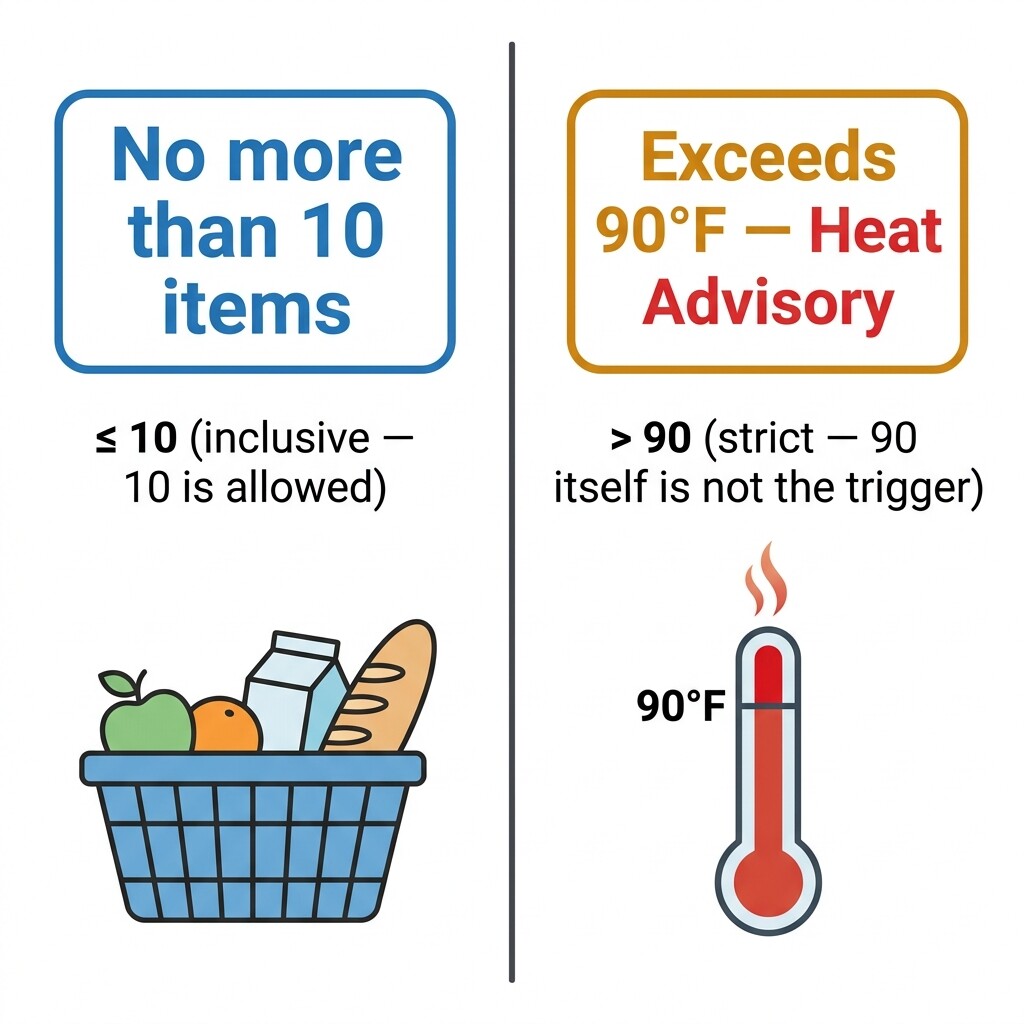
- "No more than 10" does not mean "more than 10." The word "no" flips the direction. "No more than 10" means .
- "No fewer than 5" does not mean "fewer than 5." Again, "no" reverses the meaning. "No fewer than 5" means .
- "Up to 100" is inclusive — the value can reach 100 but not exceed it, so it matches .
- "Exceeds" is strict, just like "more than." If a temperature exceeds 90°F, that means , not .
The common thread in these tricky cases is that small words — no, up to, exceeds — carry a lot of meaning. When in doubt, slow down and apply the test question from earlier: "Is the boundary number itself allowed?" That single check will steer you to the right answer.
Conclusion and Next Steps
In this lesson you learned to connect everyday bound language to the four inequality symbols , , , and . The central skill is distinguishing strict bounds, where the boundary value is excluded, from inclusive bounds, where it is allowed. You also built a phrase-to-symbol reference and practiced applying it to real-world rules from voting ages to shipping thresholds.
Up next is a set of hands-on exercises where you will match bound phrases to symbols, classify bounds as strict or inclusive, and fill in the correct inequality sign for everyday rules. These translations become second nature with a bit of practice, so jump in and give them a try!
