The Four Domain Profile
The Four Domain Profile
Last unit you took the assessment and named your themes. Now we look at what those themes actually do to your behavior in the two situations where managers most often get blindsided: when you're trying to plan something, and when you're trying to move a room. Knowing your domain mix isn't trivia. It predicts where your meetings will drift, where you'll overfunction, and where you'll quietly avoid. The four domains act like four dials, and the shape of your top themes tells you which dials sit at 9 and which sit at 3. That asymmetry shows up in measurable behavior every single week.
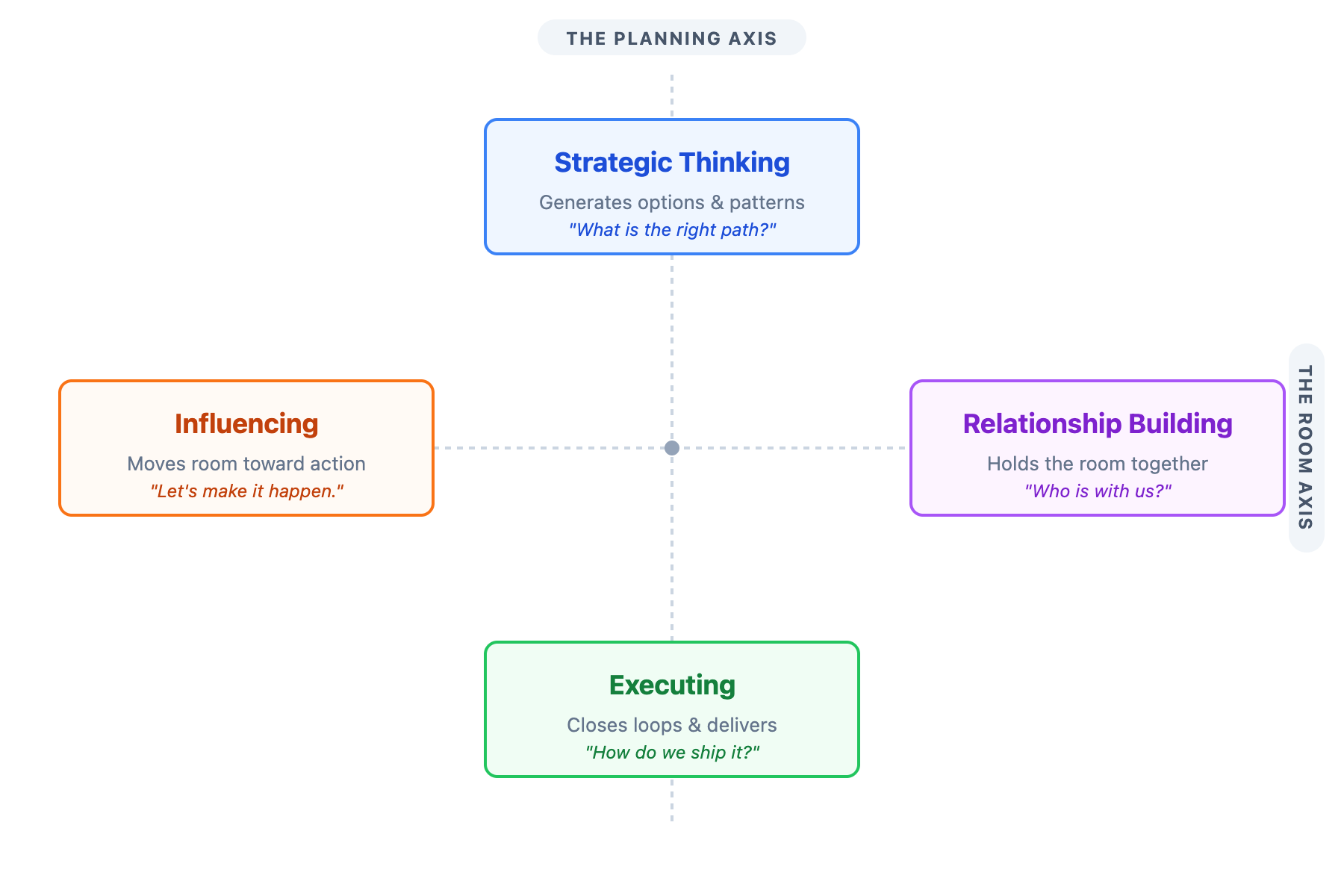
Strategic Thinking and Executing: the planning axis
These two domains together govern how you create and how you ship. Strategic Thinking themes (Ideation, Strategic, Learner, Input, Futuristic) generate options, frame problems, and pull pattern from noise. Executing themes (Achiever, Discipline, Focus, Responsibility, Arranger) close loops, build sequence, and push delivery. The diagnostic question isn't whether you have both; very few people do. It's where your weight sits and what that asymmetry produces in your planning behavior.
If you're heavy in Strategic Thinking and light in Executing, your planning meetings will generate three new directions and one unwritten action item. You'll feel productive because you've thought hard, but your team will leave unsure what they're shipping Friday. The fix isn't to suppress the ideation; that's where your value is. It's to scaffold the execution: a hard timebox at the end of every planning session, a written "what we committed to" doc, a teammate whose Executing themes you lean on by design rather than by accident.
If your weight is in Executing, the inverse risk shows up. You'll move fast on the plan in front of you and underweight the question of whether it's the right plan. Your team will hit dates and miss reframes. The discipline is to schedule the strategic thinking explicitly: a 30-minute "is this still the right problem?" check before a sprint locks in, or a standing slot every other week where you step out of the workstream and look at it from above.
Most managers have one strong domain and one weak one across this axis. The point of diagnosing it isn't to fix the weak one; that's slow, low-leverage work. It's to know which scaffold you need so the asymmetry stops costing you.
Influencing and Relationship Building: the room axis
The other axis governs how you move people. Influencing themes (Command, Activator, Woo, Communication, Self-Assurance) move a room toward action. Relationship Building themes (Empathy, Harmony, Developer, Includer, Connectedness) hold a room together long enough for trust to compound. Both are about people, but they pull in different directions under stress.
Heavy Influencing, light Relationship Building, and you'll drive decisions fast and lose the quieter voices. You'll mistake silence for agreement, push past pushback, and discover the misalignment two weeks later in a Slack thread you weren't on. Heavy Relationship Building, light Influencing, and the inverse holds: you'll read the room beautifully, sense the tension, and stall when it's time to make a call that someone will be upset about. You'll defer decisions to preserve harmony and pay for it in slow execution.
Conflict tolerance is where the asymmetry shows hardest. High Influencing tends to read pushback as engagement. High Relationship Building tends to read the same pushback as rupture and move to smooth it before the conflict has done its work.
- Victoria: When someone pushes back on your call, what's your first move?
- Nova: I usually re-explain the decision to make sure they got it.
- Victoria: And how does that land when they got it just fine and disagreed?
- Nova: Probably feels like I'm steamrolling.
- Victoria: What's the Influencing theme doing in that moment?
- Nova: It's dialed up because pushback reads as a threat to the plan. The work is catching that, not killing the dial.
Notice that Victoria doesn't ask Nova to be different. She asks them to see the dial. The behavior is observable; the next move becomes a choice.
Shadow Themes as your emotional thermostat
A Shadow Theme is what happens when one of your strengths gets dialed past useful into liability. Achiever past useful becomes compulsive output: you keep producing when the team needs you to stop and listen. Harmony past useful becomes conflict avoidance. Command past useful becomes domination. Empathy past useful becomes overidentification with a struggling teammate to the point you can't hold them accountable. The pattern is consistent: the strength isn't the problem; the dial is stuck.
The reframe that makes this operational is treating Shadow Themes as a thermostat rather than a flaw. A thermostat doesn't moralize about temperature; it reads the state and triggers a response. Your job isn't to get rid of the shadow; it's the same theme that makes you valuable. Your job is to read the early signal that the dial has crept up and have a move ready.
Three pieces make this deployable. First, name the specific stress contexts where your shadows reliably spike: a stalled meeting, a missed milestone, a stakeholder challenging your call. Second, identify the early-warning signal in your body or behavior: jaw tension, pace acceleration, the urge to interrupt, the urge to rescue. These signals are pre-conscious, but you can train yourself to notice them. Third, pre-load a regulation move you can deploy in real time: a five-second pause, a structured question you ask instead of jumping in, a physical reset like sitting back and putting your pen down.
"Thermostat" matters as a frame because it's neutral. You're not bad for running hot. You're a person whose strength dial drifted up under load, and now you have a way to read it and bring it back. Managers who treat their shadows as character flaws either suppress them (and lose the strength along with the shadow) or perform around them (and burn out). Managers who treat them as signal data adjust live.
In the following practices, you'll make a quick judgment check on how different domain concentrations play out in planning and creative situations, just to tune your eye on the patterns before you turn the lens on yourself. Then you'll analyze your own Influencing and Relationship Building tilt with a coach and translate that insight into a one-page self-regulation plan you can actually deploy under pressure.
