The CliftonStrengths Framework
The CliftonStrengths Framework
In the last unit, you mapped what happens inside you under pressure and how it ripples outward. That work gave you a feel for your defaults. This unit gives you a vocabulary for them. CliftonStrengths is one of the more durable tools managers use to name their own patterns, and the value isn't in the label, it's in giving you precise language for tendencies you've been operating from blind. Used well, it sharpens your self-coaching. Used badly, it becomes another box you check before getting back to work.
The Four Domains of Talent
CliftonStrengths sorts 34 talent themes into four Domains of Talent, and the fastest way to get value from the framework is to know what each domain actually measures in workplace behavior.
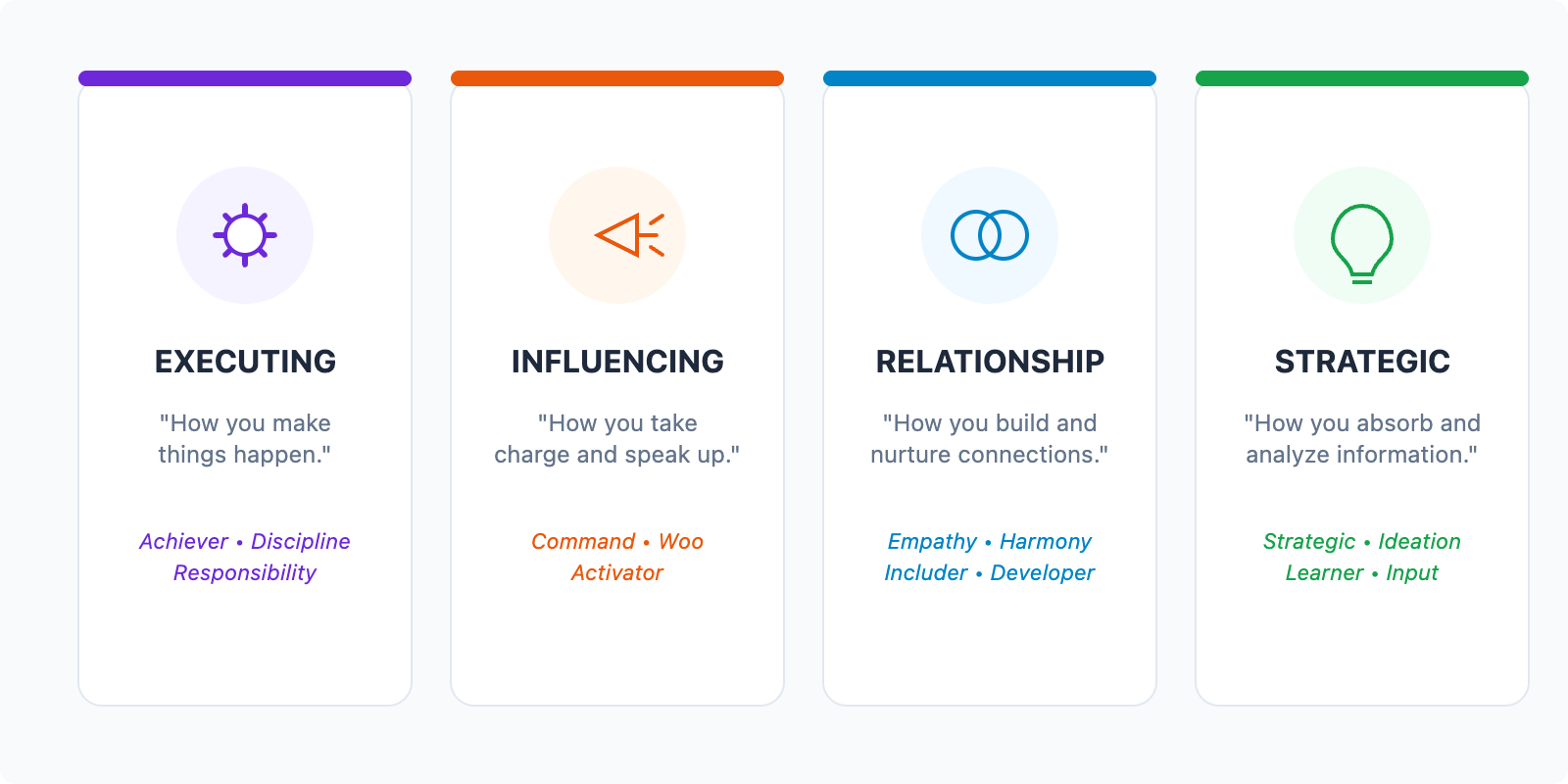
Executing is the domain of getting things done: themes like Achiever, Discipline, and Responsibility describe people who close loops, push through to delivery, and feel a near-physical discomfort when something is left hanging. Influencing is the domain of selling ideas and moving others to act: Command, Activator, and Woo show up as people who can take a half-formed direction and rally a room behind it.
Relationship Building is the domain of holding the team together: Empathy, Harmony, Developer, and Includer describe the connective tissue, the people who notice who's gone quiet and why. Strategic Thinking is the domain of analyzing information and seeing around corners: Ideation, Strategic, Learner, and Input describe the people who reframe a problem before solving it.
The reason this matters for you as a manager isn't categorization, it's prediction. Knowing your dominant domains tells you which behaviors come effortlessly and which ones are going to feel like swimming upstream. A manager loaded in Strategic Thinking and light on Executing will generate twelve good ideas in a planning meeting and miss the follow-up email. A manager loaded in Relationship Building and light on Influencing will hold the team together beautifully and freeze when it's time to push back on a stakeholder. Neither is good or bad. But if you don't know where you're loaded, you'll keep getting blindsided by the same mistakes and calling them bad luck.
Generating Your Profile From Real Evidence
Once you take the assessment, you'll get a list of your Top 5 themes. The temptation is to read them as flattering self-portraits. Resist that. The actual move is to anchor each theme in observable workplace evidence: a specific decision, a recent meeting, a pattern your team would corroborate. If your Top 5 includes Achiever, the question isn't "do I feel like an achiever?" It's "what did I do last Wednesday that confirms this, and what did I do last Wednesday that contradicts it?"
This evidence-first approach does two things. It separates the themes that genuinely describe you from the ones that sound right but don't show up in your behavior. And it surfaces the themes that surprise you, the ones you didn't expect to land in your top five. The surprises are usually the highest-value finding, because they name something you've been doing without language for it.
- Jake: My Top 5 came back with Empathy at number two. I don't see it. I'm pretty direct.
- Nova: Tell me about your last 1:1 with Chris.
- Jake: He'd had a rough week. I scrapped the agenda and just let him talk.
- Nova: Why?
- Jake: Because pushing him on goals would've been useless. He needed to be heard first.
- Nova: That's the evidence. Empathy isn't softness, it's reading state and adjusting. You did it without naming it.
Notice that Jake's first move was to dismiss the result against his self-image. The evidence was already there in his behavior; he just hadn't tagged it. That's the work for you: walk through actual recent decisions, and let the behavior tell you which themes are real.
Themes as Tendencies, Not Fixed Labels
Here's the trap most managers fall into: treating Strengths results as identity. "I'm an Achiever." "I'm just not a Relationship Building person." That language is fixed-label thinking, and it's costly. It locks you into a self-image that excuses behaviors you should be flexing. Themes are not who you are; they are tendencies you lean on, dialed up or down depending on context, energy, and intention.
The reframe is small but consequential. Instead of "I'm a Command person," try "in high-ambiguity meetings, I tend to take charge fast, which lands well in a crisis and shuts down quieter voices in a brainstorm." That sentence is portable. It tells you when to lean in and when to deliberately dial back. Fixed labels close down options; tendency language opens them up.
You'll also catch this in your team. When a teammate says "I just can't do that, I'm low in Strategic," they've collapsed a continuum into a wall. Your job is to hear the shorthand and reopen it: in what context, dialed how high, with what scaffolding?
The whole framework only earns its keep when you treat themes as moves you can choose. Three practices sit ahead of you. First, a quick matching exercise to lock in what each domain measures. Then you'll write a real profile reflection anchored in workplace evidence, the kind a peer could push back on without finding fluff. Finally, you'll sit with that peer and practice catching fixed-label language in real time, in them and in yourself. Take the assessment first if you haven't, then bring your actual Top 5 into the next slot.
