The Leader's Blind Spot
Welcome to the Course
If you've moved into management in the last few years, you already know the job is mostly internal. The hardest part isn't the calendar or the headcount plan; it's noticing what's happening inside you in the moment a teammate misses a deadline, an exec pings you at 9pm, or someone goes quiet in a retrospective meeting. This course is built on a simple premise: you cannot adapt to your team until you can read yourself with honesty.
By the end of this course, you'll be able to:
- Diagnose how your internal state shapes team performance and psychological safety
- Evaluate your default behaviors and emotional triggers under pressure
- Interpret your CliftonStrengths profile as behavioral tendencies, not fixed labels
- Predict where your overused strengths (Shadow Themes) become liabilities
- Conduct a personal bias audit and design a bias-interruption routine you'll actually use
This first unit, "The Leader's Blind Spot," lays the foundation. You'll connect your internal state to your team's behavior, catalog how you actually act under pressure (not how you wish you did), and reframe ordinary management decisions through the cost of self-unawareness.
Your Internal State Is the Team's Weather
Here's the move you have to make first: stop thinking of your mood as private. As a manager, your internal state is the most observed signal on the team. People watch your face in standup, parse the speed of your Slack replies, and read meaning into a one-line message you fired off without thinking. When you're regulated, the team takes interpersonal risks: they admit they're stuck, they push back on a decision, they ask the dumb question. When you're dysregulated, the same people go quiet, hedge, and route around you.
This is the leader's amplifier effect: whatever you bring into the room is multiplied across every person in it. A small frustration in you becomes a noticeable chill across the team. A flicker of impatience when someone gives a status update teaches three other people to over-prepare or stay silent next time. None of this requires you to yell. It just requires you to stop noticing what you're broadcasting.
- Nova: When you cancelled the second 1:1 in a row, what was actually happening for you?
- Jake: Honestly? I was buried. I figured Chris would understand it's a tough week.
- Nova: What do you think Chris read into it?
- Jake: Probably that he's not a priority right now.
- Nova: And what does that do to whether he flags a problem early next week?
- Jake: ...he won't. He'll wait until it's bad.
Notice that the cancelled meeting wasn't the problem. The problem was the signal it sent, and the manager hadn't asked what signal he was sending until someone made him.
Spotting Your Defaults Under Pressure
Now let's get specific about you. Under pressure, every manager has a small set of default behaviors that show up automatically. Some are obvious: interrupting in standups, over-functioning on a junior teammate's deliverable, going silent in a Slack DM you don't want to answer. Some are subtler: terse one-word replies, a sudden hunger for status updates, cancelling 1:1s, switching from coaching mode into directive mode without flagging the shift.
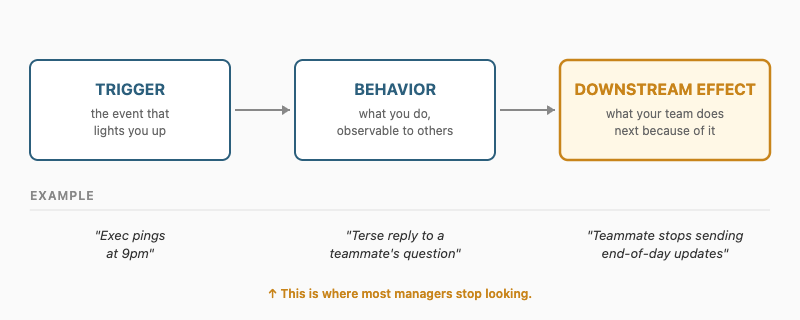
The work isn't to eliminate these defaults; you can't. The work is to name them so precisely that you can spot them in real time. That requires three things:
- The trigger (the specific event that lights you up, like a missed deadline, an exec ping, or a quality slip)
- The behavior (what you actually do, observable to others)
- The downstream effect (what your team does next because of it).
Most managers can name the first two with a little reflection. The third is where it gets uncomfortable, because that's where you start owning the cost.
A useful test: think back to the last high-pressure stretch you led through. Pick a specific Tuesday. What did you do that you wouldn't have done on a calm Tuesday? Whatever surfaces, that's a default. Write it down somewhere you'll see it again.
The Hidden Cost of Unexamined Decisions
Every managerial decision has two prices: the visible one (the call you made) and the invisible one (the cost of the internal state you made it from). Reassigning a task while you're depleted, sending a sharp message while you're threat-triggered, cancelling a 1:1 while you're avoidant: the decisions might even be defensible on the merits. But each one carries a self-awareness cost, a tax on trust, candor, or psychological safety that you didn't price in because you weren't tracking your own state.
Reframing a decision through this lens means asking three questions after the fact, and eventually before: What state was I in? How did that state distort my read of the situation? What would I have done with thirty more minutes and a calmer nervous system? You won't always change the call. But you'll start to see which ones were really yours and which ones were your stress wearing your name badge.
The recap is sharp: your team's behavior is largely a response to your internal state, and most managers are operating from defaults they've never named. Three practices sit ahead of you next. First, a quick quiz to check your read of the core concepts: the leader's amplifier effect, regulation, the trigger-behavior-effect chain, and what manager behavior signals to the team. Then you'll write a real Q3-style self-assessment cataloging your own defaults: the kind of document you could actually hand a mentor. Finally, you'll sit across from one and defend, then revise, three specific calls under live pressure. Start by picking the Tuesday.
