Cognitive Bias Audit
The Cognitive Bias Audit
Self-awareness about your strengths and shadows tells you how you behave under stress. It doesn't yet tell you how your judgment quietly bends when you're calm. That's the bias layer, and it's where most managers lose the most quality without ever feeling it. The previous unit gave you a thermostat for emotional load. This one gives you an audit for cognitive load: a way to catch the moments where your brain is deciding faster than your evidence supports, especially in the three places it costs you most: feedback, workload allocation, and performance calls.
Spotting Confirmation Bias and Halo/Horns in Your Week
Confirmation bias is the tendency to weight evidence that supports a view you already hold and discount evidence that challenges it. In management, it almost never looks like prejudice. It looks like efficiency. You've decided Teammate A is on track, so when their PR slips through with a small bug, you read it as a one-off. You've quietly written off Teammate B, so the same bug from them confirms what you already suspected. Same behavior, different interpretation, and the difference is your prior, not the data.
The halo effect is its cousin: one strong trait colors your read of unrelated traits. The teammate who presents brilliantly in skip-level reviews gets credit for technical depth you've never actually verified. The horns effect is the inverse: one weak signal (a missed deadline, an awkward Slack message, a quiet pattern in meetings) drags down your read of work you've barely examined. Halo and horns don't feel like distortion in the moment. They feel like pattern recognition.
The behavioral signs are surprisingly observable once you know what to look for. You spend more meeting prep time defending your existing read of someone than re-examining it. You can quickly list strengths for some teammates and weaknesses for others, but struggle to do the inverse. You write feedback drafts that lean entirely positive or entirely negative without much grey. You notice yourself saying "I just have a sense" about someone's performance more than "here's the evidence."
- Jake: I think Chris is coasting. Something's off.
- Victoria: What's the most recent specific thing he did that supports that?
- Jake: He was quiet in the design review last week.
- Victoria: And the strongest piece of evidence against the coasting read?
- Jake: ...He shipped the migration two days early. I forgot about that.
- Victoria: So one quiet meeting outweighed a clean delivery. That's the dial to watch.
Notice Victoria didn't argue with the conclusion. She made him weigh the disconfirming evidence he'd already filtered out.
Conducting a Personal Bias Audit
A bias audit is a structured look back at your recent decisions to surface where your judgment most reliably bends. It works best on a defined window (say, six months) and a defined decision class (feedback given, workload assigned, promotion or rating calls made). The point isn't to indict yourself. It's to find the two or three patterns that are statistically yours, so you can interrupt them before review season, not during it.
The method is straightforward but uncomfortable. Pull a list of every meaningful decision you made in the window. For each one, write the decision in one line and the evidence you used in another. Then ask three questions of the set, not the individual decision. First, whose name shows up disproportionately in your "high performer" mental tier, and what specific evidence supports that placement versus what you've assumed? Second, where did a single early signal (a great first impression, a rocky onboarding) appear to anchor your view of someone for months afterward? Third, which decisions were driven mostly by what happened in the last two weeks rather than the full window, the recency bias that loves to dominate review cycles?
What you're looking for isn't perfection. It's the two or three biases that show up in your patterns more than the others. Maybe halo dominates because you over-index on communication polish. Maybe horns dominates because you can't unsee a missed deadline from January. Maybe confirmation bias is your through-line because you formed reads early and stopped re-examining. Naming the top three is enough. Trying to fix all of them at once is how managers end up fixing none.
Designing a Bias-Interruption Routine
Awareness without a routine decays within a week. A bias-interruption routine is the operational side: specific moments, prompts, and peer checks that force you to slow down at the points where your top biases are most likely to fire. It lives in three columns because the failure modes are different in each.
For feedback, the interruption is usually a question you ask yourself before sending: "What evidence would prove the opposite of what I'm about to say?" If you can't answer in 30 seconds, your draft is probably running on a prior, not data. For workload, the interruption is structural: before assigning the next stretch project, list the last three you assigned and to whom, so the halo doesn't quietly route opportunity to the same two people. For performance decisions, the interruption is a peer calibration step: a 20-minute call with another manager who reads the same teammate from a different angle and can disconfirm your top read.
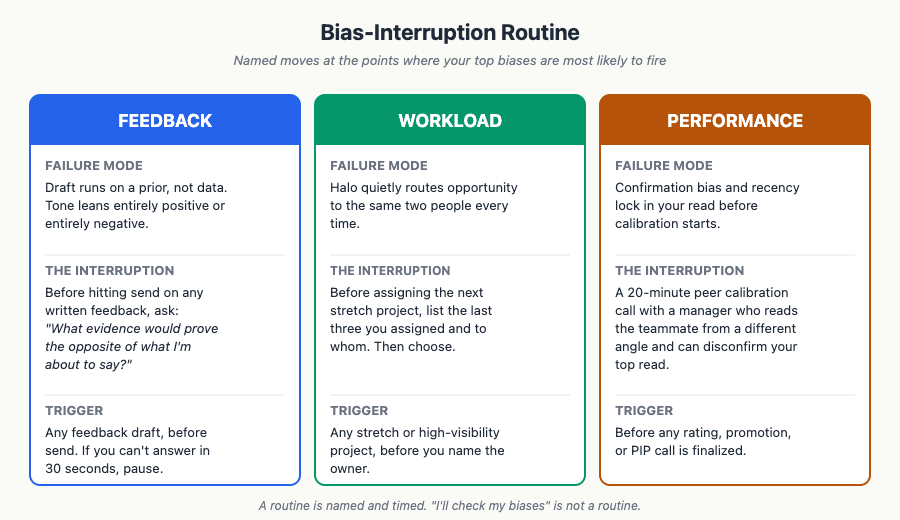
The routine works only if it's specific enough to follow on a busy afternoon. "I'll check my biases" is not a routine. "Before I hit send on any written feedback, I run the disconfirming-evidence prompt" is a routine. The difference is whether the move is named and timed, or aspirational.
This is where it gets concrete. The next quick check has you matching common bias definitions to their names so the labels are clear before you apply them. After that, you'll run the audit on your own six months and turn the top three blind spots into a routine you could actually run on a Tuesday at 4pm during review season.
