Writing Small Numbers
Introduction
You have made it to the halfway mark of Scientific Notation in Real Life — this is Lesson 3 of 6! In the first two lessons, we learned how to read scientific notation and how to convert large numbers into proper form using positive exponents. Now we are heading in the opposite direction: instead of massive quantities loaded with trailing zeros, we will work with extremely small decimals packed with leading zeros.
By the end of this lesson, you will be able to take a tiny measurement like meters (roughly the width of a human hair) and express it as a neat coefficient times a power of ten. Just as importantly, you will understand why the exponent turns out to be negative whenever the original number is less than one.
The World Below One
In Lesson 2, we compressed large numbers that were loaded with trailing zeros. Small numbers present the same readability problem, only the zeros pile up before the significant digits instead of after them. A bacterium measuring m or a light wave spanning m can be a headache to read and painfully easy to miscount.
Scientific notation handles these tiny values with the same core idea: separate the meaningful digits (the coefficient) from the scale (the power of ten). The only new piece is that the power of ten will now be negative, because the number is less than one. Let's break the process down step by step.
Forming the Coefficient
Proper scientific notation requires a coefficient that satisfies — exactly one nonzero digit to the left of the decimal point. This rule holds regardless of whether the original number is big or small.
To find the coefficient, scan past the leading zeros until you reach the first nonzero digit, then place the decimal point directly after it. For example, with :
- Skip the leading zeros:
- The first nonzero digit is 4.
- Place the decimal after it: 4.2.
The coefficient is . It captures the significant digits of the original number, exactly the way it did for large numbers in Lesson 2.
Shifting the Decimal to the Right
Here is where small numbers differ from large ones. In Lesson 2, we moved the decimal to the left and counted the shifts to get a positive exponent. For small numbers, the decimal moves to the right.
Let's stick with . The decimal starts at its original position, and we slide it to the right until it sits just after the first nonzero digit:
That is 4 places to the right. The number of shifts becomes the exponent, but with a negative sign:
Move the decimal point 4 places to the right
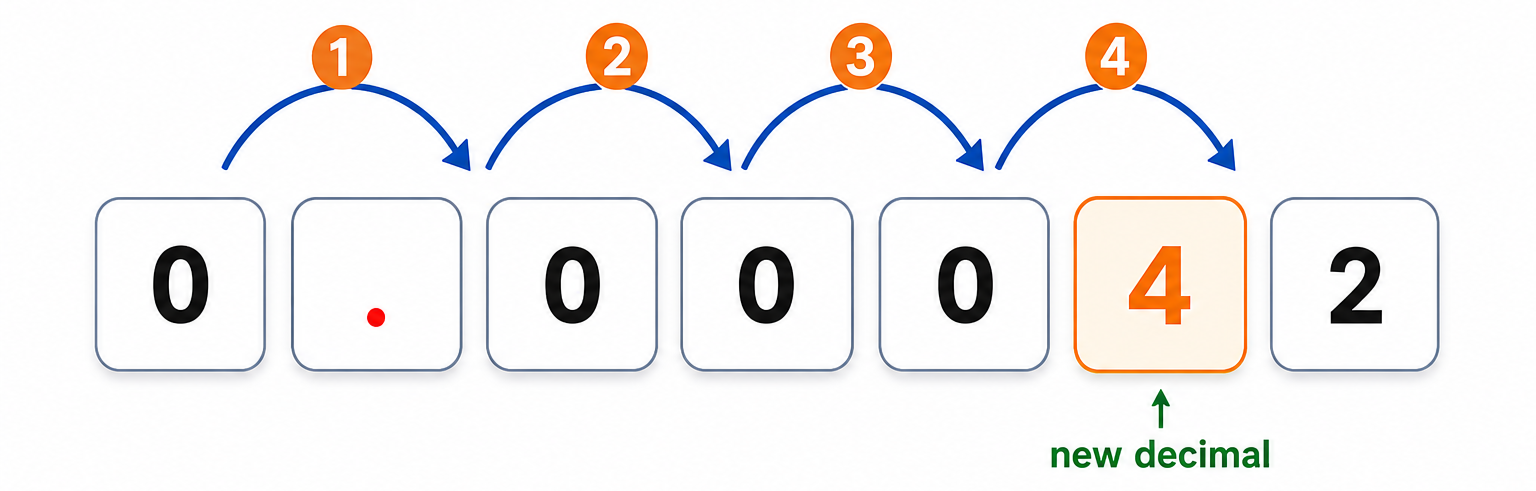
Final coefficient: 4.2
0.00042 = 4.2 × 10⁻⁴
4 rightward moves → exponent -4
Why the Exponent Is Negative
Understanding why the exponent is negative will make the rule stick rather than feel like something to memorize. Let's think through it carefully.
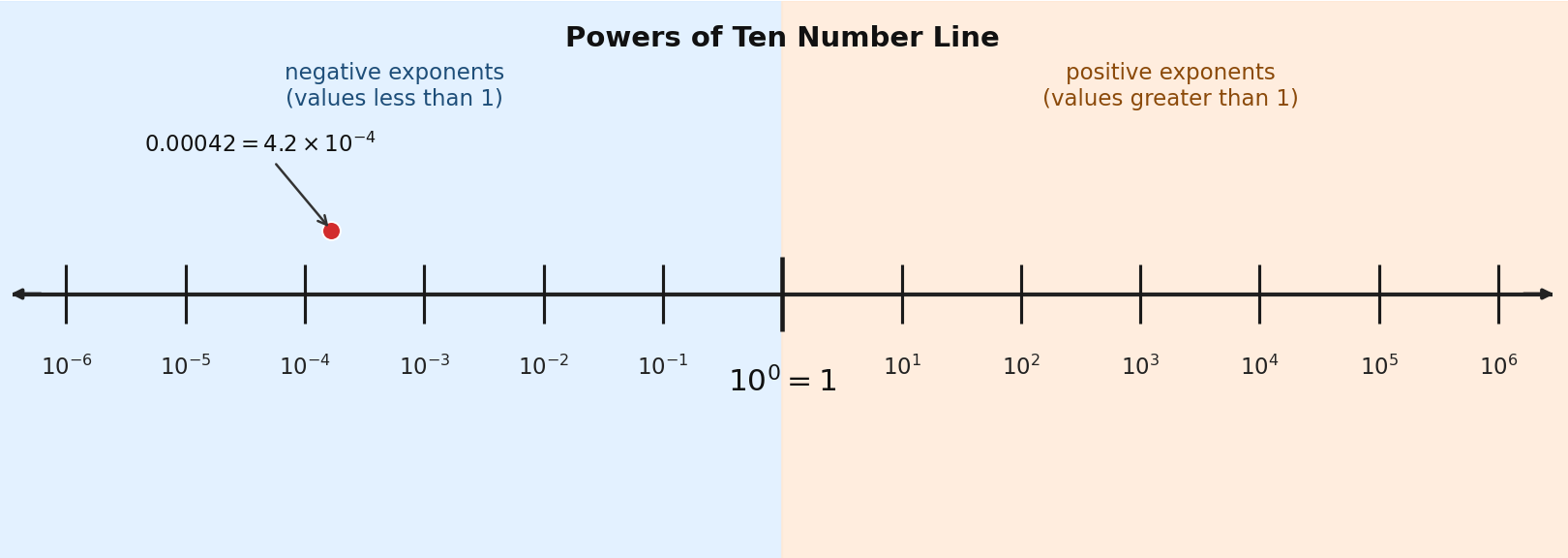
When we moved the decimal 4 places to the right, we effectively multiplied by (that is, ). That multiplication is what turned the tiny decimal into the comfortable number . But we cannot simply inflate a number and call it the same value — to keep the expression equal to the original, we must compensate by dividing by , which is the same as multiplying by :
Here is a simple way to remember it: numbers less than one are fractions of one. Since , expressing something smaller than 1 requires a power of ten that is below zero. The smaller the original number, the more negative the exponent becomes.
From Decimal to Notation: The Width of a Human Hair
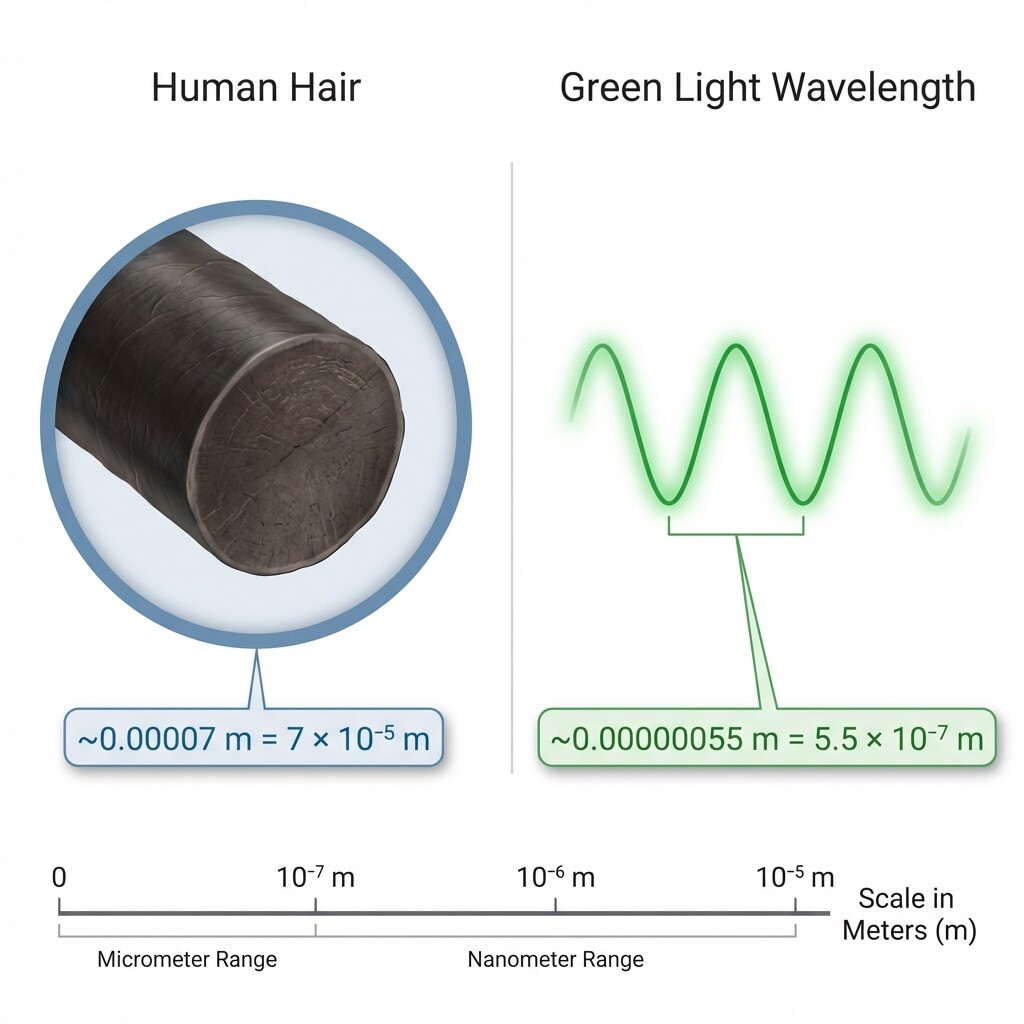
Let's apply the full process to a real-world measurement. A human hair is approximately 0.00007 meters wide.
- Find the first nonzero digit. It is 7.
- Place the decimal after it to form the coefficient: , or simply .
- Count how many places the decimal moved to the right. From to is 5 places.
- Write the result:
To verify, reverse the process from Lesson 1: start with and move the decimal 5 places to the left. You land on . ✅
Going Smaller: The Wavelength of Light
The wavelength of green light is approximately 0.00000055 meters — far tinier than a hair. Let's convert it.
- First nonzero digit: 5.
- Coefficient: (we keep the next significant digit as well).
- Decimal shifts to the right: from to is 7 places.
- Result:
Notice how the exponent grows more negative as the number gets smaller. A human hair width () is about 100 times larger than a wavelength of light (), and that difference shows up clearly in the exponents.
Common Pitfalls with Small Numbers
Working with small decimals introduces a few mistakes that are easy to make but just as easy to avoid once you know what to look for:
- Using a positive exponent. Writing instead of for . A quick sanity check always helps: , which is nowhere near . If the original number is less than 1, the exponent must be negative.
- Miscounting the leading zeros. With many zeros, it is easy to be off by one. A reliable trick is to number each position as you shift: .
- Coefficient out of range. Writing instead of . Always double-check that your coefficient satisfies .
Conclusion and Next Steps
In this lesson, we learned how to convert small decimals into proper scientific notation. The process mirrors what we did for large numbers, with one key difference: we move the decimal point to the right, and the exponent is negative. We also explored why the exponent must be negative — shifting the decimal right effectively multiplies the number by a power of ten, so we attach a negative exponent to bring it back to its original value.
Up next are hands-on exercises where you will convert a range of small real-world measurements into scientific notation — from the building blocks of biology to the precision scales of modern engineering. You will also have the chance to explain the negative exponent in your own words, which is one of the best ways to make the concept truly yours.
