Comparing Scientific Notation
Introduction
Welcome back to Scientific Notation in Real Life — this is Lesson 4 of 6, so we are well into the second half of the course! In the first three lessons, we built a solid toolkit: reading scientific notation, writing large numbers with positive exponents, and writing small numbers with negative exponents. Each of those skills focused on one number at a time.
Now we raise the stakes. In this lesson, we will learn how to compare two or more numbers in scientific notation and decide which is larger or smaller. Whether we are sizing up planetary distances or contrasting microscopic measurements, the method is surprisingly simple — and it only takes two steps.
Why Comparing Matters
Imagine reading that one asteroid passed km from Earth while another passed at km. Which one came closer? When both numbers sit in scientific notation, it can be tempting to glance at the coefficients — looks bigger than — and jump to a conclusion. But that instinct can easily mislead us.
Every number in scientific notation has two parts: a coefficient (a number from 1 up to 10) and a power of ten that captures the scale. Comparing two such numbers is really about examining these two pieces in the right order. The power of ten carries far more weight than the coefficient, and once we respect that hierarchy, comparisons become quick and reliable.
Step One: Compare the Exponents
The exponent on the power of ten tells us the order of magnitude — the broad scale a number lives on. A number with a larger exponent sits on a completely different level, so the exponent is always the first thing we check.
Consider these two numbers:
Even though is a larger coefficient than , the first number wins because is ten times larger than . Converting to standard form confirms this: while . The exponent made all the difference:
Rule: When two numbers in scientific notation have different exponents, the number with the larger exponent is the larger number — regardless of the coefficients.
Step Two: Compare the Coefficients
If both exponents are the same, both numbers live on the same scale. In that case, we simply compare the coefficients, just as we would compare two ordinary numbers.
For example:
Both numbers share the exponent , so we compare and . Since :
This makes intuitive sense: both numbers are in the hundreds of millions, and is clearly bigger than .
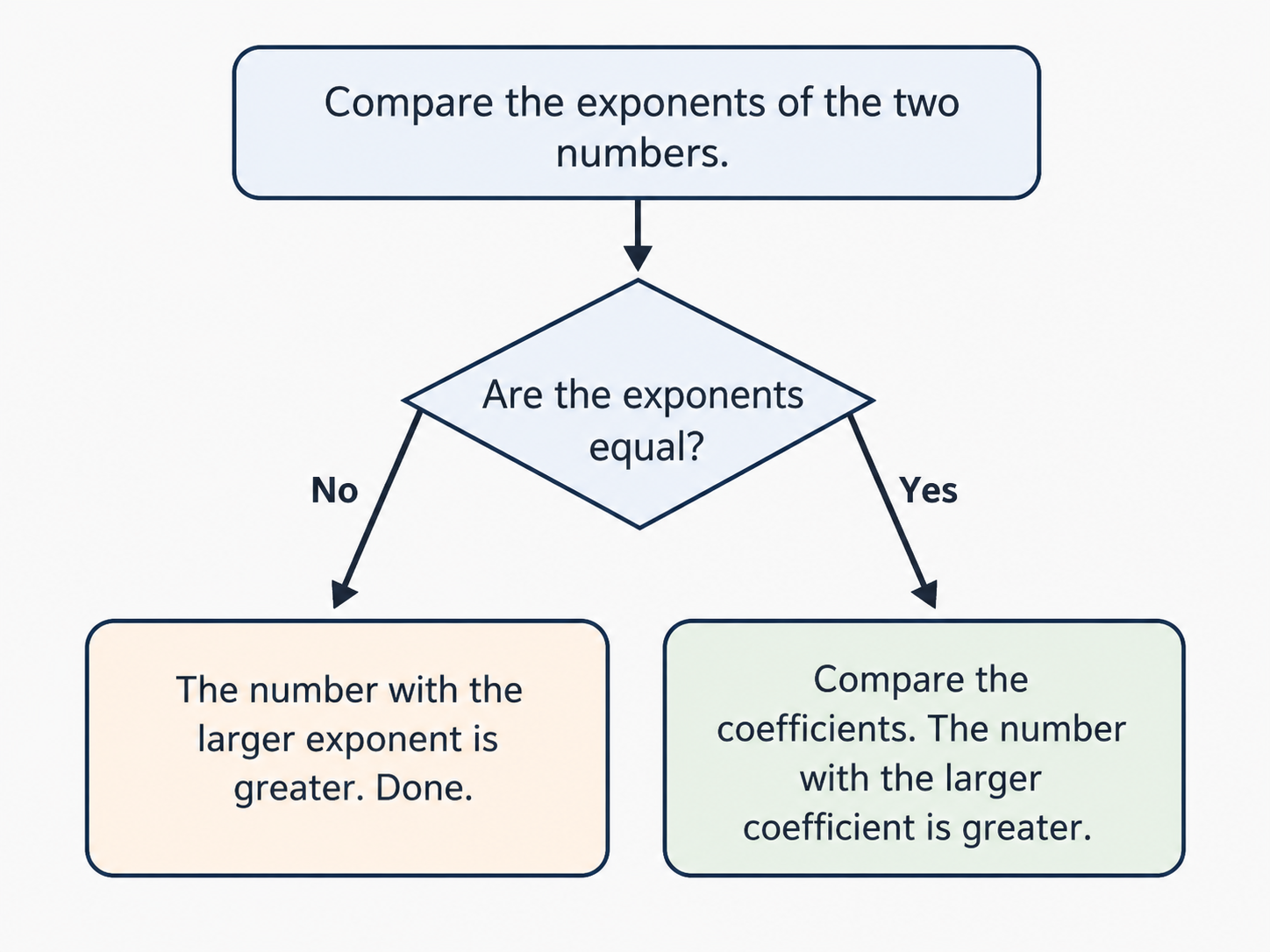
The Two-Step Strategy at a Glance
Here is the full comparison method in compact form:
- Compare the exponents. If one exponent is larger, that number is larger. Done.
- If the exponents are equal, compare the coefficients. The larger coefficient means the larger number.
That is the entire process — the first step alone resolves most comparisons. The flowchart below maps out the decision:
The table below shows the strategy in action across three different scenarios:
| Comparison | Exponents | Result | Reason |
|---|---|---|---|
| vs. | is larger | Larger exponent wins | |
| vs. | is larger | Same exponent; larger coefficient wins | |
| vs. | is larger | Less negative exponent is larger |
Real-World Comparisons
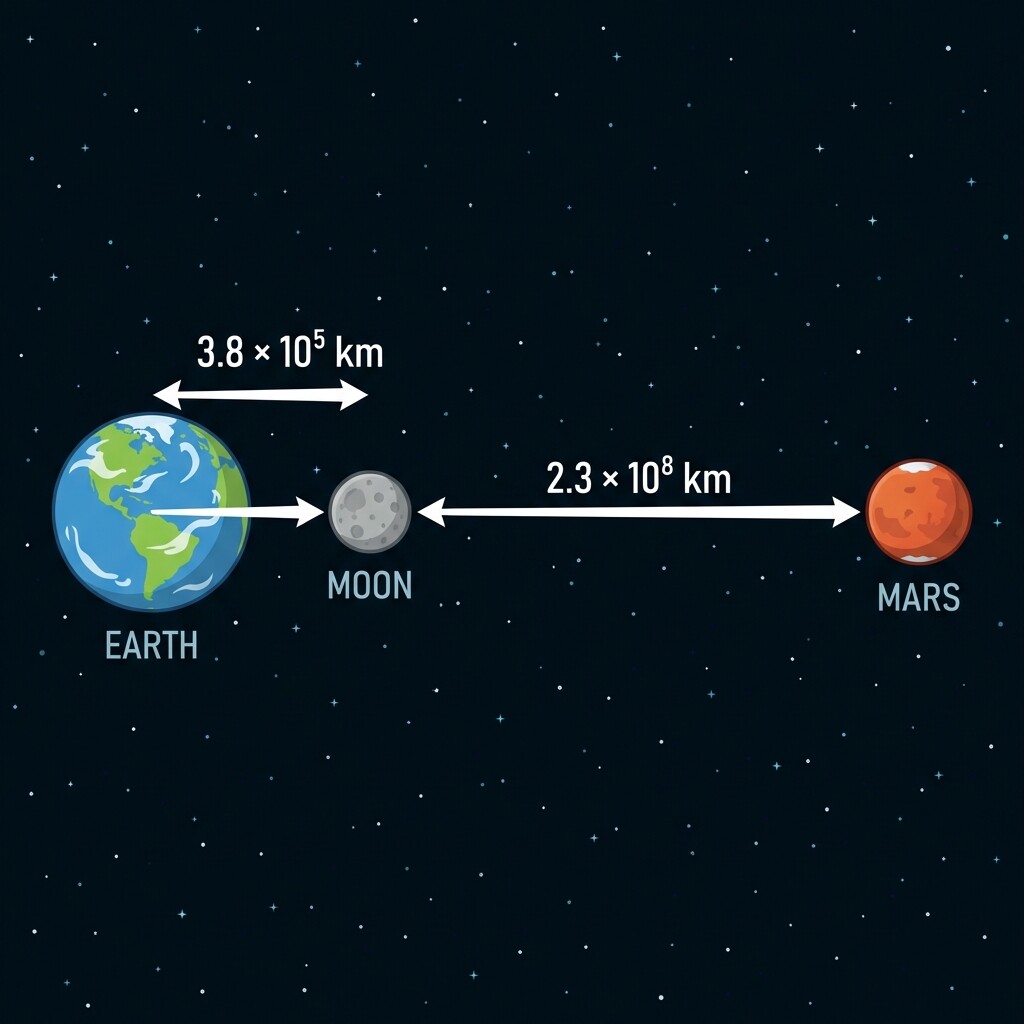
Let's put the strategy to work with quantities we can picture. Consider the average distance from Earth to the Moon versus the average distance from Earth to Mars:
- Distance to the Moon: approximately km
- Distance to Mars: approximately km
Step 1: Compare the exponents — vs. . Since , Mars is farther away and we are done. The coefficients ( vs. ) play no role here.
Now consider two measurements from the tiny end of the scale:
- Width of a human hair: approximately m
- Length of a typical virus: approximately m
Step 1: Compare the exponents — vs. . On a number line, sits to the right of , so and therefore represents a larger value than . The human hair is wider than the virus.
This example highlights an important detail: with negative exponents, the value that is less negative is the larger one. A helpful way to think about it: means dividing 1 by , while means dividing 1 by . Dividing by a bigger number always produces a smaller result.
Ordering More Than Two Numbers
Sometimes we need to sort several values from smallest to largest. The same two-step strategy extends naturally: group the numbers by their exponents, order the groups, and then sort within any group that shares the same exponent.
Consider these four real-world measurements:
| Object | Size |
|---|---|
| Diameter of Earth | m |
| Height of Mount Everest | m |
| Width of a human hair | m |
| Length of a virus | m |
Step 1: List the exponents: . Ordering them from smallest to largest gives .
Step 2: Since no two exponents match here, the ordering is already complete:
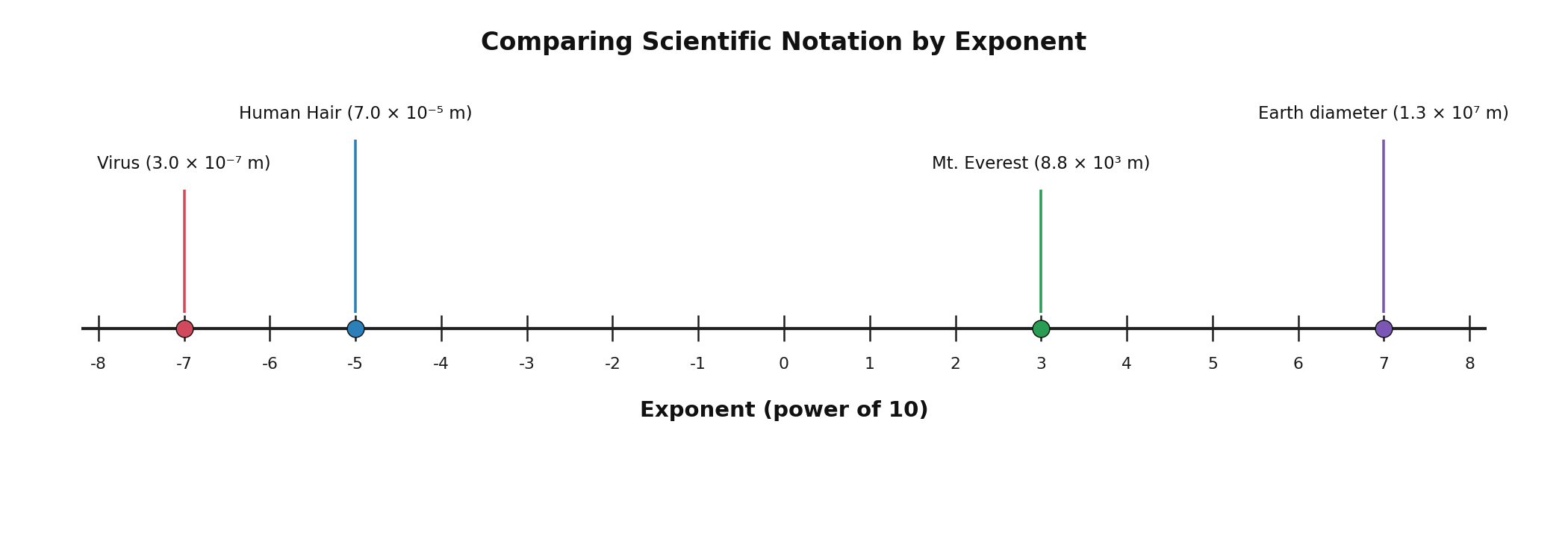
From a virus to a planet, four tidy expressions tell the whole story. If two of these objects had shared the same exponent, we would simply compare their coefficients to break the tie — exactly as Step 2 prescribes.
Common Pitfalls
A few mistakes come up regularly when comparing numbers in scientific notation. Spotting them ahead of time makes them easy to avoid:
- Focusing on the coefficient first. Seeing next to makes it tempting to declare larger overall. But when the exponents differ, the coefficient is irrelevant — always check exponents first.
- Mixing up negative exponents. The value is larger than , even though looks like the "bigger number" at a glance. On a number line, sits to the right of , so it is the larger exponent.
- Forgetting to compare coefficients when exponents match. Two numbers that share the same exponent are not automatically equal — you still need to check which coefficient is greater.
Conclusion and Next Steps
In this lesson, we learned a clean two-step strategy for comparing numbers in scientific notation: compare the exponents first, and only move on to the coefficients when the exponents match. We applied this method to real-world quantities spanning from the length of a virus to the diameter of Earth, and we highlighted one key detail — with negative exponents, the less negative value is the larger one.
Up next, you will put this strategy to work in a set of hands-on exercises. You will fill in comparison symbols between pairs of numbers, decide which of two real-world quantities is larger, and sort entire lists of measurements from smallest to largest. By the end of practice, comparing numbers in scientific notation should feel just as natural as reading them.
