Writing Large Numbers
Introduction
Welcome back to Scientific Notation in Real Life! This is our second lesson out of six in the course, so we are off to a strong start. In Lesson 1, we learned how to read scientific notation — picking apart the coefficient and the power of ten, checking for proper form, and expanding expressions back into standard numbers. Now we are going to flip that skill around: given a large standard-form number, we will learn how to write it in proper scientific notation.
By the end of this lesson, you will be able to take a number like (the approximate distance from Earth to the Sun in kilometers) and express it neatly as a coefficient times a power of ten. Let's get to it!
Why Compress Large Numbers?
Think about how often you see big numbers in headlines: a country's population, a company's revenue, the distance to another planet. These numbers are packed with zeros that make them hard to read, compare, and use in calculations. Scientific notation strips away that clutter by separating the meaningful digits from the scale.
Converting a large number into scientific notation is really just the reverse of what we did in Lesson 1. Back then, we started with a compact expression like and expanded it to by moving the decimal to the right. Now we start with the long number and compress it back down. The entire task comes down to two questions: where does the decimal point go to create a proper coefficient, and how many places did it move?
Placing the Decimal to Form the Coefficient
Recall that proper scientific notation requires a coefficient satisfying . In practice, that means exactly one nonzero digit sits to the left of the decimal point.
To find the coefficient, locate the leftmost nonzero digit of the number and place the decimal point directly after it. For example, with the number :
- The leftmost nonzero digit is 4.
- Place the decimal right after it: 4.500000.
- Drop the trailing zeros: the coefficient is 4.5.
That is all there is to it. The coefficient captures the significant digits of the original number in a compact form.
Counting the Shifts to Find the Exponent
Once we have the coefficient, we need the power of ten. The exponent tells us how many places the decimal point traveled from its new position (right after the first digit) to where it originally sat (at the far right end of the whole number).
Let's continue with . In standard form the decimal point lives at the far right: We moved it to sit right after the 4, which means it shifted 6 places to the left. Each leftward shift corresponds to one power of ten, so the exponent is .
Here is the key rule: for large numbers, the exponent equals the number of places the decimal point moves to the left. Because the original number is larger than 10, the exponent is always positive.
A Complete Walkthrough
Let's pull the steps together and apply them to a real-world value. The average distance from Earth to the Moon is approximately 384,400 kilometers.
- Find the first nonzero digit. It is 3.
- Place the decimal after it to form the coefficient: .
- Count the places the decimal moved. From the original position at the far right of to just after the is 5 places.
- Write the result:
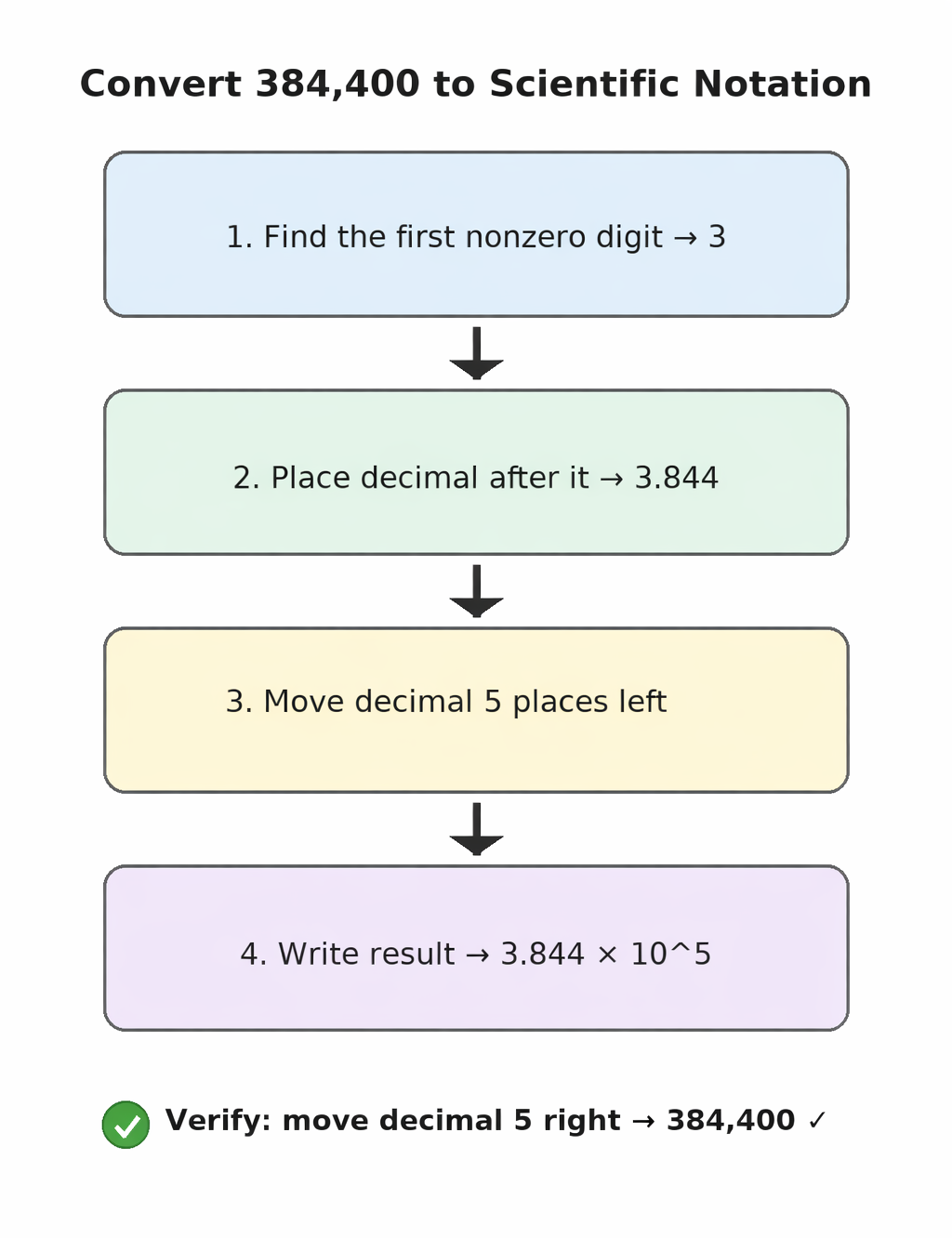
We can double-check by reversing the process from Lesson 1: move the decimal in five places to the right and we get . ✅
Practice with a Population
Let's try another example. Suppose a country has a population of 67,000,000 — roughly the population of France or the United Kingdom.
- First nonzero digit: 6.
- Coefficient: .
- Decimal shifts: from the end of to after the is 7 places.
- Result:
Notice how the coefficient is short and clean even though the original number is packed with zeros. That is exactly the convenience scientific notation provides.
The Conversion Process at a Glance
Here is the full process in table form, applied to the Earth-to-Sun distance of km:
| Step | Action | Example |
|---|---|---|
| 1 | Find the first nonzero digit | 1 |
| 2 | Place the decimal after it to form | |
| 3 | Count places the decimal moved | 8 places |
| 4 | Write |
A compact expression replaces nine digits — much easier to read, write, and compare.
Common Mistakes to Watch For
Before we wrap up, here are a few pitfalls worth keeping in mind:
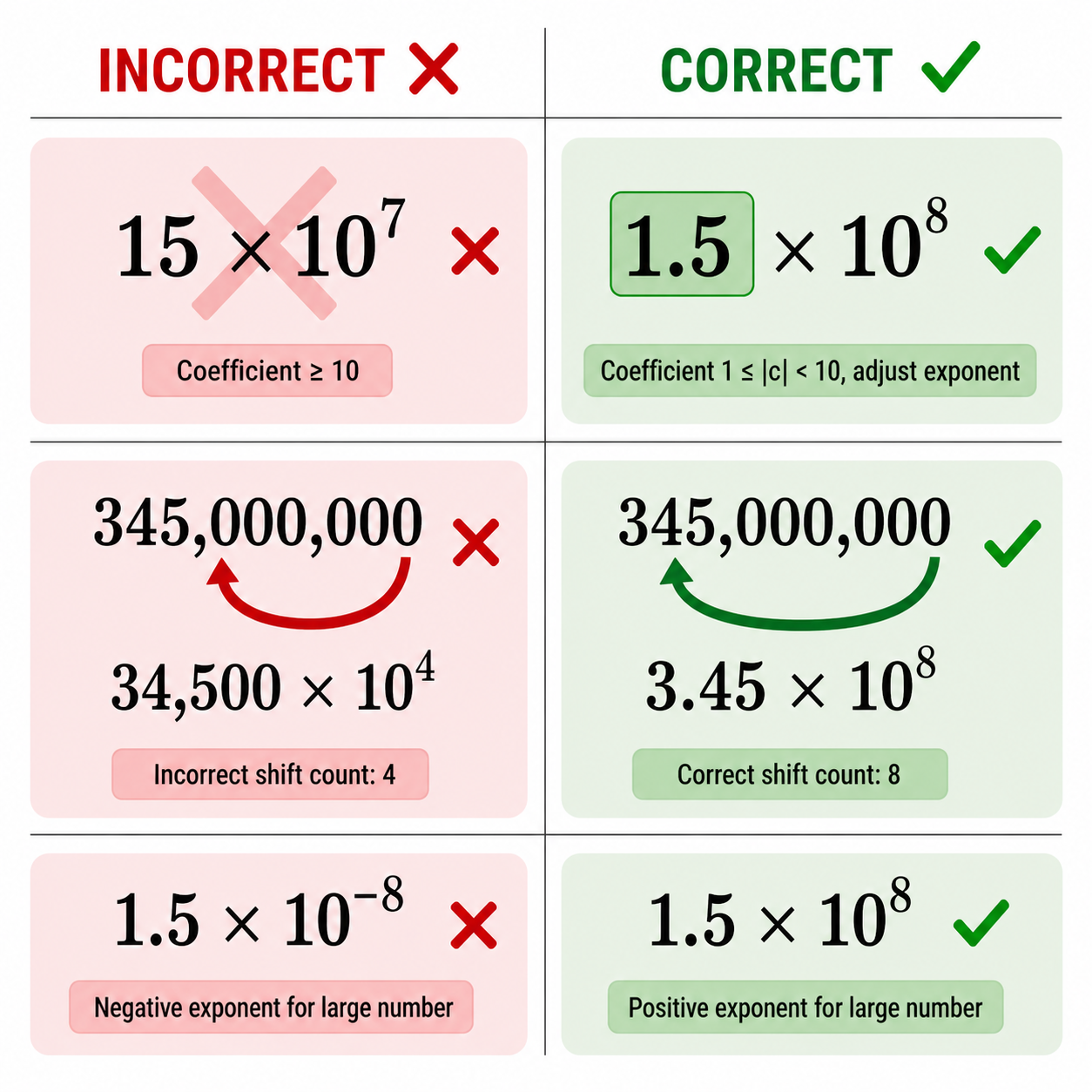
- Coefficient out of range. Writing instead of . If the coefficient is 10 or greater (or less than 1), the notation is not in proper form. Always verify that .
- Miscounting the shifts. A reliable trick is to number each digit position between the new decimal and the old one. For , count the five positions: .
- Using a negative exponent for a large number. Negative exponents belong to small numbers (less than 1). When the original number is greater than 10, the exponent is always positive.
Conclusion and Next Steps
In this lesson, we learned how to convert large standard-form numbers into proper scientific notation. The process has two core moves: place the decimal after the first nonzero digit to create a coefficient between 1 and 10, then count how many places the decimal shifted to determine the positive exponent. We practiced with real-world values like the Earth-to-Moon distance and national populations, and we reviewed the most common mistakes that can trip you up.
Up next are hands-on exercises where you will convert increasingly large numbers into scientific notation — from guided fill-in-the-blank warm-ups all the way to full conversions of truly massive quantities like light-year distances. Time to put those decimal-shifting skills into action!
