Reading Scientific Notation
Introduction
Welcome to Scientific Notation in Real Life! Over the previous two courses, we built a solid foundation with exponents and exponent rules. Now it is time to put those skills to work with one of the most practical tools in everyday mathematics: scientific notation.
In this first lesson, we will learn how to read scientific notation. By the end, you will be able to identify the parts of a scientific notation expression, decide whether it is written in proper form, and convert it back into a standard number. Let's get started!
Why We Need Scientific Notation
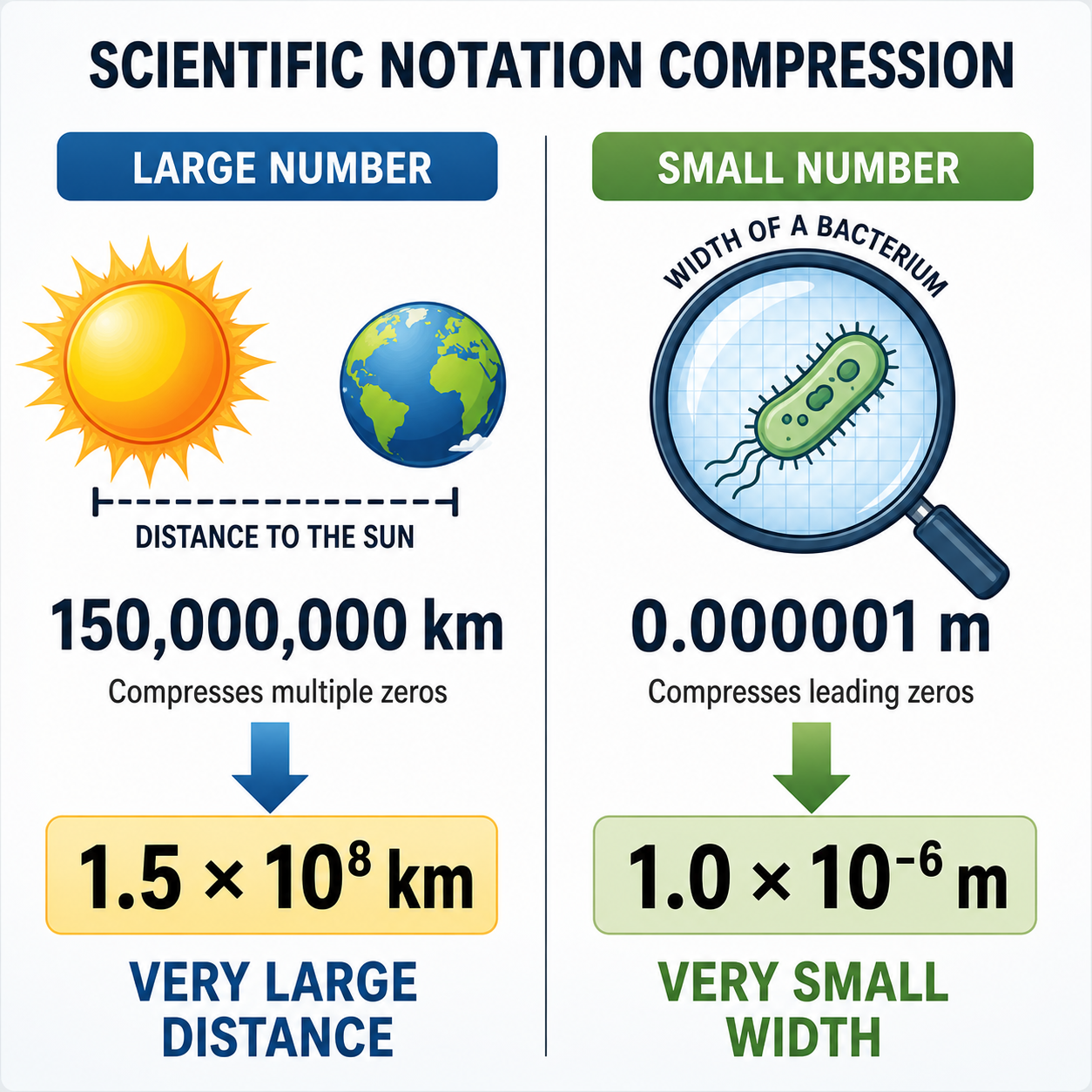
Consider the distance from Earth to the Sun: roughly 150,000,000 kilometers. Now think about the width of a single bacterium: about 0.000001 meters. Writing out all those zeros is tedious and easy to mess up. Scientific notation gives us a compact way to express numbers like these by pairing a short decimal with a power of ten.
As you may recall from the previous course on exponent rules, powers of ten act as a scaling tool: , , and . Scientific notation builds directly on that idea, so you already have the background you need.
The Anatomy of Scientific Notation
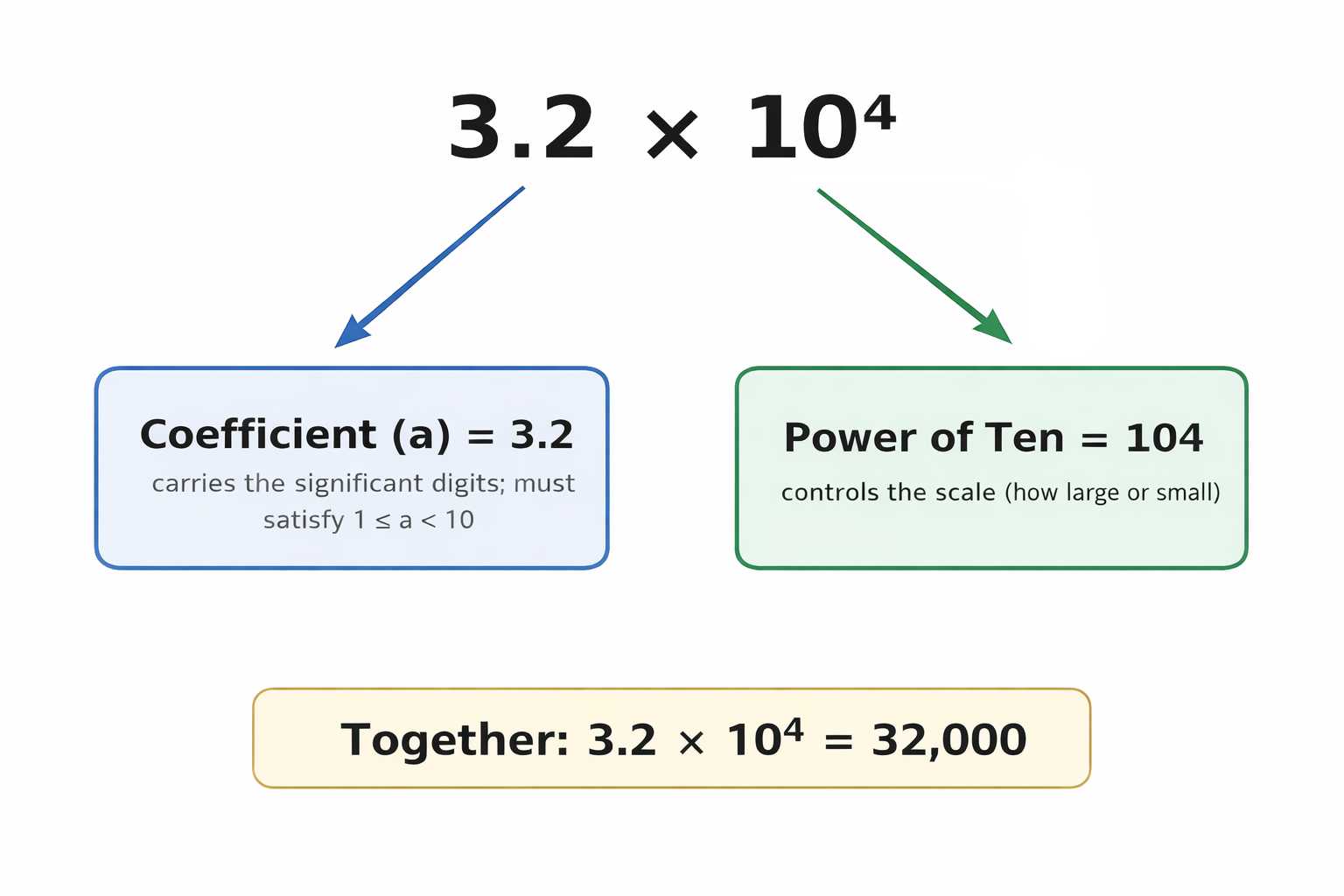
Every number written in scientific notation has exactly two parts:
- The coefficient () carries the significant digits of the number.
- The power of ten () tells us the scale — how large or small the number really is.
For example, in , the coefficient is 3.2 and the power of ten is . Together they represent the number 32,000. Think of the coefficient as the "what" and the power of ten as the "how big."
What Makes It "Proper"
Not every expression with a coefficient and a power of ten counts as proper scientific notation. For the notation to be proper, the coefficient must be at least 1 and less than 10:
Let's look at a few expressions side by side:
| Expression | Coefficient | Proper? | Reason |
|---|---|---|---|
| ✅ Yes | |||
| ❌ No | is less than | ||
| ❌ No | is not less than | ||
| ✅ Yes |
The key rule is simple: the coefficient should have exactly one nonzero digit before the decimal point. If there is more than one digit before the decimal point, or if the coefficient is less than 1, the expression is not in proper form.
Converting to Standard Form with Positive Exponents
Now that you can recognize proper scientific notation, let's convert it back into a regular number. When the exponent is positive, the original number is large, so we move the decimal point to the right.
Here is the step-by-step process for :
- Start with the coefficient: .
- The exponent is , so move the decimal point 3 places to the right.
- Fill in zeros where needed: .
So . The exponent tells you exactly how many places to shift.
Let's try a bigger example: the Earth's mass is approximately kg. Moving the decimal 24 places to the right produces a number with 25 digits — that wall of zeros is precisely why scientific notation is so useful!
Converting to Standard Form with Negative Exponents
When the exponent is negative, the original number is small, so we move the decimal point to the left instead. Recall from earlier work with negative exponents that means we are dividing by rather than multiplying.
Let's convert :
- Start with the coefficient: .
- The exponent is , so move the decimal point 5 places to the left.
- Fill in zeros: .
So . That is roughly the width of a human hair in meters — a number that is far easier to read in scientific notation! Here is a quick reference for the direction rule:
| Exponent Sign | Decimal Moves | Number Size |
|---|---|---|
| Positive () | Right | Large |
| Negative () | Left | Small |
| Zero () | No movement | Equal to the coefficient |
Conclusion and Next Steps
In this lesson, you learned how to read scientific notation by identifying its two parts — the coefficient and the power of ten — and checking whether the coefficient satisfies for proper form. You also practiced converting to standard form by moving the decimal point right for positive exponents and left for negative ones. These skills form the foundation for everything else we will explore in this course.
Now it is time to put what you have learned into action. The practice exercises up next will ask you to spot proper notation, trace the decimal-point movement step by step, and convert real-world measurements on your own. Once you feel confident reading scientific notation, the next lesson will flip the process around: you will learn to write large numbers in scientific notation from scratch.
