The Quotient Rule
Introduction
Welcome back to Rules of Integer Exponents! In the first lesson of this course, you learned the Product Rule — multiply same-base powers by adding exponents. In this second lesson, we explore its natural companion: what happens when we divide same-base powers? That's the Quotient Rule, and it's every bit as useful. By the end, you'll be able to simplify quotients of same-base powers quickly and confidently.
From Multiplying to Dividing
Recall that exponents count how many times a base appears as a factor. The product rule worked because multiplying same-base powers meant combining groups of identical factors into one larger group. Division is the reverse of multiplication, so dividing should remove factors instead of adding them.
Think of it this way: if putting groups together means adding exponents, then pulling a group away should mean subtracting exponents. With that intuition in mind, let's look at some concrete examples.
Cancelling Matching Factors
Consider . If we expand each power and write the division as a fraction, we get:
Each factor of in the denominator cancels with one factor of in the numerator, leaving . Let's try another example with base :
Notice the pattern: and . When we divide same-base powers, we subtract the denominator's exponent from the numerator's exponent. Cancelling matching factors in a fraction is exactly the same as subtracting exponents.
The Quotient Rule
Here is the general rule we just discovered:
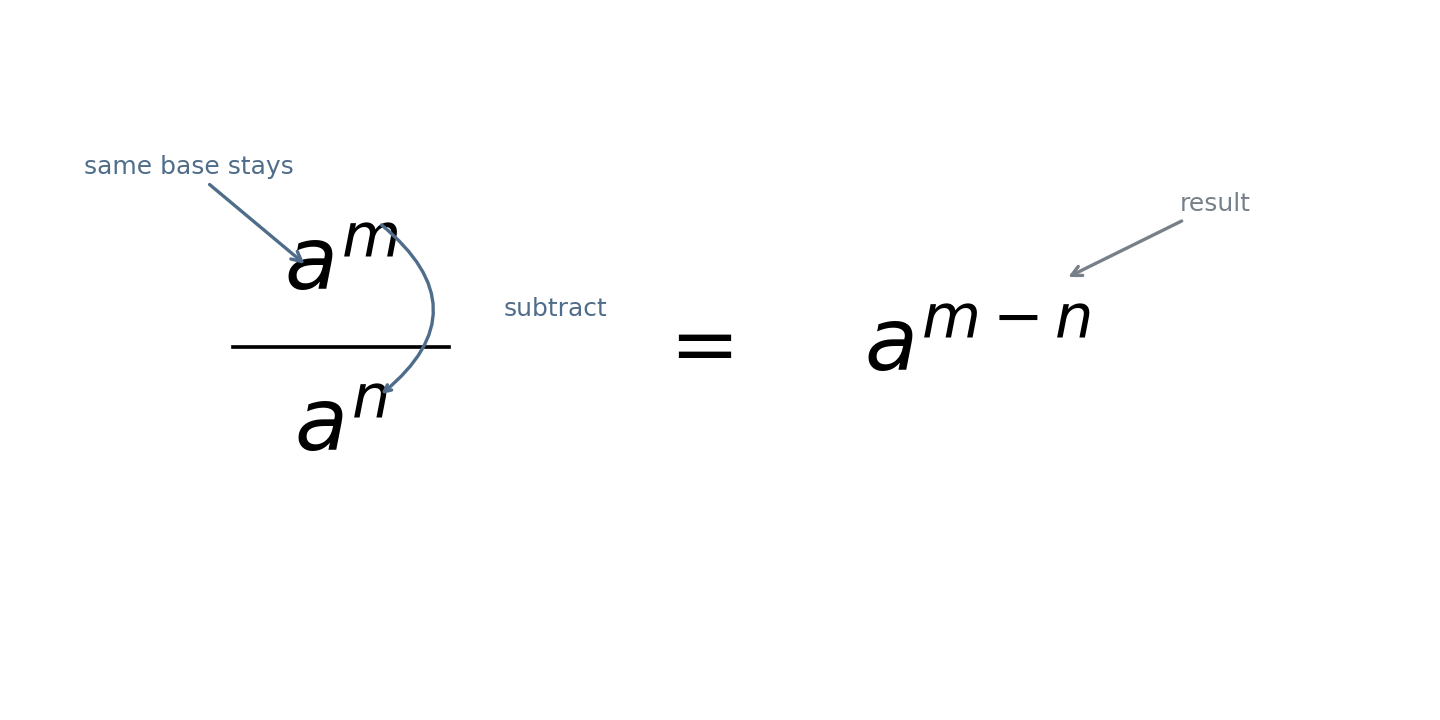
When dividing two powers that share the same nonzero base, keep the base and subtract the exponents. A couple of quick examples:
Just like the product rule, the bases must match for this shortcut to work. An expression like involves different bases, so the quotient rule does not apply and each power must be evaluated separately.
Zero and Negative Results
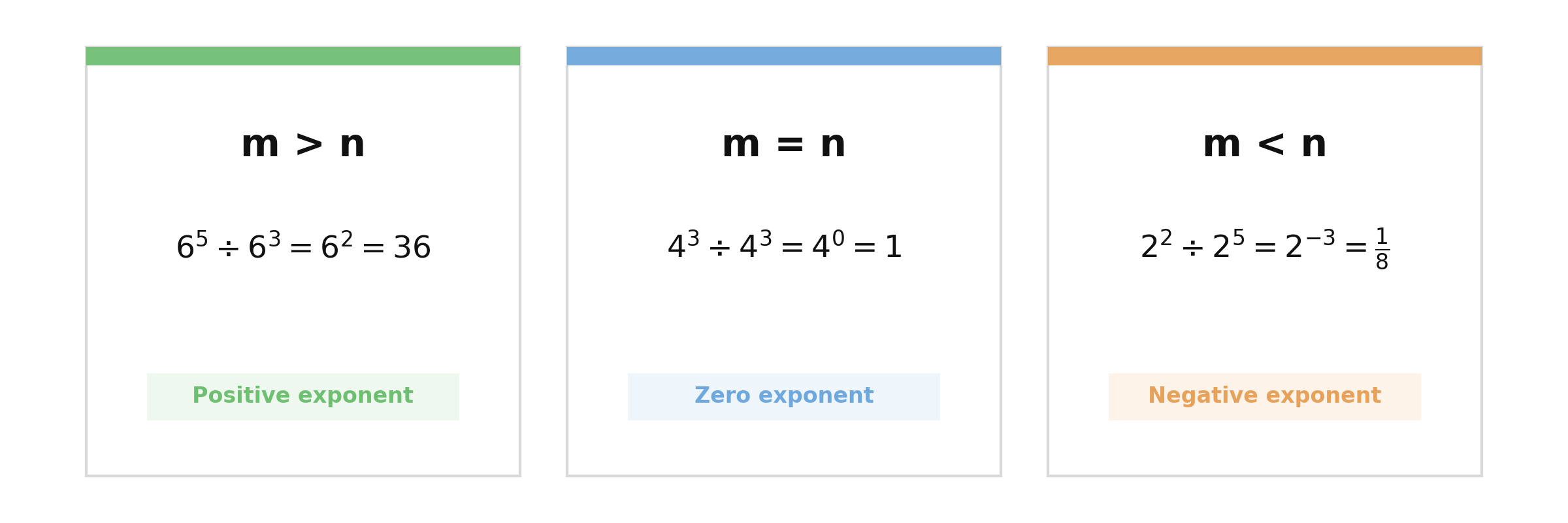
What happens when both exponents are equal? Let's try :
This makes perfect sense: any nonzero number divided by itself equals . As you may recall from the first course, for any nonzero base .
Now consider a case where the bottom exponent is larger:
The subtraction produces a negative exponent, which tells us to take the reciprocal. The quotient rule works seamlessly in all three situations:
| Expression | Subtract Exponents | Single Power | Value |
|---|---|---|---|
The rule also works when both exponents are negative. For example, . Subtracting a negative number is the same as adding its absolute value, so the result here is actually a larger, positive exponent.
Applying the Quotient Rule
The quotient rule shows up whenever you split a total into equal groups and both quantities are expressed as powers of the same base. Let's walk through two examples.
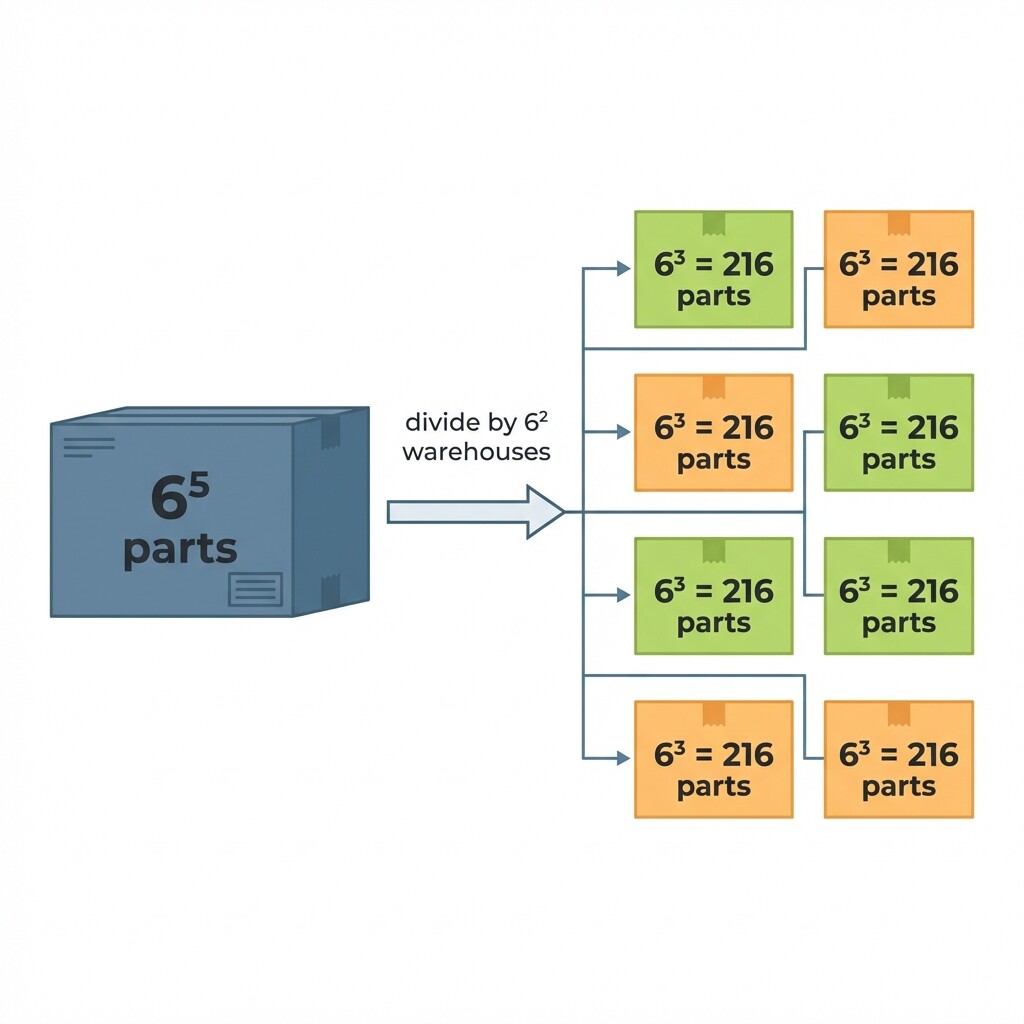
Logistics. A factory produces identical parts and ships them equally to warehouses. The number of parts each warehouse receives is:
Instead of computing the long way, we simply subtracted the exponents.
Computing. A file server holds kilobytes of data spread evenly across storage partitions. Each partition contains:
In both cases, the quotient rule turns a potentially large division problem into a quick subtraction.
Conclusion and Next Steps
Here's the key takeaway: when you divide two powers that share the same nonzero base, keep the base and subtract the exponents — . This shortcut comes directly from cancelling matching factors in a fraction, and it works whether the result is a positive, zero, or negative exponent. Together with the product rule from the previous lesson, you now have two powerful tools for simplifying exponent expressions.
Time to put the quotient rule to work! In the practice tasks ahead, you'll expand and cancel factors by hand, build speed with direct exponent subtraction, handle tricky zero and negative exponent cases, and tackle real-world problems from warehouse logistics to server memory to chemistry labs. Let's jump in!
