Power of a Power
Introduction
Welcome back to Rules of Integer Exponents! You've already added two essential exponent shortcuts to your toolkit: the product rule for multiplying same-base powers and the quotient rule for dividing them. Now past the halfway mark of this course, we tackle a new kind of expression: what happens when a power is raised to another power? This is the Power of a Power Rule, and together with the product and quotient rules, it completes the core set of exponent laws.
Stacking One Exponent on Another
So far, we've combined powers that sit next to each other in a multiplication or a division. But sometimes one power sits inside another. The expression tells us to take and raise that entire quantity to the second power — we're stacking one exponent on top of another.
This kind of structure shows up whenever a repeated process is itself repeated. Think of folding a piece of paper: each fold doubles the number of layers, so folding three times gives layers. If you then repeated that entire three-fold sequence twice, the layers would compound. Let's unpack what happens by expanding a few examples by hand.
Discovering the Rule Through Expansion
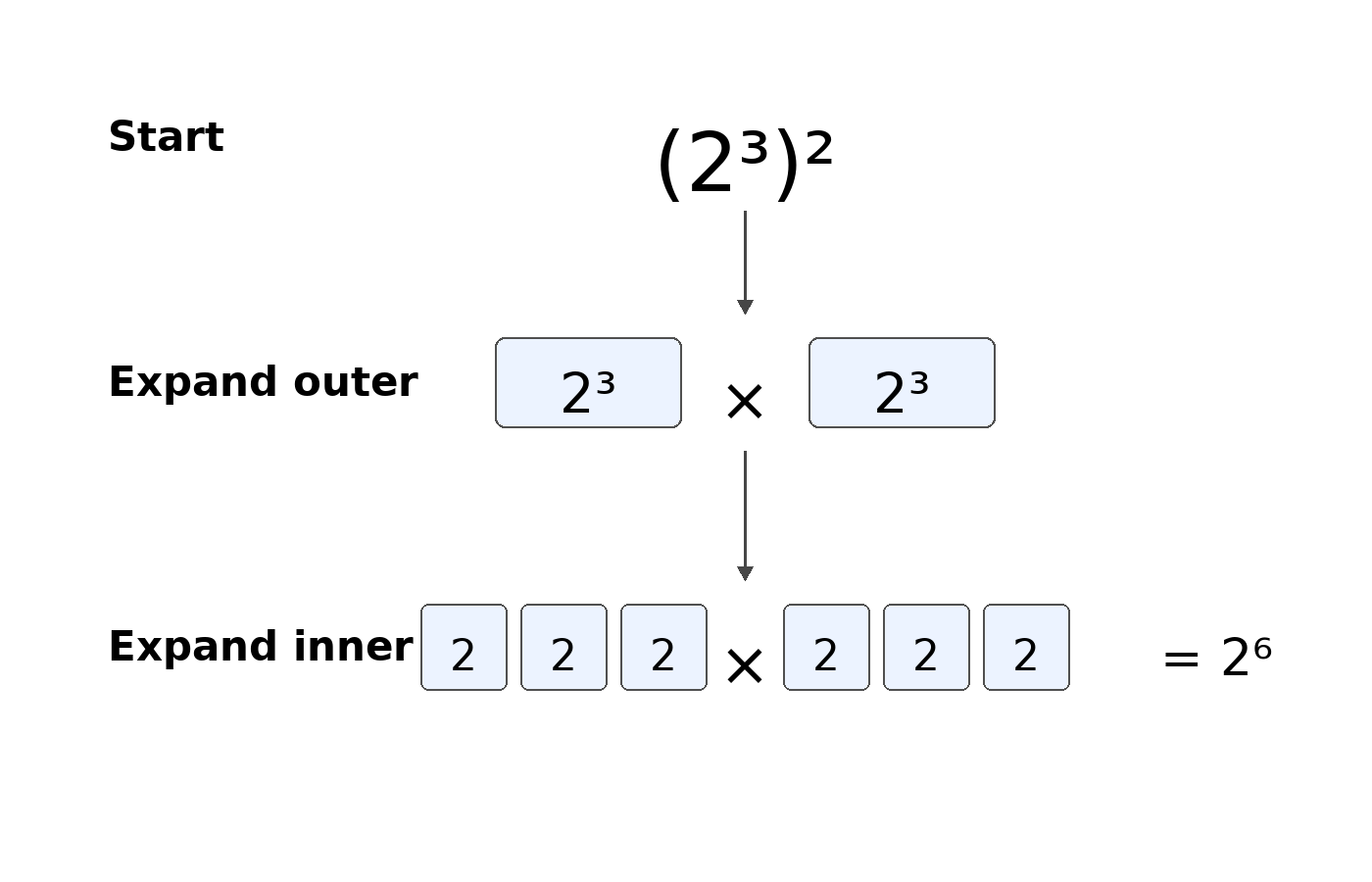
Let's start with . The outer exponent means we multiply the inner power, , by itself two times:
Now expand each into its individual factors:
We end up with six factors of , and sure enough, . Let's confirm the pattern with a second example:
Once again, . The inner exponent tells us how many factors are in each copy, and the outer exponent tells us how many copies we have. Multiplying those two counts gives the total number of factors.
The Power of a Power Rule
Here is the general rule we just discovered:
When a power is raised to another power, keep the base and multiply the exponents. A few quick examples:
| Expression | Multiply Exponents | Single Power | Value |
|---|---|---|---|
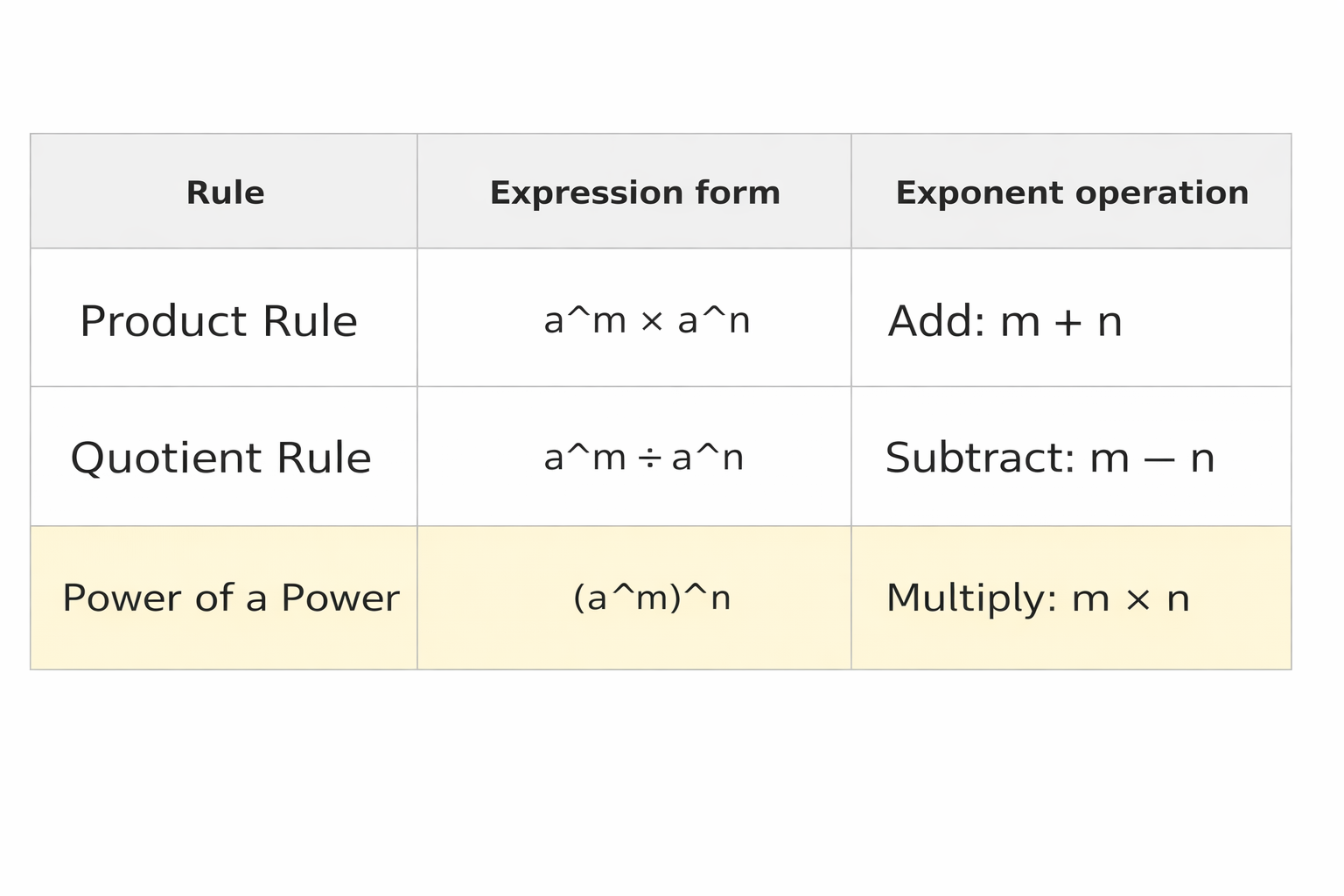
Notice how this rule fits alongside the two you already know:
- Product rule: same base, multiplying powers → add exponents
- Quotient rule: same base, dividing powers → subtract exponents
- Power of a power: raising a power to a power → multiply exponents
Each rule pairs a familiar operation on expressions with a simpler operation on their exponents.
Handling Zero and Negative Exponents
The rule holds whenever either exponent is zero. Because multiplying any number by zero gives zero, and any nonzero base to the zero power equals 1, the result is always 1:
The power of a power rule still applies when one or both exponents are negative — we just multiply them using the sign rules you already know from arithmetic. Consider . Multiplying the exponents gives :
We can verify by expanding: . ✓
Here are two more examples with mixed signs:
| Expression | Multiply Exponents | Single Power | Value |
|---|---|---|---|
A positive times a negative exponent gives a negative result (a fraction), while a negative times a negative gives a positive result (a whole number or a large power). The sign rules carry over directly.
Applying the Rule to Real-world Problems
The power of a power rule appears naturally whenever we square or cube a quantity that is already expressed as a power. Let's look at two quick examples.
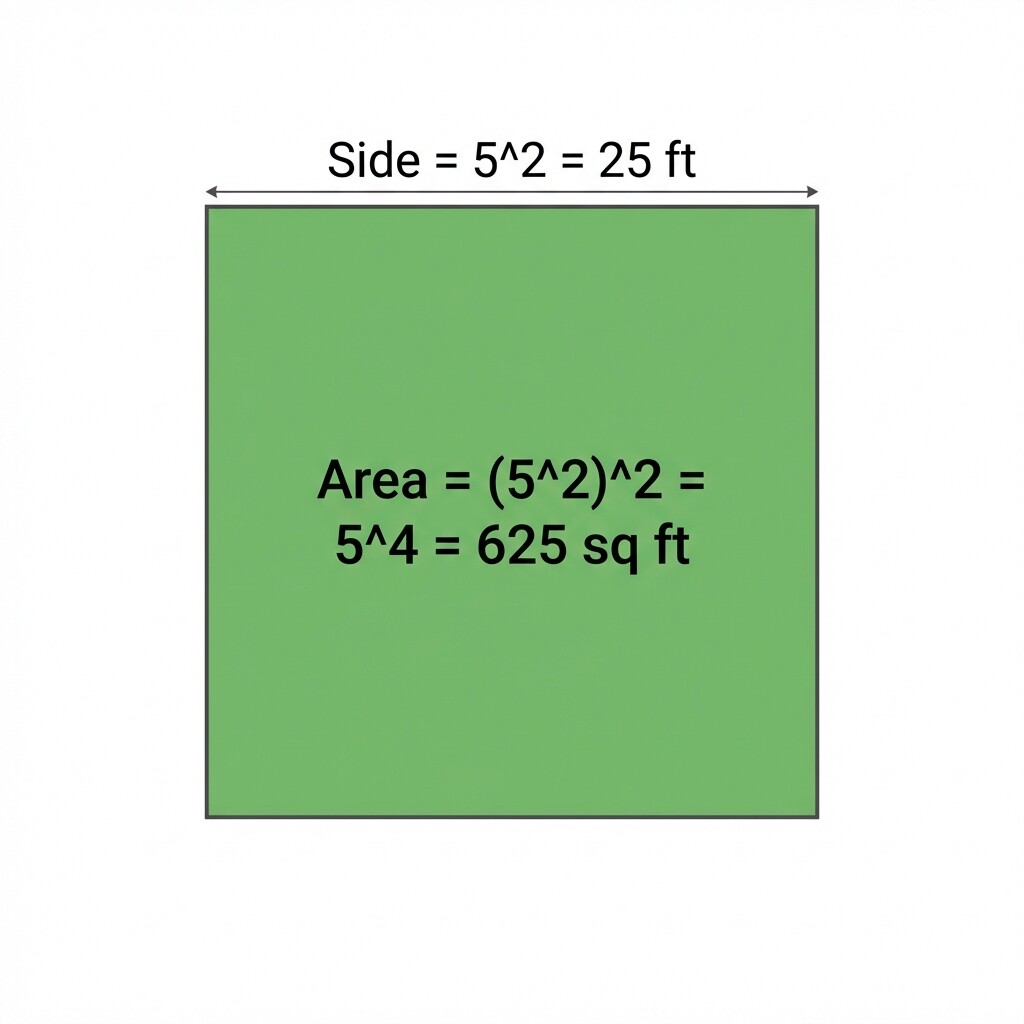
Area of a square garden. A garden plot measures feet on each side. To find the area, we square the side length:
Instead of computing by hand, we multiply the exponents and evaluate a single power.
Volume of a storage cube. A cubic shipping container has an edge length of centimeters. Its volume is the edge length cubed:
In both cases, stacking one exponent on another captures the idea that a repeated measurement is being repeated again — side length becomes area, or edge length becomes volume. The power of a power rule turns that layered calculation into a single, quick multiplication of exponents.
Conclusion and Next Steps
Here's the key takeaway: when a power is raised to another power, keep the base and multiply the exponents — . This works for positive, zero, and negative exponents alike. Combined with the product rule and the quotient rule from the first two lessons, you now have the complete set of core exponent laws.
Up next, you'll put this rule to the test! The practice exercises will walk you through hands-on expansions, direct exponent multiplication, negative exponent challenges, and real-world scenarios spanning digital imaging, chip engineering, and pharmacy. Let's get to it!
