Powers of Ten
Introduction
Welcome to the final lesson of Rules of Integer Exponents! Over the past three lessons, you built up a powerful toolkit: the product rule for multiplying same-base powers, the quotient rule for dividing them, and the power of a power rule for simplifying nested exponents. Now we turn our full attention to one very special base: 10. Because our entire number system is built on ten, powers of 10 follow an especially clean and practical pattern — one that shows up everywhere from metric conversions to scientific measurements. Let's explore it together.
Why Ten Deserves Its Own Spotlight
You might wonder why we are dedicating an entire lesson to a single base. The reason is that we use a base-ten number system. Every time you write a number like 500 or 0.03, you are already working with powers of 10 behind the scenes. The digit positions in any number — ones, tens, hundreds, thousands — correspond to increasing powers of 10.
That tight connection means the exponent on 10 directly controls how a number looks in standard form: the number of zeros, the position of the decimal point, and the overall size of a quantity. Mastering this link will also prepare you for scientific notation, the topic of the next course in this learning path.
Positive Powers of Ten
Let's start with the familiar side. When we raise 10 to a positive integer exponent, we multiply 10 by itself that many times:
Notice the pattern: the exponent tells you exactly how many zeros follow the 1. For , you write a 1 followed by six zeros — that's (one million). This works because each additional factor of 10 simply appends one more zero to the result.
| Power | Standard Form | Name |
|---|---|---|
| Ten | ||
| One hundred | ||
| One thousand | ||
| Ten thousand | ||
| One hundred thousand | ||
| One million |
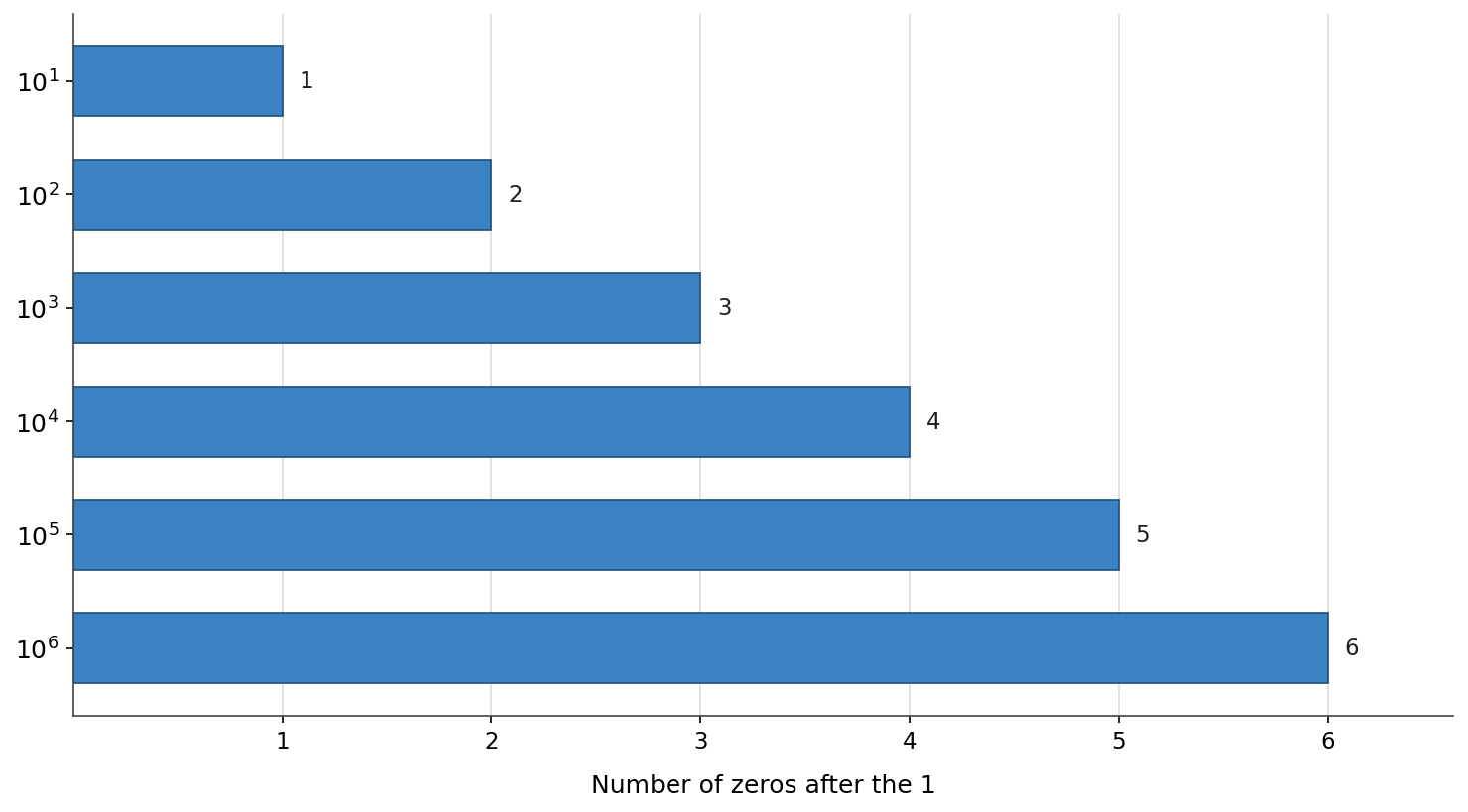
Quick rule for positive exponents: is a 1 followed by n zeros.
Zero and Negative Powers of Ten
As you may recall from the first course, any nonzero base raised to the zero power equals 1. So . This fits our pattern nicely: a 1 followed by zero zeros is just 1.
Now let's move into negative territory. From our earlier work with negative exponents, we know that a negative exponent means a reciprocal:
Here the pattern shifts to the right side of the decimal point. The absolute value of the exponent tells you how many places the digit 1 sits after the decimal point. For , the digit 1 is two places to the right of the decimal, giving . For , it is three places to the right, giving .
Negative Powers of Ten The 1 moves farther right of the decimal point
| Expression | Decimal Form | Description |
|---|---|---|
| 1 place | ||
| 2 places | ||
| 3 places |
Quick rule for negative exponents: is a decimal with the digit 1 in the nth place after the decimal point.
The Full Picture at a Glance
Putting both sides together, here is a reference table running from through :
| Power | Standard Form | How to Read It |
|---|---|---|
| One thousandth | ||
| One hundredth | ||
| One tenth | ||
| One | ||
| Ten | ||
| One hundred | ||
| One thousand | ||
| Ten thousand | ||
| One hundred thousand | ||
| One million |
As you move up the table (increasing exponent), each row is ten times larger than the one before it. As you move down (decreasing exponent), each row is ten times smaller. Think of the exponent as a dial that slides a number's size up or down by factors of ten.
Reading Round Numbers as Powers of Ten
So far we have gone from exponent to standard form. Now let's practice the reverse: given a round number, express it as a single power of 10.
For a large round number, count the zeros after the 1. The number has five zeros, so . Similarly, has seven zeros, so .
For a small decimal, count how many places the digit 1 sits to the right of the decimal point and make the exponent negative. In , the 1 is in the third decimal place, so . Likewise, has the 1 in the fourth place, giving .
Whenever you see a number that is simply a 1 surrounded by zeros — whether those zeros come before or after the decimal point — it can be written as a single power of 10. This skill becomes the foundation of scientific notation in the next course.
Powers of Ten in the Metric System
One of the most common real-world places you encounter powers of 10 is the metric system. Metric prefixes are literally named after powers of 10, so every unit conversion is just a matter of multiplying or dividing by the right power. Here are some widely used prefixes:
| Prefix | Meaning | Power of 10 | Example |
|---|---|---|---|
| kilo- | one thousand | 1 kilometer = meters | |
| centi- | one hundredth | 1 centimeter = meters | |
| milli- | one thousandth | 1 milligram = grams | |
| micro- | one millionth | 1 microgram = grams |
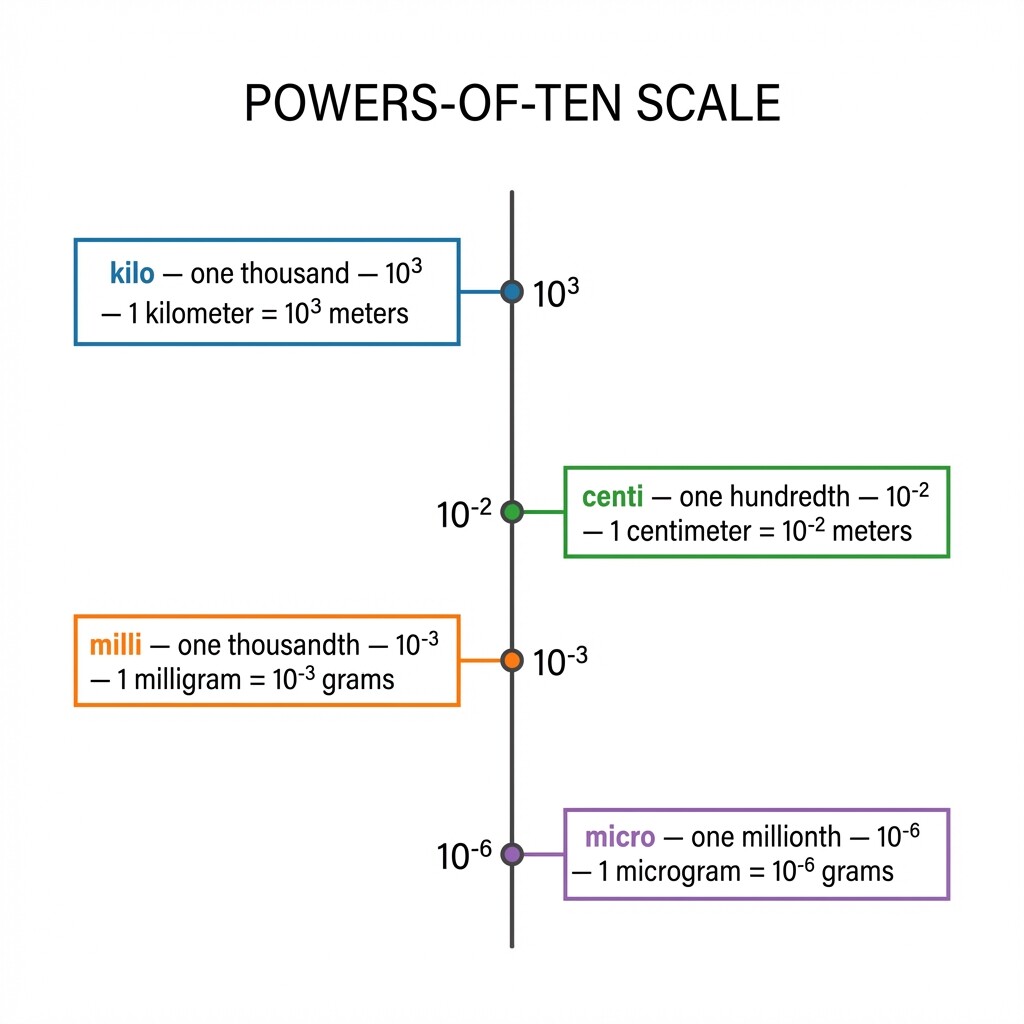
When someone says "a milligram," they are really saying grams. The prefix is the power of 10. Recognizing this makes converting between metric units far more straightforward — no memorized conversion factors needed, just exponent awareness.
Combining Powers of Ten with Exponent Rules
Because 10 is a base like any other, all the exponent rules from earlier lessons still apply. The product rule is especially handy when multiplying powers of 10:
For a quick example, suppose a clinical study uses grams of a substance per sample and prepares samples. The total amount needed is:
The quotient rule works just as smoothly. Imagine you have bytes of data and you split it equally among files:
The beauty of base 10 is that the answers always reduce to clean, familiar numbers. These quick calculations are at the heart of how scientists and engineers estimate quantities every day.
Conclusion and Next Steps
Here are the key ideas from this lesson. For positive exponents, gives a 1 followed by n zeros. For negative exponents, places the digit 1 exactly n places after the decimal point. And bridges the two sides neatly. Paired with the exponent rules from our earlier lessons, powers of 10 let you handle very large and very small numbers with ease.
With this lesson, you have completed all four topics in Rules of Integer Exponents: the product rule, the quotient rule, the power of a power rule, and now powers of ten. The upcoming practice exercises will have you filling in tables, matching everyday quantities to their powers, decoding metric prefixes, and working through a real-world dosage calculation. Time to put your powers-of-ten fluency to the test!
