The Product Rule
Introduction
Welcome to Rules of Integer Exponents, the second course in your learning path! In the previous course, you built a solid understanding of what exponents mean, how negative bases and signs behave, and what happens with zero and negative exponents. Now it's time to put that foundation to work and learn the shortcuts that make exponent arithmetic fast and efficient. In this first lesson, we focus on the Product Rule — the rule that tells you exactly what happens when you multiply two powers that share the same base.
Exponents Count Factors
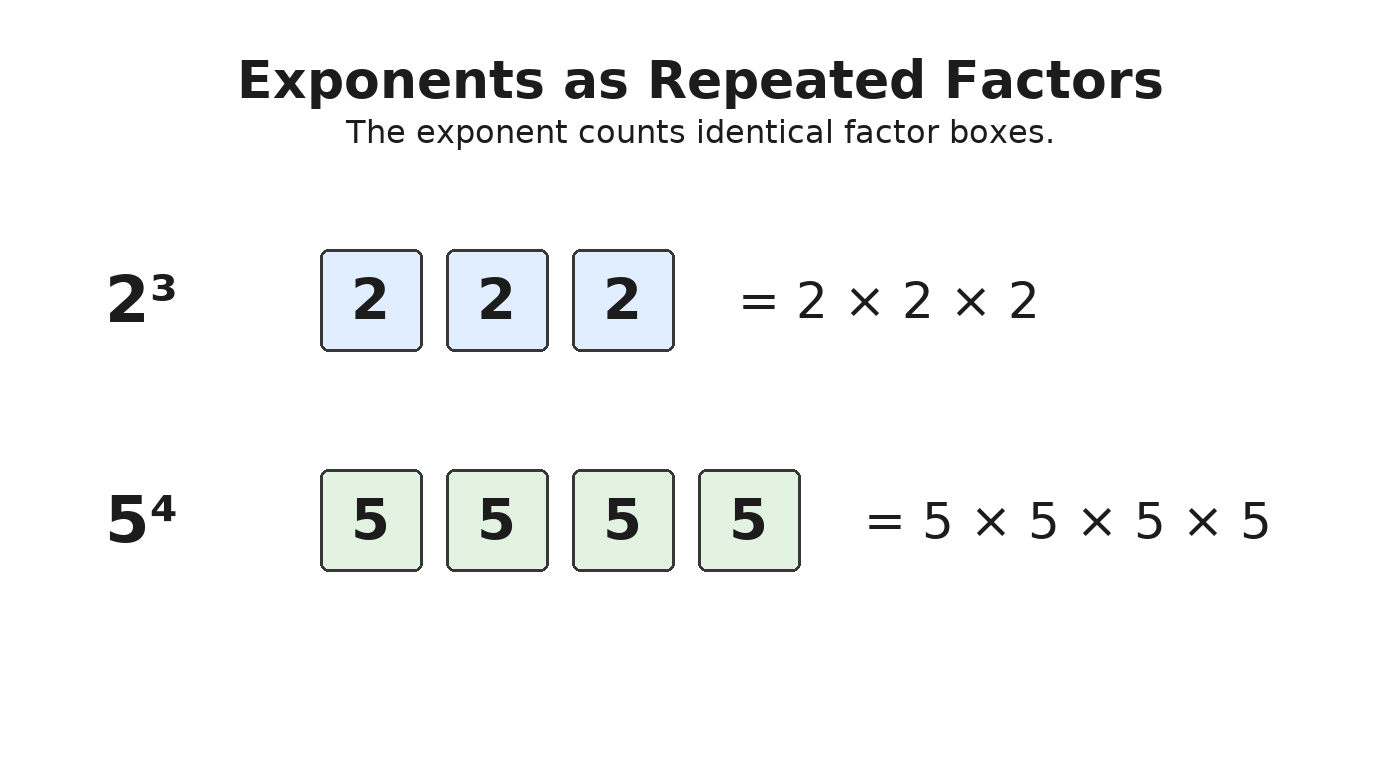
Before we introduce anything new, let's ground ourselves in one key idea. An exponent tells you how many times to use the base as a factor. For example, means (three factors of 2), and means (four factors of 5).
Keeping this "factor-counting" perspective front and center will make the product rule feel completely natural, because the rule is really just a shortcut for counting factors.
Discovering the Pattern
Let's see what happens when we multiply two powers that have the same base. Consider . Expanding each power into its factors gives us:
Three 2s from the first power plus two 2s from the second power gives five 2s in total. Now try the same idea with base 4:
Two 4s plus three 4s again gives five 4s. Do you see the pattern? When we multiply powers with the same base, the total number of factors equals the sum of the two exponents. We are simply combining two groups of identical factors into one larger group.
The Product Rule
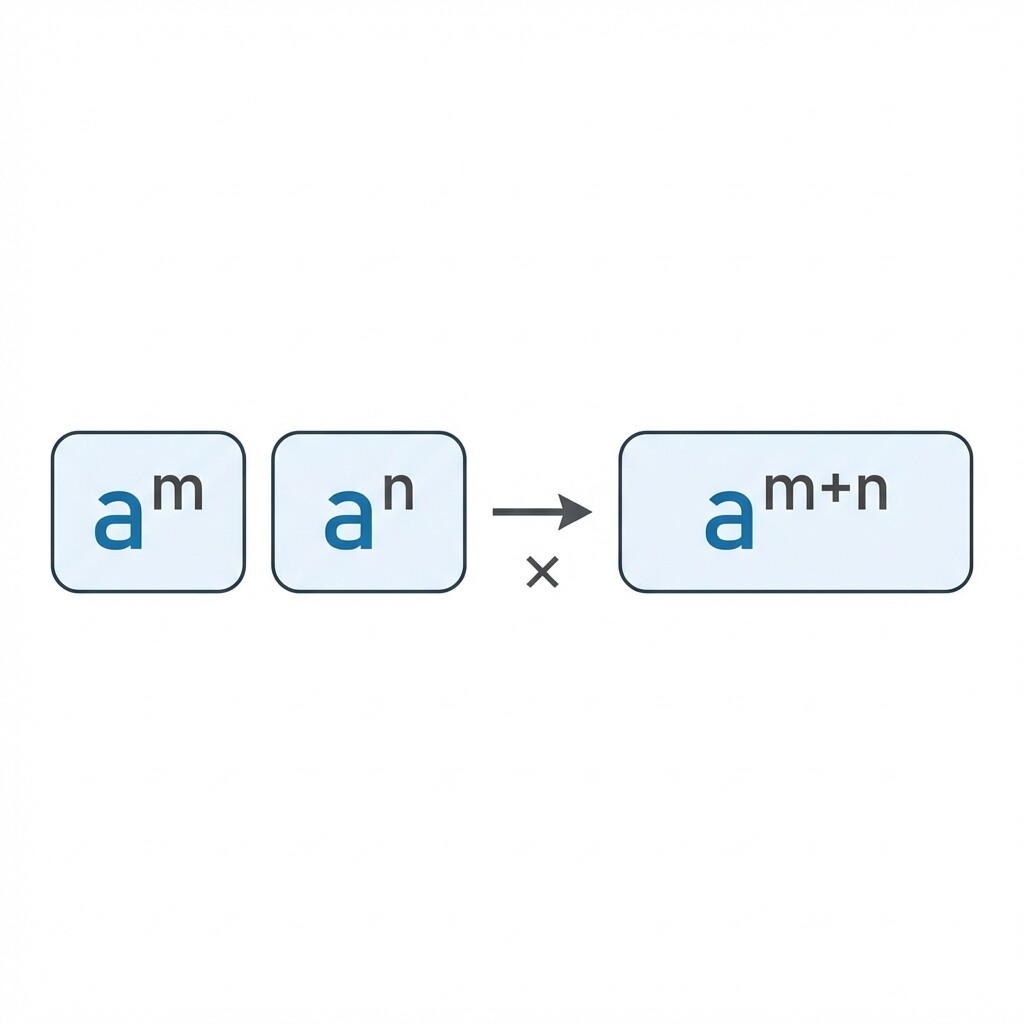
Here is the general rule we just discovered:
When multiplying two powers that share the same base, keep the base and add the exponents. A couple of quick examples:
⚠️ Common Mistake: When applying the product rule, students sometimes multiply the bases as well as add the exponents — for example, writing . This is incorrect. The base stays the same; only the exponents are added. The correct result is . Think of it this way: you are just counting up more factors of the same number, so the base never changes.
The rule extends naturally to three or more powers with the same base — just keep adding the exponents:
For example:
Four 2s, then three 2s, then two 2s — nine 2s total. The same logic applies no matter how many powers are in the product.
One important detail: the bases must be the same for this rule to apply. An expression like has different bases, so the product rule does not help simplify it — you would need to evaluate each power separately.
Extending to Zero and Negative Exponents
The product rule isn't limited to positive exponents. Recall that for any nonzero base, and a negative exponent gives a reciprocal (for instance, ). The great news is that the rule works exactly the same way — just add the exponents, even when they are zero or negative.
| Expression | Add the Exponents | Single Power | Value |
|---|---|---|---|
The last row makes intuitive sense: multiplying by doesn't change anything, so the exponent stays at 4. This consistency across positive, zero, and negative exponents is what makes the product rule so reliable.
Real-World Applications
The product rule shows up naturally whenever same-base quantities multiply together. Let's walk through three real-world scenarios.
Biology — bacterial growth. Suppose a biology student counts bacteria on a slide. After incubation, the colony grows by a factor of . The total count is:
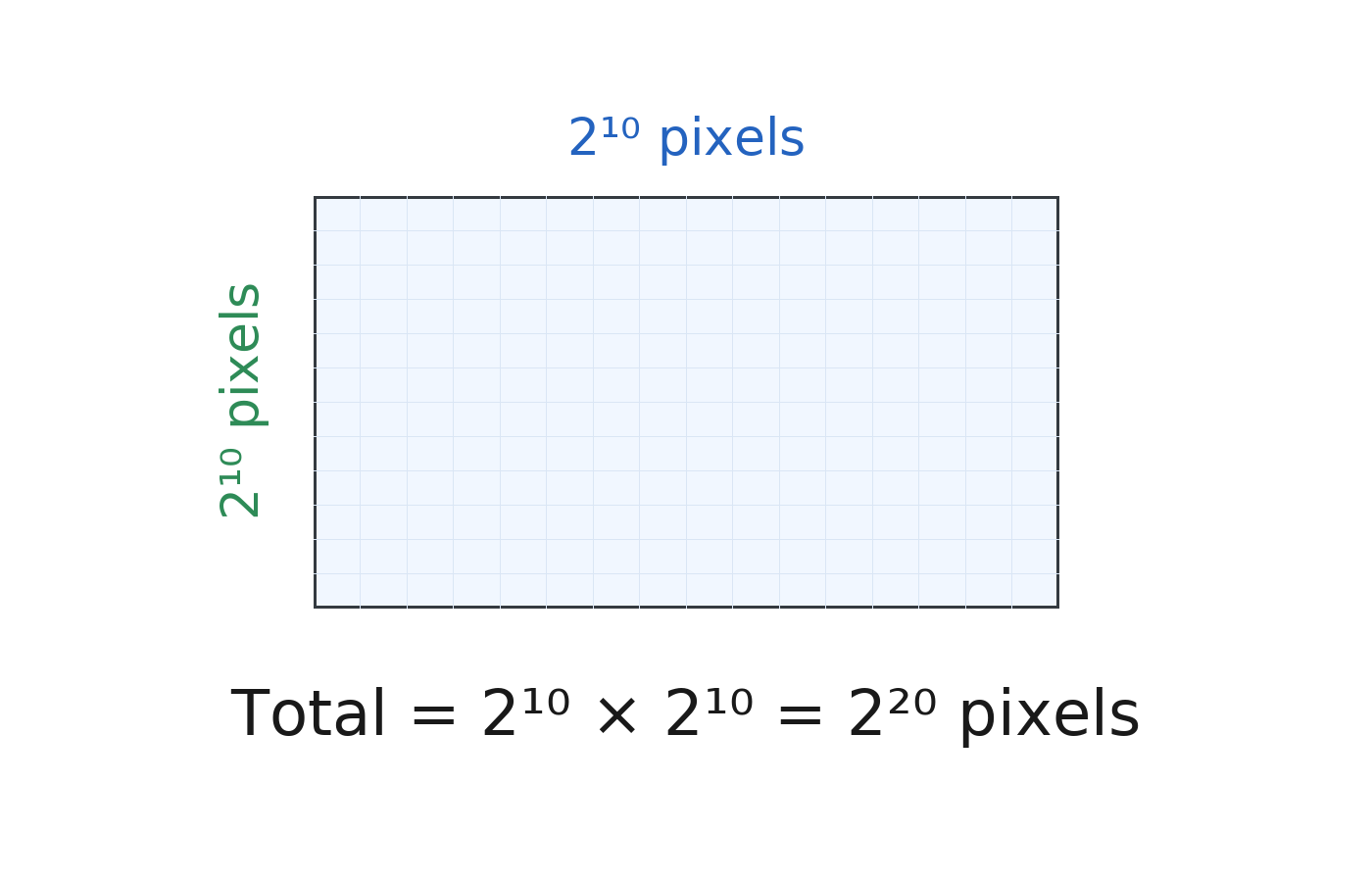
Technology — camera sensors. A camera sensor has pixels in each row and pixels in each column. The total pixel count is pixels — roughly one megapixel. Instead of multiplying large numbers, we just added the exponents.
Physics — mass of protons. A single proton has a mass of about kg, and a lab sample contains protons. The total mass is kg, which is kg. Here the rule handles a negative exponent and a positive exponent seamlessly.
In every case, the product rule saves you from writing out long chains of factors.
Conclusion and Next Steps
Let's recap the big idea. When you multiply two or more powers that share the same base, you keep the base and add the exponents: , and more generally . This shortcut follows directly from viewing exponents as a count of repeated factors, and it works whether the exponents are positive, zero, or negative.
Up next, you'll put the product rule into practice through a series of hands-on tasks. You'll start by expanding factors to see the rule in action, then build speed applying it directly, and finish by solving real-world problems in biology, technology, and physics. Let's dive in!
