Add Side Lengths Strategically
Introduction 🎉
Welcome to Add Side Lengths Strategically! This second lesson focuses on finding the perimeter of triangles and irregular polygons. Triangles and irregular shapes show up in many everyday measurements, from triangular garden plots to oddly shaped patios with six or seven edges. Because their sides do not always come in matching sets, you cannot rely on a single tidy formula. Instead, you will learn to identify every outer edge and add the side lengths strategically.
In this lesson, you will learn to:
- Calculate the perimeter of different types of triangles and irregular polygons.
- Add whole-number and decimal side lengths accurately.
- Trace boundaries systematically to ensure no outer edge is missed or counted twice.
🧠 From Formulas to Flexible Thinking
The shortcuts you learned for squares () and rectangles () both rely on the fact that certain sides are guaranteed to be equal. When that guarantee disappears, the shortcuts disappear too.
The good news is that the core idea behind perimeter has not changed at all: add up every outer side, and the total is the perimeter. With triangles and irregular polygons, there is no single tidy formula to memorize. Instead, our strategy becomes: list every boundary side, confirm the count, and sum them up. The math is simple addition — the real skill is making sure no side is missed and no side is counted twice.
🔺 Perimeter of Triangles
A triangle has exactly three sides. No matter what the triangle looks like, its perimeter is always:
Here , , and represent the three side lengths. The three common triangle types each offer a slightly different summing experience:
- An equilateral triangle has three equal sides, so — a quick multiplication, much like the square shortcut.
- An isosceles triangle has two equal sides and one different side, giving , where is the repeated side and is the base.
- A scalene triangle has three unequal sides, so you can simply add all three: .
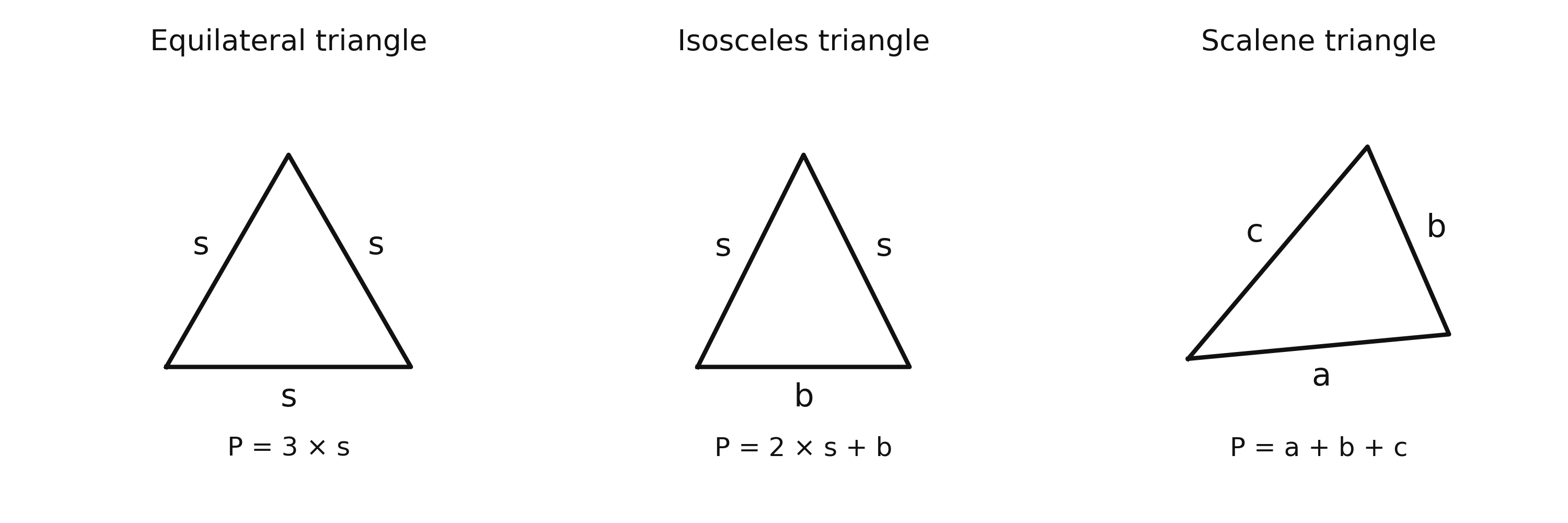
Example: A scalene triangle has sides of , , and .
No matter the type, the underlying idea is identical: add every outer edge. The equilateral and isosceles shortcuts simply save a small step when sides repeat.
📐Triangles with Decimal Side Lengths
Real-world triangles rarely have perfectly round measurements. A triangular garden plot might have sides of , , and . The formula does not change. You just need to be more careful with the addition.
Example: Find the perimeter of a triangle with sides , , and .
A useful technique is to split the addition into whole-number and decimal parts. First, add the whole numbers together (). Next, add the decimal portions (). Finally, combine the two totals (). Breaking the work into smaller steps makes the math easier to manage in your head.
If you prefer to write the addition out on paper, you can stack the numbers vertically. When doing this, the most important rule is to line up the decimal points exactly one under the other. This ensures you are adding tenths to tenths and whole numbers to whole numbers. Both methods work perfectly, and breaking the work down helps prevent errors, especially when more decimal places are involved.
Perimeter of Irregular Polygons 🧩
An irregular polygon is any polygon that is not regular — that is, its sides are not all equal, or its angles are not all equal, or both. Think of the floor plan of an L-shaped room or the outline of a yard that is not a simple rectangle. These shapes can have four, five, six, or more sides, and our approach stays the same — just with more terms to track:
In this formula, the small numbers are labels used to keep track of each individual side. You read it as "side one plus side two plus side three," continuing all the way to the final side, . The letter just stands for the total number of sides the shape has, which is a mathematical way of saying "keep adding until you run out of edges."
Example: An L-shaped patio has six sides with the following lengths: , , , , , and .
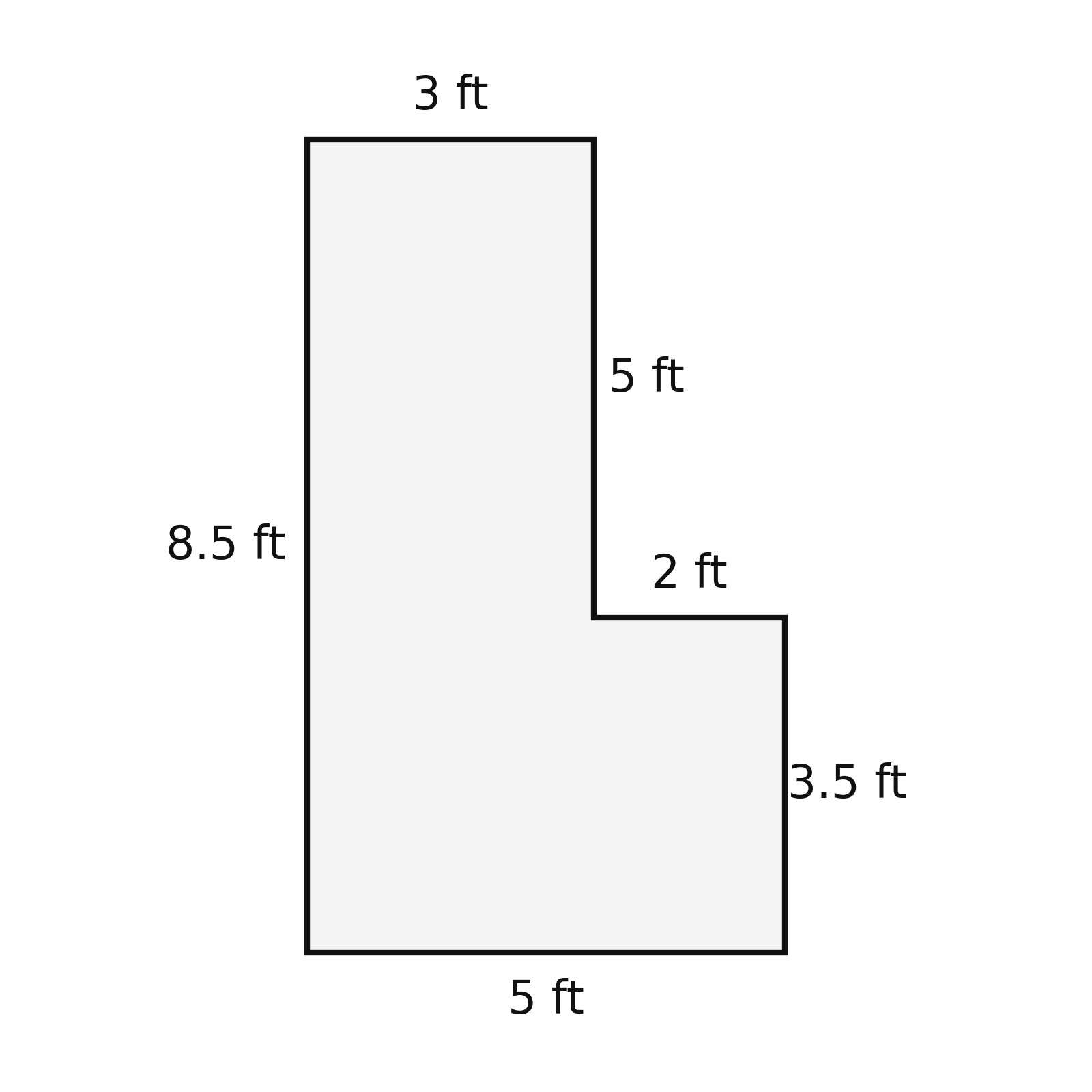
The most important step is counting the sides before you start adding. If a shape has six edges, you should see six numbers in your sum. This simple check catches mistakes before they happen.
⚠️ Avoiding Common Mistakes
With squares and rectangles, the structure of the formula kept you on track. With irregular shapes, there is more room for error. Two pitfalls come up again and again:
- Skipping a side. When a shape has many edges or an unusual layout, it is easy to overlook one. Always count the total number of sides first and verify that your addition has the same number of terms.
- Counting a side twice. When tracing a boundary, you might accidentally revisit an edge you already recorded, especially at corners where two sides meet. Mark or check off each side as you go to avoid duplicates.
A practical habit is to start at one corner and move consistently in one direction, either clockwise or counterclockwise, listing each side in order. This organized tracing makes it much harder to skip or double-count an edge.
📋 Formulas and Strategies at a Glance
Here is a compact summary of everything covered in this lesson:
| Shape | Sides | Perimeter Strategy |
|---|---|---|
| Equilateral triangle | 3 equal | |
| Isosceles triangle | 2 equal + 1 different | |
| Scalene triangle | 3 unequal | |
| Irregular polygon | Varies |
As always, every answer needs the correct linear unit attached — , , , and so on.
Conclusion and Next Steps
In this lesson, you moved beyond the neat formulas for squares and rectangles and learned to find the perimeter of triangles and irregular polygons by summing all boundary sides. For triangles, small shortcuts exist when sides repeat (equilateral and isosceles), but the core method is always . For irregular polygons, the same idea extends to as many sides as the shape has — the key is counting every edge exactly once.
Now it is time to put these skills to work! In the practice section ahead, you will identify which segments belong to a shape's boundary, trace perimeters interactively, calculate side sums for various triangles and polygons with whole-number and decimal lengths, and spot errors in someone else's calculation. Let's see how sharp your perimeter skills have become.
