Calculate Perimeter of Common Shapes
Introduction 🎉
Welcome to Perimeter and Circumference! This first lesson focuses on finding the perimeter of squares and rectangles. Squares and rectangles show up in many everyday measurements, from picture frames to garden beds. Because their equal sides create useful patterns, you can use shortcuts instead of adding every side one by one.
In this lesson, you will learn to:
- Use perimeter shortcuts for squares and rectangles.
- Calculate perimeters with whole-number and decimal side lengths.
- Label every perimeter answer with the correct linear unit.
📏 Thinking About Boundary Length
As you may recall from earlier lessons, perimeter is the total distance around the boundary of a flat shape. Imagine walking along the edges of a basketball court and counting every step until you return to where you started. The total distance you walked is the perimeter.
This idea is simple, but it is powerful: no matter how complex a shape looks, its perimeter is always found by adding up the lengths of all its outer sides. For squares and rectangles, you can do even better than adding side by side, because some of those sides are guaranteed to be equal.
🔲 Perimeter of a Square
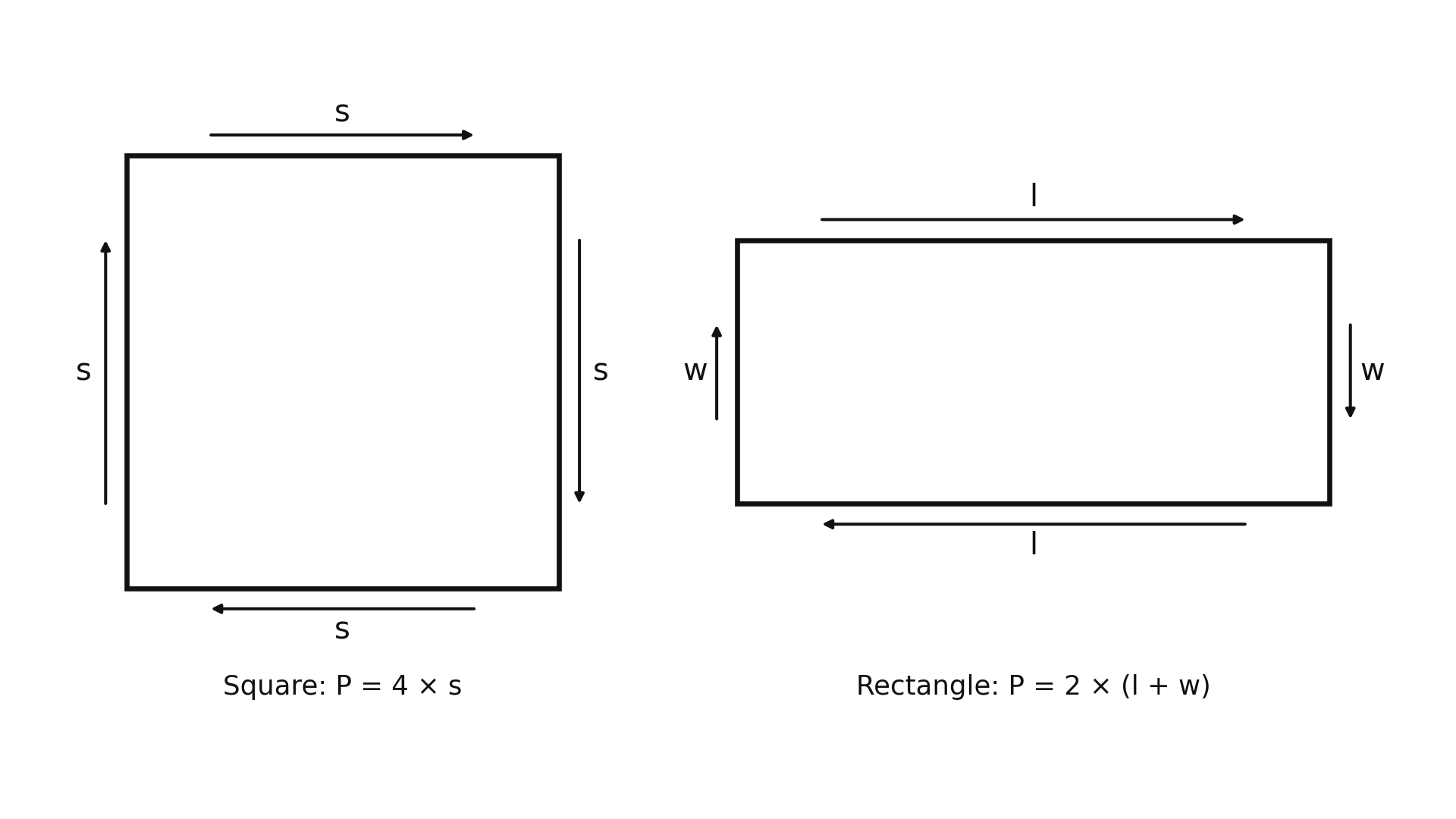
A square has four equal sides. If each side has length , you could add all four sides together:
Since every side is the same, multiplication gives you a cleaner shortcut:
For example, a square tile with a side length of has a perimeter of . This shortcut works exactly the same way for decimals; a side length of results in a perimeter of . Multiplication is faster and less error-prone than adding four numbers, whether the dimensions are whole or decimal.
🖼️ Perimeter of a Rectangle
A rectangle has two pairs of equal sides. The longer side is usually called the length (), and the shorter side is called the width (). If you added all four sides individually, you would get:
Grouping the matching pairs gives you a tidier formula:
Consider a desk that is long and wide. Its perimeter is:
Notice how the two different dimensions are added first, then the result is doubled. This two-step approach keeps the arithmetic simple and reduces the chance of mistakes.
Real measurements rarely come out to neat whole numbers. A photo might be by , or a floor tile could be on each side. The formulas stay exactly the same — you just need to be a bit more careful with the arithmetic. A helpful tip: when adding decimals, line up the decimal points (even if you are doing it mentally) so that tenths add to tenths and ones add to ones. This small habit prevents the most common arithmetic slips.
🏷️ Labeling with the Correct Unit
A number without a unit does not tell you much. If someone says the perimeter is "20," you cannot tell whether they mean inches, feet, or meters. Because perimeter is a length, the answer must always carry a linear unit such as , , , or .
Keep these rules in mind:
- Use the same unit that the side lengths are given in.
- If the sides are in different units, convert them to a single unit before adding.
- Never use square or cubic units for perimeter — those belong to area and volume.
| Measurement | Correct Unit Type | Example Label |
|---|---|---|
| Perimeter | Linear | , , |
| Area | Square | , |
| Volume | Cubic | , |
📋 Formulas at a Glance
Here are the two key formulas from this lesson, gathered in one place for easy reference:
| Shape | Property | Formula |
|---|---|---|
| Square | Four equal sides of length | |
| Rectangle | Length and width |
Both formulas work with whole numbers and decimals alike. The only things that change are the numbers you plug in.
Conclusion and Next Steps
In this lesson, you learned how the repeated sides of squares and rectangles turn perimeter into a quick calculation. For a square, multiply one side by four (). For a rectangle, add the length and width, then double the result (). These shortcuts work just as well with decimal dimensions, and every answer needs a proper linear unit to be complete.
Up next, you will put these skills into action through a set of hands-on practice tasks. You will fill in partially worked calculations, explore how changing dimensions affects boundary length in real time, tackle both whole-number and decimal problems on your own, and figure out how much trim is needed for a real picture frame.
