Welcome back to Percent Foundations for Everyday Life! We are already on the third lesson of the course, so our percent skills are building nicely. In the first lesson we explored what percentages mean in daily life, and in the second we learned to convert between percents and decimals using a two-place shift. Today we take the next logical step: converting percents to fractions.
By the end of this lesson, we will be able to rewrite any percent as a fraction in its simplest form — whole-number percents, decimal percents, and even percents greater than 100% — giving us yet another way to express and compare quantities.
Why Fractions Are a Natural Next Step
From Percent to Fraction in Two Steps
Join the 1M+ learners on CodeSignal
Be a part of our community of 1M+ users who develop and demonstrate their skills on CodeSignal
As we may recall from earlier lessons, a percent is simply a number "out of 100." That phrase already sounds like a fraction: 25% means 25 out of 100, which is 10025. Last time we divided that fraction to get a decimal (0.25). This time, instead of dividing, we will simplify the fraction itself.
Fractions like 41 are often easier to picture and work with than 25% or 0.25, especially when we want to see at a glance that something is "a quarter" of a whole. If a news headline says "75% of voters support the measure," thinking of that as 43 can make the size of that majority feel more concrete. Learning to move between percents and fractions gives us the flexibility to choose whichever form makes the math — or the message — clearest.
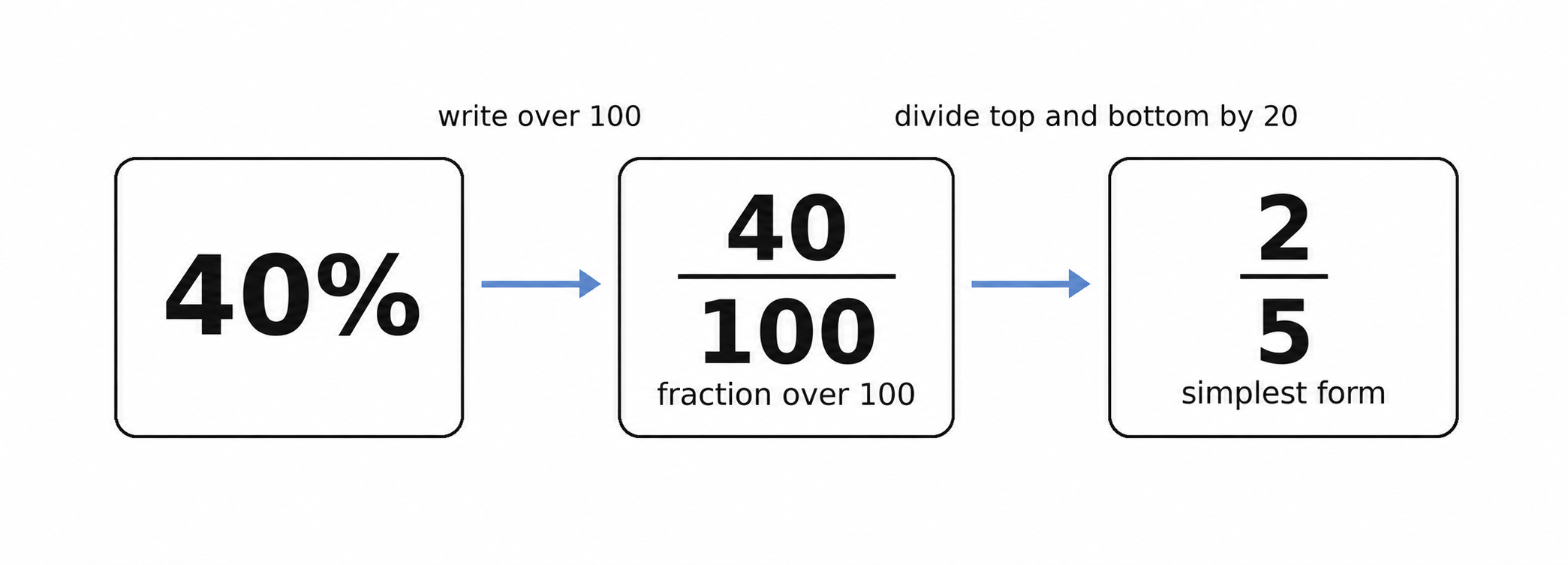
Every percent-to-fraction conversion follows the same two-step process: write the percent over 100, then simplify. The first step is straightforward — place the percent value over 100:
Percent%=100Percent
Here are a few quick examples of that first step:
Percent
Fraction over 100
40%
10040
75%
10075
6%
1006
The second step is where the real work happens: reducing the fraction to its simplest form. To simplify, we find the greatest common factor (GCF) of the numerator and denominator and divide both by it.
Let's walk through 10040:
The factors of 40 include 1,2,4,5,8,10,20,40.
The factors of 100 include 1,2,4,5,10,20,25,50,100.
The greatest factor they share is 20.
Divide both by 20:
10040=100÷2040÷20=52
So 40%=52. If spotting the GCF in one shot feels tricky, we can simplify in stages. For instance, divide 10040 by 2 to get 5020, then by 2 again to get 2510, and finally by 5 to reach 52. The result is the same either way.
Some percents come up so often that it is worth memorizing their fraction forms. These benchmark pairs act as mental shortcuts and will serve us throughout the rest of this course and beyond.
Percent
Fraction over 100
GCF
Simplest form
10%
10010
10
101
20%
10020
20
51
25%
10025
25
41
50%
10050
50
21
75%
10075
25
43
80%
10080
20
54
Notice that 50% is exactly one half and 25% is one quarter. These connections make it easy to visualize what a percent represents. If someone says "75% of the class passed," we can immediately picture three quarters of the class.
Not every percent reduces to a tidy benchmark. Let's practice with a few that require a closer look at common factors.
Example 1 — 35%:
10035→GCF of 35 and 100=5→100÷535÷5=207
Example 2 — 12%:
10012→GCF of 12 and 100=4→100÷412÷4=253
Example 3 — 18%:
10018→GCF of 18 and 100=2→100÷218÷2=509
Here is a helpful shortcut: since 100=2×2×5×5, the only prime factors of 100 are 2 and 5. So when we look for common factors with the numerator, we only need to check whether it is divisible by 2, 4, 5, 10, 20, 25, or 50. This narrows the search considerably and makes finding the GCF faster.
What if the percent itself has a decimal in it, like 7.5% or 0.5%? The recipe is still "write over 100, then simplify" — we just add one extra step at the start to clear the decimal from the numerator.
To clear a decimal, we multiply the numerator and the denominator by the same power of 10. If there is one digit after the decimal point, multiply by 10; if there are two digits, multiply by 100. This keeps the value of the fraction unchanged, since we are really multiplying by 1.
This is a useful benchmark to remember: 12.5%=81. We will see it again in later lessons.
Example 6 — 0.5%:
1000.5=10005→GCF=5→1000÷55÷5=2001
So 0.5%=2001, which lines up nicely with what we learned in Lesson 1: a percent below 1% describes a very small slice of the whole. As a sanity check, 2001 really is a tiny piece.
In Lesson 1 we saw that percents can climb above 100% — think of "sales rose 150% compared to last year." Converting these to fractions follows the same two-step process. The only thing that changes is the look of the result: when the percent is above 100%, the fraction will be greater than 1, which we call an improper fraction. We can also rewrite it as a mixed number if that feels clearer.
Example 7 — 150%:
100150→GCF=50→100÷50150÷50=23(or 121)
So 150% is the same as 23, or one and a half. That matches the idea that 150% is "more than one whole."
Example 8 — 120%:
100120→GCF=20→100÷20120÷20=56(or 151)
Example 9 — 250%:
100250→GCF=50→100÷50250÷50=25(or 221)
A quick gut check: any percent above 100% should produce a fraction with a numerator larger than the denominator. If our simplified fraction is less than 1, we know to look for an arithmetic slip.
Percentages and fractions describe the same idea — a share of a whole — so knowing how to switch between them helps us read and interpret real-world information. In survey reports, we might read something like "44% of respondents preferred Option A." Converting that to a fraction gives us a different perspective:
44%=10044→GCF=4→100÷444÷4=2511
So just under half of respondents — 11 out of every 25 people — preferred that option. Decimal percents show up in data too: "12.5% of customers chose the premium plan" becomes 81, which tells us exactly one in eight chose that plan. Throughout this learning path, we will continue to switch between percents, decimals, and fractions depending on which form communicates the idea most clearly.
In this lesson, we learned a reliable two-step method for converting any percent to a fraction: write the percent over 100, then simplify by dividing the numerator and denominator by their greatest common factor. We saw that benchmark percents like 25%, 50%, and 75% map to familiar fractions (41, 21, 43), and we practiced reducing less common percents like 35% and 18%. We also extended the same method to decimal percents (clear the decimal first, then simplify) and to percents above 100% (the result is an improper fraction or mixed number).
Now it is time to put this method into action! The upcoming practice exercises will take us from guided fill-in-the-blank conversions through benchmark matching and all the way to turning real survey data into simplified fractions, so let's dive in and make these conversions feel effortless.