Welcome back to Percent Foundations for Everyday Life! This is the fourth lesson in our course, which means we are halfway through. So far we have explored what percents mean in daily life, learned to shift between percents and decimals, and mastered turning percents into simplified fractions. Today we flip the direction: converting fractions to percents.
This skill comes up whenever information is given as a fraction and we need a percent to compare it with other data or communicate it more clearly. By the end of this lesson, we will know two reliable methods for making this conversion and will be able to handle fractions that produce clean results as well as ones that lead to repeating decimals.
Thinking in Reverse
In the previous lesson, converting a percent to a fraction meant writing the percent over 100 and simplifying. Going the other way, our goal is the opposite: start with a fraction and figure out how many hundredths it represents, since a percent is always a number out of 100.
Consider 43. We want to know what that fraction equals when the denominator is 100. If we can answer that question, we have our percent. There are two clean paths to get there, and we will learn both so we can pick whichever one is faster for a given fraction.
Method 1: Building an Equivalent Fraction over 100
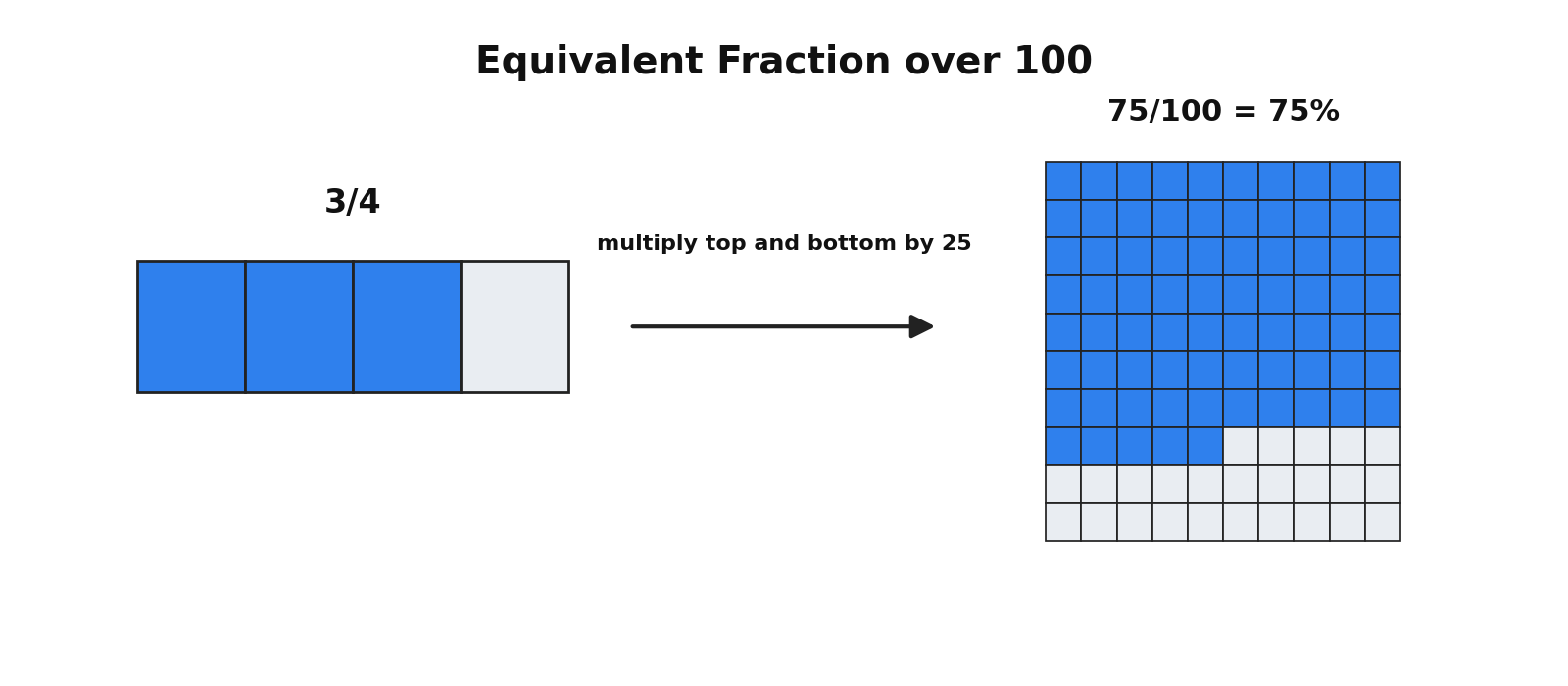
When the denominator of our fraction divides evenly into 100, we can rescale the fraction so the denominator becomes 100. The numerator then tells us the percent directly.
Here is the idea in a formula. If we find a whole number k such that denominator×k=100, we multiply both parts of the fraction by k:
ba=b×ka×k=100?
Example: Convert 43 to a percent.
Since 4×25=100, we use k=25.
Multiply the numerator by the same factor: 3×25=75.
So 43=10075=75%.
This method works neatly whenever the denominator is a factor of 100. The table below lists the denominators that qualify and the multiplier for each:
Denominator
Multiplier (k)
Denominator ×k
2
50
100
4
25
100
5
20
100
10
10
100
20
5
100
25
4
100
50
2
100
If the denominator appears on this list, rescaling is usually the quickest route to a percent.
Join the 1M+ learners on CodeSignal
Be a part of our community of 1M+ users who develop and demonstrate their skills on CodeSignal
Not every denominator divides evenly into 100. Denominators like 3, 6, 7, 8, or 9 are not factors of 100, so Method 1 does not produce a whole-number multiplier. In these cases we use a second approach: divide the numerator by the denominator to get a decimal, then multiply by 100 to convert that decimal to a percent.
ba⟶a÷b=decimal⟶decimal×100=percent
Example: Convert 83 to a percent.
Divide: 3÷8=0.375.
Multiply by 100: 0.375×100=37.5.
So 83=37.5%.
Notice that the "multiply by 100" step is the same two-place decimal shift we practiced in Lesson 2. This method works for every fraction, but it is especially valuable when the denominator does not fit neatly into 100.
In the previous lesson we memorized benchmark pairs going from percents to fractions. Now let's lock in those same relationships from the fraction side, so we can recall them instantly in either direction.
Fraction
Equivalent Fraction
Percent
21
2×501×50=10050
50%
41
4×251×25=10025
25%
43
4×253×25=10075
75%
51
5×201×20=10020
20%
52
5×202×20=10040
40%
53
5×203×20=10060
60%
101
10×101×10=10010
10%
These benchmarks are worth recognizing on sight. For example, if a recipe says to use 52 of a bag of flour, we can immediately think "that's 40% of the bag" without reaching for a calculator.
Some fractions produce decimals that go on forever. The fraction 31, for instance, gives 1÷3=0.3333…, a repeating decimal. When we multiply by 100 we get 33.333…%, which still repeats. In these cases we round to a practical number of decimal places. One decimal place is a common and useful choice.
Let's work through a few examples:
31: 1÷3=0.3333…→33.333…%→ rounded to 33.3%
32: 2÷3=0.6666…→66.666…%→ rounded to 66.7%
65: 5÷6=0.8333…→83.333…%→ rounded to 83.3%
71: 1÷7=0.142857…→14.2857…%→ rounded to 14.3%
Notice that for 32 we round up because the digit after the tenths place is 6 (which is 5 or greater). When rounding, always look at the digit immediately past the place we are keeping: if it is 5 or more, round up; otherwise, keep the digit as it is. It is also good practice to note that a rounded percent is an approximation, not an exact value.
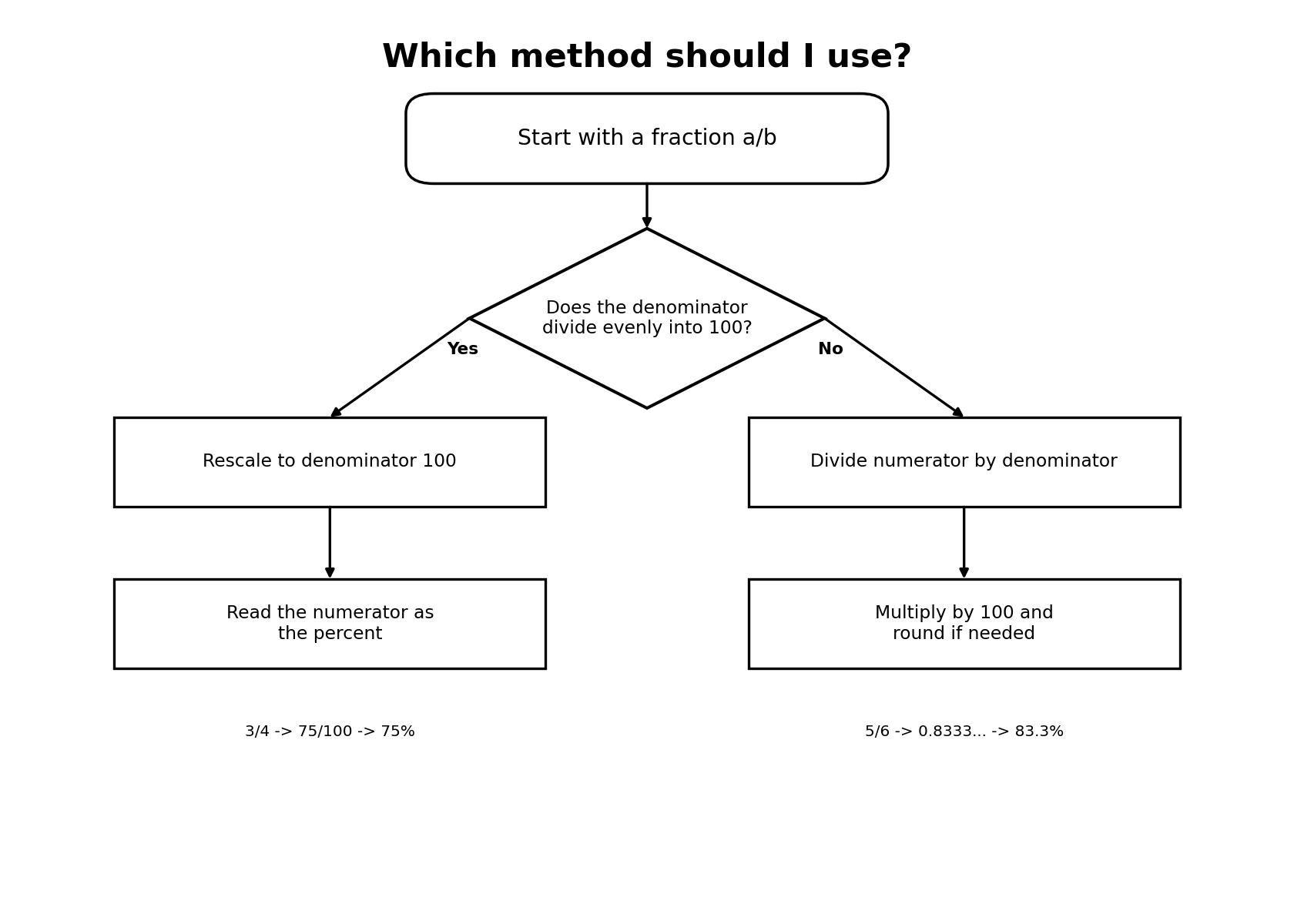
With two methods in our toolkit, how do we decide which one to use? A quick mental check of the denominator is all it takes:
Is the denominator a factor of 100? — that is, 2, 4, 5, 10, 20, 25, or 50? If yes, rescaling to 100 will be fast and exact.
Any other denominator (such as 3, 6, 7, 8, 9, 12, etc.)? Go straight to the division method.
For example, 54 has a denominator of 5, which divides into 100, so we multiply top and bottom by 20 to get 10080=80%. On the other hand, 65 has a denominator of 6, which does not divide into 100 evenly, so we divide: 5÷6≈0.8333, giving us about 83.3%. Building this habit of checking the denominator first saves time and keeps our work tidy.
Fractions appear on all sorts of everyday labels and descriptions. Imagine a clothing tag that reads "83 wool, 85 cotton." To understand those shares as percents, we apply the division method since 8 is not a factor of 100:
Wool:3÷8=0.375→37.5%
Cotton:5÷8=0.625→62.5%
A quick sanity check: 37.5%+62.5%=100%. The shares add up to the whole, which confirms our work. This kind of check is a great habit whenever the parts should cover the entire whole.
Whether we are reading nutrition labels, comparing survey results, or interpreting material compositions, converting a fraction to a percent puts numbers on a common scale and makes comparisons faster and clearer.
In this lesson we learned two methods for converting fractions to percents. Method 1 rescales the fraction so the denominator becomes 100, which works cleanly when the denominator is a factor of 100. Method 2 divides the numerator by the denominator and multiplies by 100, handling every fraction — including those that produce repeating decimals, where we round to a practical number of decimal places.
Up next, the practice exercises will put both methods to work. We will start by choosing the best method for a given fraction, complete benchmark conversions step by step, tackle repeating-decimal cases with rounding, and finish by converting real-world fraction labels into percents with written explanations of our reasoning. Let's jump in!