Benchmark Percent Mental Math
Introduction
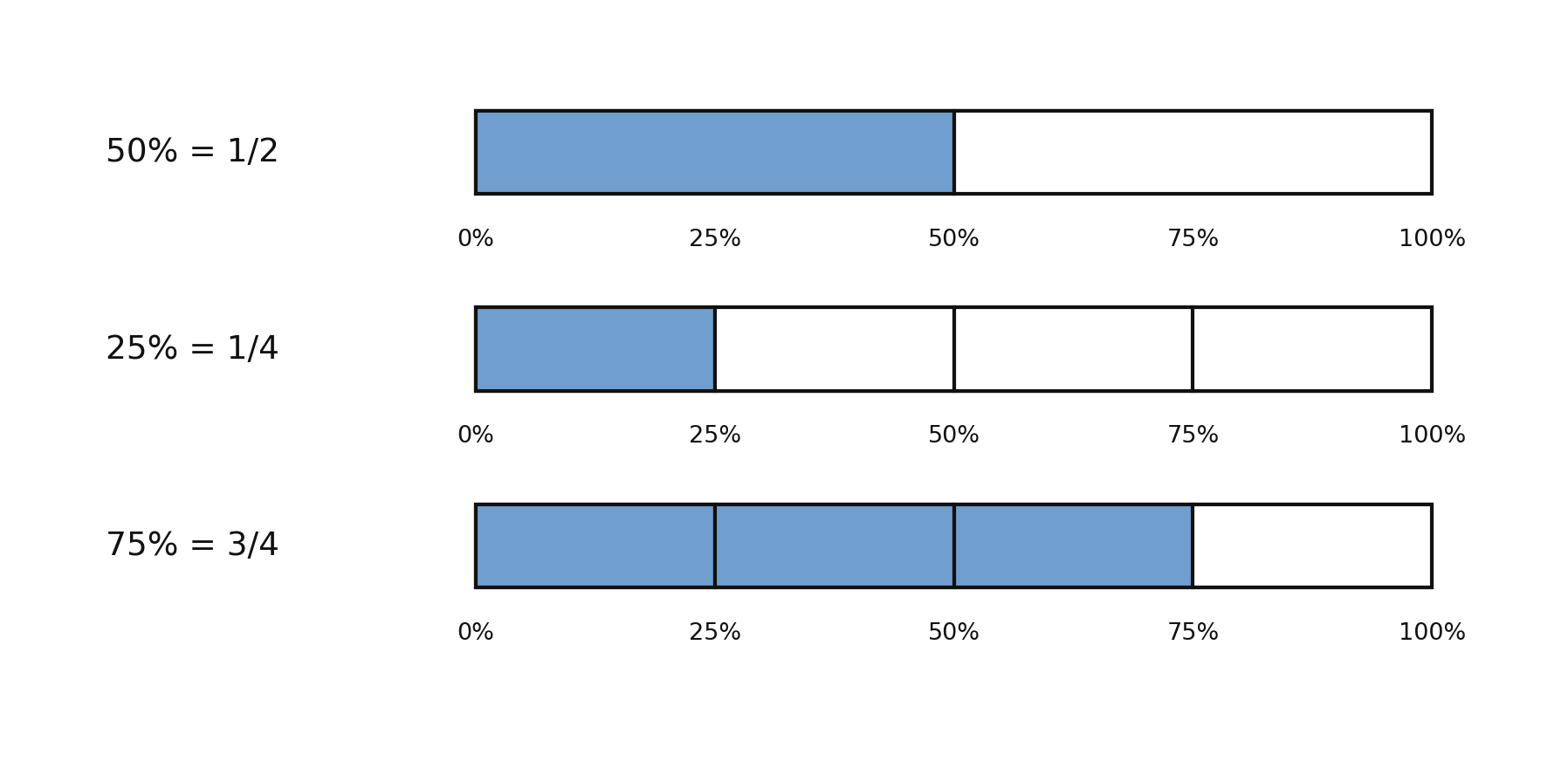
Welcome back to Percent Foundations for Everyday Life! With four lessons now under our belt, we have crossed the halfway mark of this course. We know how to interpret percents, convert fluently between percents, decimals, and fractions, and recall key benchmark pairs on sight. Today, in our fifth lesson, all of that groundwork pays off as we tackle Benchmark Percentages and Mental Math.
The goal is simple but powerful: learn to calculate common percents like , , , , , and of everyday amounts in our heads, and then combine those benchmarks to estimate less convenient percents without ever reaching for a calculator.
The Power of a Few Easy Percents
Think about how often percents pop up in daily life: a tip at a restaurant, a -off sale at a store, or a news headline about a rise in prices. In most of these situations, we do not need an exact answer down to the last cent. A quick mental estimate is enough to make a smart decision.
The trick is that almost any percent can be built from a handful of easy ones. If we can quickly find and of any number, we can combine those pieces to reach nearly any percent we need. The rest of this lesson shows exactly how.
Starting Point: 10% and 1%
A percent is a number out of , so finding of a number means taking , or , of it. In decimal terms, we multiply by . The shortcut? Move the decimal point one place to the left.
Finding works the same way, but we divide by instead of . That means moving the decimal point two places to the left.
Let's practice a few more to build the reflex:
| Amount | (÷ 10) | (÷ 100) |
|---|---|---|
No multiplication needed — we are just sliding the decimal point. These two benchmarks are the foundation for everything that follows.
Building 5% from 10%
Once we know , getting is one small step: take half of . Since is exactly half of , this makes perfect sense.
Here is another example with a larger number:
This "half of " shortcut is especially handy for quick tax or tip estimates. If we want to leave roughly extra on a $60 bill, we find ($6) and halve it ($3). Done in seconds.