Converting Percents and Decimals
Introduction
Welcome back to Percent Foundations for Everyday Life! This is the second lesson of the course, and we are picking up right where we left off. Last time, we built a solid understanding of what percentages mean and practiced reading them in everyday contexts. Now we are going to unlock a skill that comes up every time we use a calculator, read a spreadsheet, or double-check a receipt: converting between percents and decimals. By the end of this lesson, we will be able to move confidently in both directions, even with tricky values below or above .
Why Percents and Decimals Are Connected
We already know that a percent is simply a number "out of 100." Writing is the same as writing , and when we carry out that division, we get . So and are really two ways of expressing the exact same quantity — one wears a sign, and the other uses a decimal point.
This matters in practice because most tools expect one form or the other. A calculator needs the decimal form when we multiply, while a report for our manager looks cleaner with the percent form. The bridge between the two is always the number 100, and the rest of this lesson is about crossing that bridge quickly and accurately.
From Percent to Decimal
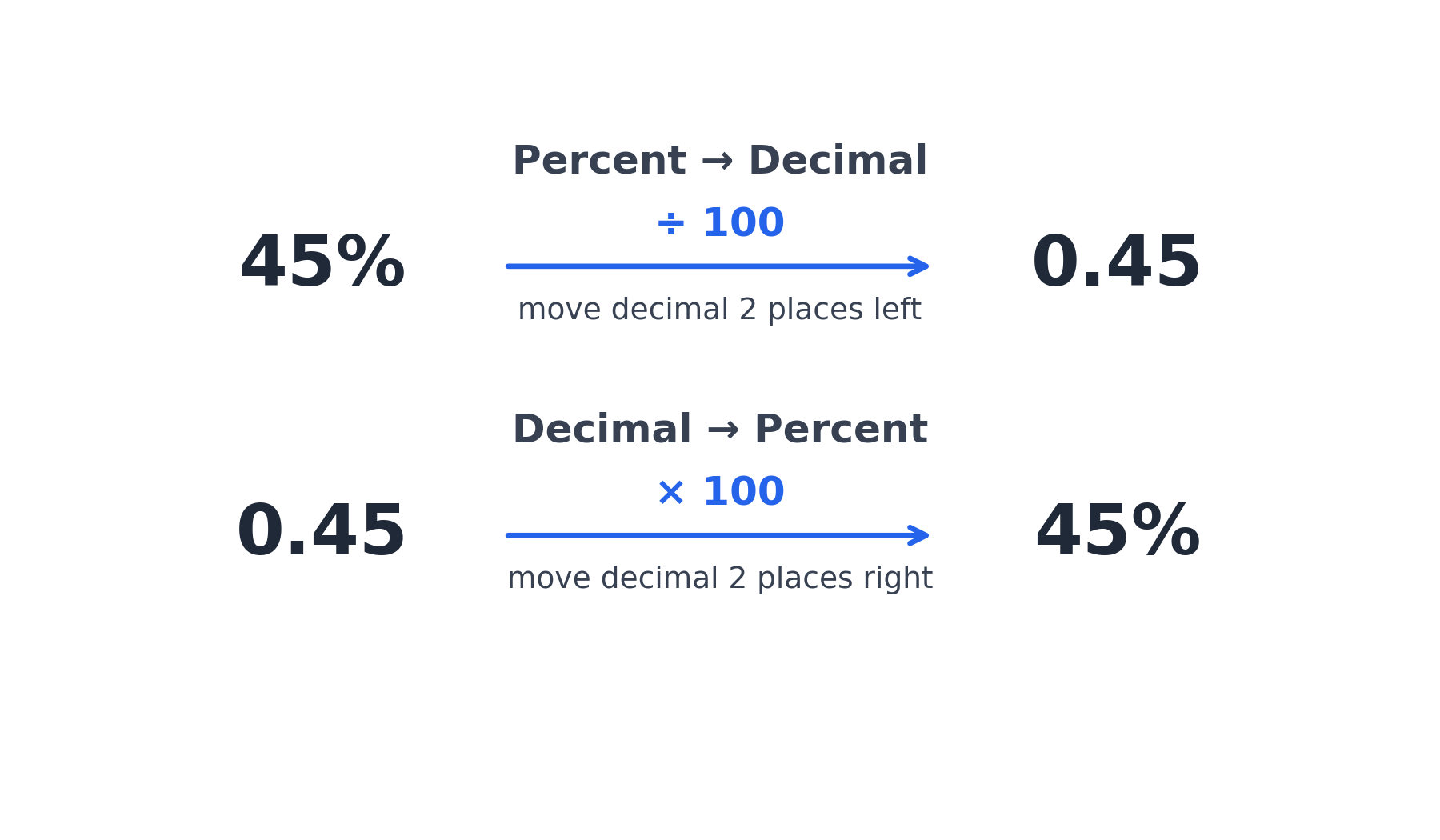
To convert a percent to a decimal, we divide by 100. In practice, dividing by 100 simply moves the decimal point two places to the left.
Let's walk through a few familiar values:
| Percent | ÷ 100 | Decimal |
|---|---|---|
Notice what happens with . The starting number is , which we can think of as . Moving the decimal two places to the left gives . That leading zero is easy to forget, so it is worth pausing on single-digit percents like this one.
The method works the same way when the percent itself contains a decimal. For example, becomes . We still shift two places to the left, filling in zeros wherever we need them.
From Decimal to Percent
Going the other way, we multiply by 100. Multiplying by 100 moves the decimal point two places to the right, and then we attach the symbol.
| Decimal | × 100 | Percent |
|---|---|---|
Notice that these two conversions are mirror images of each other. If we convert to and then convert back, we land right on again. That symmetry is not a coincidence — it flows from the single idea we explore next.