Welcome to Percent Foundations for Everyday Life! This is the very first lesson of the course, and we are glad to have you here. Over the coming lessons, we will build a strong, practical understanding of percentages — one of the most commonly used math ideas in adult life. By the end of this lesson, we will be comfortable explaining what a percentage means and reading percentages in places like weather apps, clothing tags, and food labels.
The Meaning Behind the Symbol
Before we look at real-world examples, let's make sure we share a clear picture of what "percent" actually means. The word percent comes from the Latin phrase per centum, which translates to "for every hundred." So whenever we see a number followed by the % symbol, it tells us a quantity out of 100.
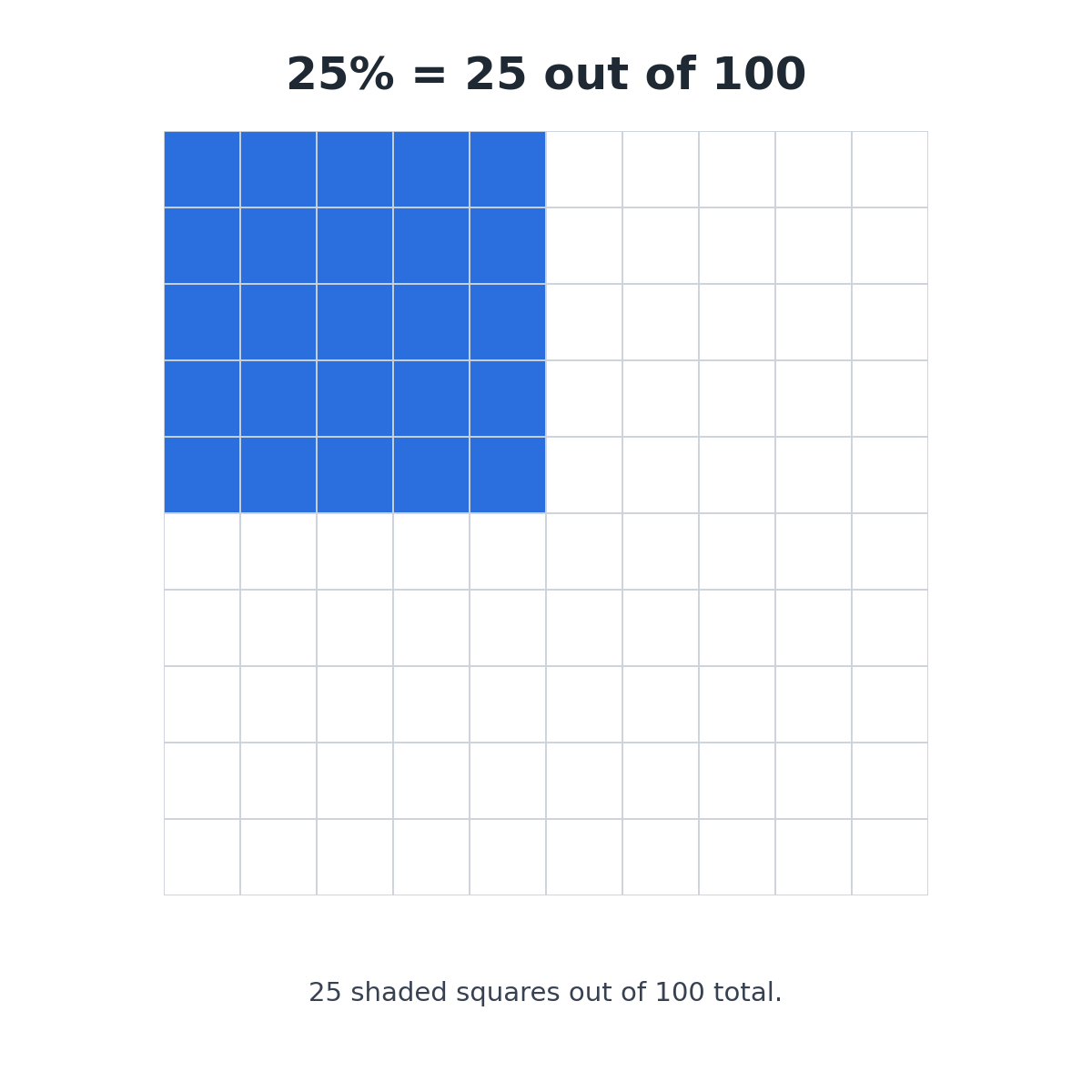
Think of it this way: imagine slicing something into 100 equal pieces. A percentage tells us how many of those pieces we are talking about. Writing 25% is the same as saying "25 out of 100," which we can also express as:
25%=10025
That single idea — a number out of 100 — is the engine behind every percentage we will ever meet.
Spotting Percentages in Daily Life
Percentages show up everywhere once we start looking. Here are a few examples we might encounter on any given day:
Battery indicator: "Phone at 45%" means 45 out of every 100 units of the battery's full capacity remain.
Weather forecast: "70% chance of rain" means that, out of 100 similar weather situations, roughly 70 would produce rain.
Clothing tag: "60% cotton, 40% polyester" means that in every 100 parts of fabric, 60 parts are cotton and 40 are polyester.
Survey result: "82% of respondents preferred Option A" means about 82 out of every 100 people surveyed chose that option.
Each of these uses a percentage to describe a part of some larger quantity. That larger quantity is the key to reading the statement correctly, and it leads us to an important idea.
Every Percentage Has a Whole
Whenever we see a percentage, it describes a portion of something. That "something" is called the whole (sometimes called the base). Misidentifying the whole means misreading the percentage entirely.
A helpful habit is to ask one short question every time we see a percent sign: "Out of what?" Let's revisit our earlier examples through that lens.
Statement
The Whole (100%)
"Battery at 45%"
The battery's full capacity
"70% chance of rain"
All possible weather outcomes for that forecast
"Shirt is 60% cotton"
The total fabric in the shirt
"82% preferred Option A"
All people who responded to the survey
Notice how different the whole is from one context to the next. Percentages only make sense when we know what they are measured against. Carrying the "Out of what?" habit forward will pay off throughout this entire course.
Join the 1M+ learners on CodeSignal
Be a part of our community of 1M+ users who develop and demonstrate their skills on CodeSignal
Most percentages we encounter fall between 0% and 100%, but that range is not a hard boundary. Percentages can dip below 1% and still make perfect sense.
Consider the statement: "Only 0.5% of the population carries this gene." Because 0.5% means 0.5 out of every 100, that is the same as 1 out of every 200 people. Very small percentages describe very small slices of the whole.
We commonly see them on ingredient labels ("contains less than 0.5% of…") and in medical or scientific reports. The "out of 100" logic works exactly the same way; the slice is simply tiny.
On the other end, percentages can also go above 100%. This happens whenever something exceeds the original whole.
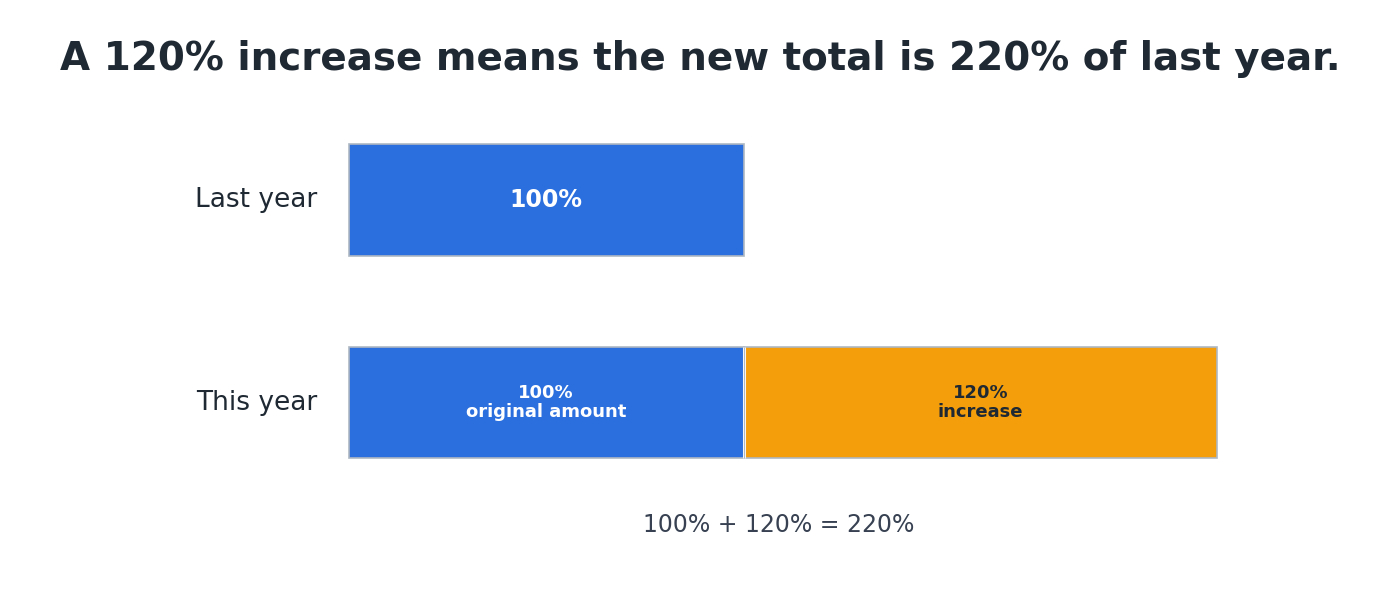
Take the headline: "Sales rose 120% compared to last year." Here, 120% describes the size of the increase relative to last year's sales. If last year's sales are the whole (100%), the new total is:
100%+120%=220%
That means this year's sales are 2.2 times last year's figure. Percentages above 100% appear regularly in business reports and news stories about growth. Once again, the meaning is still "per hundred"; we simply have more than one full hundred.
Let's apply everything to a document many of us see daily: the nutrition label on packaged food. Below is a small snippet from a cereal box showing one serving:
Nutrient
Amount
% Daily Value
Total Fat
2 g
3%
Sodium
200 mg
9%
Dietary Fiber
7 g
25%
Iron
8 mg
45%
The % Daily Value column tells us how much of the recommended daily amount one serving provides. So what is the whole here? It is 100% of what a typical adult needs in an entire day.
3% for Total Fat means this serving supplies only 3 out of every 100 parts of the fat recommended per day — almost the entire daily allowance (97%) is still available from other meals. 25% for Dietary Fiber means one serving covers a quarter of the fiber we need for the whole day, a meaningful contribution from a single bowl of cereal.
The crucial detail is the whole: it is the total daily recommended intake, not the total food we eat. Keeping the whole straight helps us make informed choices at the table.
In this lesson, we explored the core idea that every percentage is simply a number out of 100, and we practiced reading that meaning in everyday settings like batteries, weather forecasts, fabric tags, surveys, and nutrition labels. We also stretched our understanding to percentages below 1% and above 100%, confirming that the same "per hundred" logic holds in every case. The single most useful habit to carry forward is asking "Out of what?" whenever a percent sign appears.
Now it is time to put these ideas into action. In the upcoming practice section, we will interpret real-world percentage statements, match numbers to visuals, and analyze a nutrition label snippet — so get ready to make this knowledge truly your own.