How to Interject in a Meeting
How to Interject in a Meeting ✋
You’re sitting in a meeting with a great idea or a pressing question, but you hesitate—what if you’re wrong, or your suggestion falls flat? This is a common experience, especially when you’re new to a team or the topic at hand feels outside your expertise. The real challenge isn’t just about having something to say; it’s about finding a way to contribute that feels safe and constructive. As highlighted in the HBR Guide to Making Every Meeting Matter, Jodi Glickman suggests effective participation isn’t about dominating the conversation, but about using practical, low-risk techniques to make your voice heard and invite group engagement. In this lesson, you’ll discover how to introduce ideas and ask questions in ways that lower the stakes, encourage collaboration, and help you participate powerfully.
Introducing Ideas and Seeking Clarification 💡
Many people hesitate to speak up in meetings because they fear being wrong, uninformed, or the proponent of a "dumb" idea. This fear can keep valuable contributions and important questions unspoken. This approach offers practical ways to interject that minimize personal risk and encourage group engagement, whether you’re floating a new idea or seeking clarification.
If you have a suggestion but aren’t fully confident about it, try presenting it as a question to the group rather than a statement. This shifts the focus from you as the owner of the idea to the group as co-explorers. For example, instead of saying, "We should get Marin involved in the PR campaign," try, "Have we thought about getting Marin involved in the PR campaign directly?" This subtle shift invites discussion and input, making it easier for others to build on or refine the idea without anyone feeling defensive.
Here’s how this works in practice:
- Ryan: Have we considered whether our current RFP criteria might be missing something important?
- Victoria: Actually, that's a good question. What aspects are you thinking about?
- Ryan: Well, did anyone mention looking at the vendors' experience with remote implementations? I seem to recall that becoming more critical after our last project issues.
- Victoria: You know what, that's worth exploring. What is everyone else's take on adding that criterion?
Notice how Ryan’s use of a depersonalized question transformed the exchange from a potential point of conflict into an open, collaborative problem-solving discussion.
Other useful depersonalized phrases include:
- "Did anyone mention the Brealy report? I seem to recall it covered some of the same topics Amrit has raised here."
- "Another option we may want to consider is pushing back the timeline until early October."
- "Is it worth revisiting last week's minutes from the meeting to review the agreed-upon product specifications?"
These approaches allow you to contribute without taking full ownership of the idea, which is especially helpful when you’re new to a team, speaking with senior leaders, or venturing outside your area of expertise.
Just as introducing ideas can feel risky, asking for clarification can be equally intimidating—especially if you worry about revealing a gap in your understanding. Yet, seeking clarity is just as important for effective participation. Asking questions help you get the information you need without undermining your credibility.
The “iceberg of participation” below illustrates this dynamic: in most meetings, only a small portion of thoughts, questions, and concerns are actually voiced, while much more remains unspoken beneath the surface.

Phrases like, "I'm not entirely sure I'm following you," or "Could you please recap what you just mentioned regarding the August delivery?" identify a communication gap without blaming anyone. Being specific about what you need helps others respond more effectively.
Sometimes, acknowledging what you’re “supposed” to know actually makes you appear more confident. For example:
- "I'm sure I'm supposed to know this already, but how many attendees are we expecting at the conference next week?"
- "I apologize if this is totally obvious to everyone here, but what does CAFE stand for?"
Even self-deprecating questions like, "This may be a dumb question, but I'm still not up to speed on why we're not using rail instead of truck," can be effective. They signal humility and often prompt relief from others who share your confusion.
The key is to ask early and specifically, and to do so with confidence. Seeking clarification shows engagement and often helps others who may also be confused but hesitant to speak up.
Applying Disagreement Frameworks ⚖️
Disagreeing without being disagreeable is one of the most challenging communication skills to master. When the conversation heads in a direction that doesn't work for you, it may be difficult to keep your mouth shut. Of course, it is your right and perhaps even your responsibility to speak up when you have something contrarian to say. The key, however, is knowing how to finesse your comments so you don't come off sounding like a jerk or create unnecessary tension in the room. There are three distinct strategies for expressing disagreement, each suited to different situations and relationships:
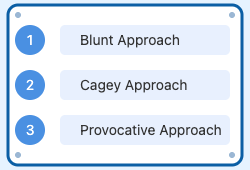
- Blunt Approach: Use this when you have established credibility and the situation calls for directness. Clearly state your position without being hostile. For example, “I respectfully disagree with that assessment, Shun,” The word “respectfully” is important here, as it acknowledges that reasonable people can disagree while maintaining professional courtesy. This approach is most effective when time is limited, decisions need to be made quickly, or when softer approaches have failed to surface important concerns.
- Cagey Approach: This more indirect strategy positions you as exploring alternatives rather than directly opposing the current direction. For instance, “I just want to play devil’s advocate here for a moment. What if we were to go with the opposite approach and use direct-mail marketing instead of relying solely on social media efforts?” By explicitly labeling yourself as devil’s advocate, you signal that you’re testing ideas, which gives others permission to voice concerns they might share but haven’t articulated. This technique is particularly useful when disagreeing with someone more senior or when the group seems strongly aligned around a direction you question.
- Provocative Approach: This approach challenges fundamental assumptions rather than specific proposals; “I want to throw out a curveball here and challenge our assumption that we have to take the deal.” This strategy can powerfully break groupthink or redirect conversations that have become too narrow. However, it requires confidence and should be used judiciously, as it can disrupt meeting flow if overused.
Choosing between these approaches depends on several factors: your relationship with other participants, the meeting's formality, time constraints, and how strongly you feel about the issue. You might start with a cagey approach and escalate to blunt if your concerns aren't being heard, or you might lead with a provocative statement to jolt a complacent group into fresh thinking. The key is having all three tools in your toolkit and developing the judgment to deploy them appropriately. Each approach serves a purpose, and mastering when to use which one transforms disagreement from a source of conflict into a catalyst for better decisions.
In our upcoming sessions, you'll practice using depersonalized questions to float ideas in challenging situations, selecting and applying the right disagreement framework when confronting powerful colleagues, and crafting clarification requests that maintain your credibility while ensuring understanding. These scenarios will help you develop the instincts and confidence to interject effectively in any meeting situation.
