Polite Ways to Decline a Meeting Invitation
Welcome to the Course 🎉
Welcome to Participating Powerfully in Others’ Meetings! As a people manager, you know the challenge of balancing collaboration with the need to protect your time. Your calendar fills with meeting invitations—some essential, many questionable—and you’re left wondering how to contribute meaningfully without sacrificing your own priorities.
This lesson gives you practical skills to move from passive attendee to strategic participant, drawing in particular on expert guidance from Liane Davey in the HBR Guide to Making Every Meeting Matter. You’ll learn how to evaluate which meetings truly require your presence, how to decline invitations diplomatically, and how to influence outcomes even when you’re not in the room. We will cover proven scripts and techniques for speaking up when it matters, redirecting unproductive discussions, and supporting better meeting outcomes whether you’re a participant or simply on the invite list.
By mastering these skills, you’ll approach every meeting invitation with a clear, strategic mindset. You’ll know when to show up, how to add value, and how to model the kind of meeting behaviors that elevate your entire organization’s culture. These time management tactics will strengthen your leadership skills by ensuring your contributions drive real results, even in meetings you do not attend. In this lesson, you will tackle one of the most essential and often most difficult skills: knowing when and how to decline a meeting invitation.
Applying the Three-Question Filter 3️⃣❓
Every meeting invitation deserves thoughtful consideration, but not every meeting deserves your attendance. Here is a powerful three-question filter that helps you make strategic decisions about which meetings truly require your presence. This systematic approach removes the guilt and guesswork from declining meetings by giving you clear criteria for evaluation.
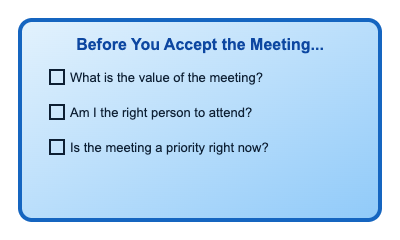
- Is the meeting valuable? Look for a clear purpose and structured agenda that signal a well-planned gathering. If these are missing, seek clarification by asking for more information on the agenda, the stage of decision making, or how you should prepare. These questions help you determine whether the meeting will be productive.
- Am I the right person to attend? Honestly assess whether the issues fall within your area of responsibility and if you have unique knowledge or perspective to contribute. If you are unsure why you were invited, ask the organizer what they are looking for you to contribute or who else from your department will be there. This can reveal if your presence is truly necessary or if you were invited mainly for visibility.
- Does this meeting align with my current priorities? Consider whether the meeting fits with your immediate deadlines and responsibilities. Think about how central the topic is to your core work and whether someone else could represent your perspective just as effectively. This is not about avoiding work—it is about making strategic choices to maximize your impact where it matters most.
Declining Constructively ↩️
When you determine a meeting doesn't pass your three-question filter, declining isn't the end of your contribution—it's the beginning of a different kind of participation. How you decline matters as much as the decision itself. Constructive declining maintains relationships, demonstrates professionalism, and often provides more value than reluctant attendance would.
One powerful approach involves recommending an alternative participant when the meeting is important but you're not the right attendee. This strategy works particularly well when someone on your team possesses deeper expertise or more relevant experience for the topic at hand. Rather than suggesting just anyone to fill your spot, invest time in identifying the person who would genuinely add more value to the discussion. You might frame your response as "I think Lucca would have the necessary context for this discussion. Would you be comfortable inviting them instead?" or "Given that this is a decision-making meeting, I think it's more appropriate to have my manager represent our team." This thoughtful approach shows that you're not simply trying to escape another meeting but are genuinely concerned with ensuring the best possible outcome.
Let's look at how this might play out in a real conversation:
- Ryan: Hey Victoria, I saw you declined the vendor evaluation meeting tomorrow. We really need input from your team on this.
- Victoria: I appreciate you thinking of me, Ryan. I looked at the agenda, and it's primarily focused on technical specifications for the monitoring tools, right?
- Ryan: Yes, we need to evaluate three different platforms and their integration capabilities.
- Victoria: That's what I thought. Dan from my team actually has deep expertise in monitoring tools—he implemented our current system. Would you be comfortable if he attended instead? I could brief him on any strategic considerations you need addressed.
- Ryan: I hadn't thought of Dan. That actually makes more sense since we'll be diving into technical details.
- Victoria: Perfect. I'll connect you two today, and I'll make sure Dan knows our budget parameters and strategic priorities. If any high-level decisions come up that need my input, he can loop me in.
- Ryan: That works great. Thanks for thinking this through rather than just declining.
Notice how Victoria applied the three-question filter (the meeting has value but she's not the right person), then offered a constructive alternative that actually improved the meeting's potential outcome. She maintained the relationship while protecting her time for priorities that truly required her expertise.
Another effective strategy involves contributing in advance when the meeting topic matters but the timing conflicts with your priorities. This demonstrates engagement and commitment without requiring physical presence. Your advance contribution might involve pulling together relevant data, creating a brief summary of your perspective, or thoroughly briefing another attendee who can represent your viewpoints during the discussion. Consider offering something like "I'm not able to attend, but I will find time to share my thoughts so you can include them in the conversation" or "If I prepare you in advance, could I ask that you represent my ideas at the meeting?" This approach often provides more focused value than attending while distracted by competing priorities, and it shows respect for both the meeting's importance and your own time constraints.
For meetings where only certain agenda items relate to your work, partial attendance offers a practical compromise that respects everyone's time. This requires coordination with the meeting organizer but can be highly effective when executed properly. You might propose "Would it be possible to cover the rebranding discussion as the first agenda item? I can't stay for the entire meeting but I'd really like to contribute on that one." This targeted attendance ensures you contribute where you add the most value while avoiding time spent on discussions outside your expertise or responsibility. It also models efficient time management for others who might be struggling with similar meeting overload.
Stopping Unnecessary Meetings 🛑
Even when you suspect a meeting is premature or unnecessary, it can feel risky to voice that concern directly. There are several diplomatic techniques to help you raise these issues constructively, ensuring your feedback is heard while maintaining positive relationships.
| Technique | How to Use It | Example Script |
|---|---|---|
| Question Timing and Readiness | Raise concerns about whether the meeting is happening too soon or before necessary work is done. | "This is an interesting topic. Based on our current-year priorities, I'm not sure we're ready for a productive conversation yet. Would it be possible to push this meeting back and let the working group make a little more progress before we meet?" |
| Check for Critical Participants | Point out if key stakeholders are missing, which could prevent decisions from being made. | "I'm looking forward to making some decisions on this issue. From the meeting invite, it doesn't look like Production is involved. I would like to wait until someone from that team is willing to join. Otherwise, we won't be able to make any decisions." |
| Suggest Efficient Alternatives | Recommend a summary or written update if the meeting is primarily informational. | "Based on the information in the invitation, it looks like this meeting is for informational purposes. Would it be possible to get a summary sent out rather than hold a meeting?" |
Each of these techniques allows you to question the necessity or timing of a meeting without appearing uncooperative. By focusing on readiness, stakeholder involvement, and efficient communication, you model strategic thinking and help your organization use meeting time more effectively.
By using these strategies, you can protect your time, ensure meetings are truly productive, and demonstrate leadership by modeling thoughtful participation. Next, you’ll have the opportunity to practice these techniques in realistic scenarios—evaluating invitations, crafting diplomatic responses, and handling sensitive conversations about meeting necessity—so you can confidently apply them in your own work.
