Evaluating Real Patterns
Introduction 🎉
Welcome back to Outsmarting Probability Traps! In the first two lessons, you built a solid toolkit for thinking about chance. Now you will face a trickier question: when you do spot a pattern in real-world data, how do you decide whether it reflects a genuine change or is just randomness doing its thing? By the end, you will be able to:
- Use a baseline to judge whether a result is actually unusual — instead of reacting to a number in isolation, you will compare it to the longer-term average or expected level.
- Recognize when short-term results are too small to be convincing — and explain why patterns based on only a few observations can swing wildly just by chance.
- Evaluate whether a pattern is strong enough to trust by asking whether it differs meaningfully from the baseline, is supported by enough data, and stays consistent over time.
📌 Knowing When a Pattern Matters
The first two lessons gave us two important guardrails. On one side, we know not to be startled by every streak, because randomness is naturally clumpy. On the other side, we know not to expect a streak to reverse, because independent events do not self-correct. But life often demands a third skill: deciding whether an observed trend is meaningful enough to act on.
Imagine a small bakery notices that sales jumped over the past three days. Should the owner order extra supplies? Or imagine a teacher sees that a student failed two tests in a row after months of strong grades. Should the teacher intervene? These situations require us to evaluate the evidence before drawing conclusions, and that is exactly what this lesson is about.
⚓ Starting with a Baseline
The first step in evaluating any pattern is asking: compared to what? A number on its own tells us very little. Saying "we had 12 customer complaints today" sounds alarming, but not if the daily average over the past year is 11. A pattern only stands out when we measure it against a baseline — the typical or expected result drawn from longer-term data.
Think of a baseline as an anchor. For a salesperson, it might be their close rate over the past year. For a website, it might be average daily traffic over the past six months. For weather, it might be the historical average temperature for a given month. Without a baseline, we have no way to judge whether a recent result is unusual or perfectly ordinary.
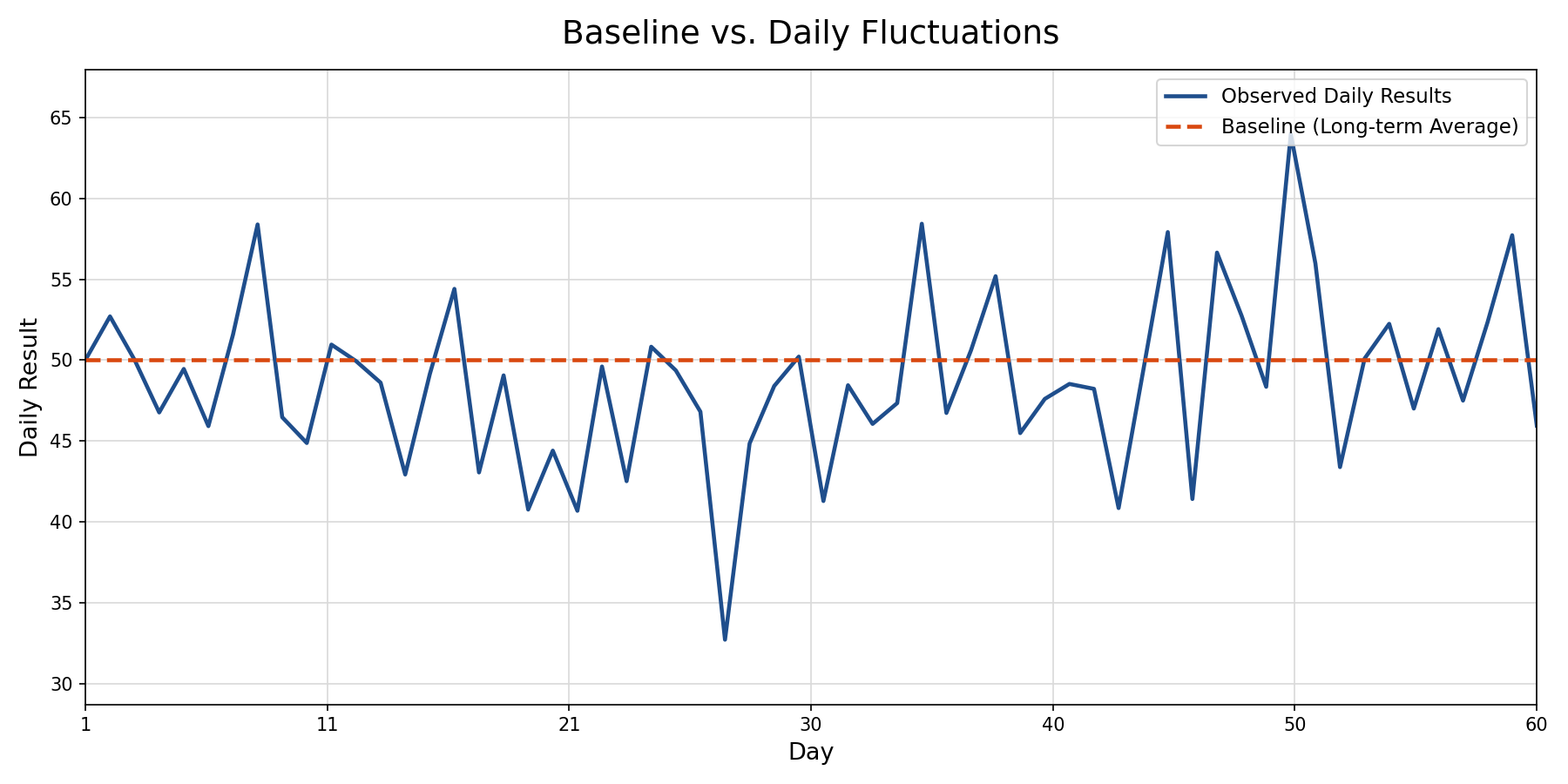
As you may recall, small samples produce a wide range of outcomes just by chance. This is one of the biggest reasons short-term patterns fool us. Let us walk through a concrete example.
Suppose a salesperson has a long-term close rate of , based on hundreds of deals over the past year. That is a reliable baseline. Now imagine that in one particular week, they close 5 out of 8 deals, for a rate of:
That looks like a massive improvement! But with only 8 deals, the results can swing wildly. In another week, the same salesperson might close just 1 out of 8 deals (). Neither week, on its own, tells us much. The small sample makes the observed rate unstable.
Now compare that to a different scenario: the salesperson closes 60 out of 100 deals over a full quarter, which is also a rate. This is much harder to dismiss as a fluke because the larger sample leaves far less room for random variation to distort the picture.
| Scenario | Deals | Successes | Observed Rate | Baseline | Convincing? |
|---|---|---|---|---|---|
| One good week | 8 | 5 | 62.5% | 30% | Not yet |
| Strong quarter | 100 | 60 | 60.0% | 30% | Much more so |
The observed rate is similar in both rows, but the evidence behind it is very different.
📝 Three Questions to Evaluate a Pattern
When you notice something that looks like a trend or a shift, a simple set of questions can help you decide whether the evidence is strong enough to trust:
- How does it compare to the baseline? If the observed result is close to the long-term average, there may be nothing unusual happening. The bigger the gap between the observation and the baseline, the more attention it deserves.
- How much data is behind it? A pattern based on two days, five coin flips, or one week of sales is built on very little information. The more data points supporting the pattern, the more confident you can be that it is not just noise.
- Has it been consistent over time? A single spike or dip is easy for randomness to produce. If the pattern holds steady across multiple time periods or repeated observations, it is far more likely to reflect a real change.
Think of these three questions as a quick checklist. A pattern that passes all three is much more likely to be real than one that only passes one.
📈 Diagnosing a Bakery Sales Spike
Let us apply our checklist to a realistic scenario. A small bakery sells an average of loaves per day, based on the past year of data. Over the last three days, sales have jumped to around loaves per day. The owner is wondering whether to order significantly more supplies going forward.
Step 1 — Compare to the baseline. The recent average is loaves per day, while the yearly baseline is loaves per day. To find the size of the jump, we first subtract the baseline from the recent value:
This tells us that sales are up by 60 loaves per day compared with the usual level. But saying "up 60 loaves" does not yet tell us how large the jump is relative to the baseline. To express the change as a percentage, we divide the increase by the original baseline of :
So we subtract because we want to measure how far the new result is above the usual level, and we divide by because the baseline is the reference point we are comparing against. This shows that recent sales are 40% above normal, which is a noticeable gap.
Step 2 — Check the amount of data. We only have three days of observations. Daily bakery sales can fluctuate due to weekends, local events, weather, or even a single social media mention that drove temporary foot traffic. Three data points is a very thin foundation.
Step 3 — Look for consistency. Has the spike persisted, or could it be a brief surge? We do not know yet. If sales stay near for two or three more weeks, the evidence becomes much stronger. If they drop back to tomorrow, the "spike" was likely just normal fluctuation.
Verdict so far: The gap from the baseline is worth noting, but three days is not enough to confirm that something has truly changed. The bakery owner should keep monitoring rather than committing to a large supply order right now. It is perfectly reasonable to investigate possible causes — a nearby event, a positive online review, a seasonal shift — while waiting for more data. The key point is that the current evidence alone does not confirm a real shift.
⏸️ Avoid Jumping to Conclusions
Our brains are wired to spot patterns and react quickly. In many areas of life, this instinct serves us well. But when it comes to evaluating data, acting too fast on too little evidence leads to poor decisions. The three-question checklist from the previous section is your deliberate counterweight to that impulse. The most common mistake is skipping straight from noticing a result to explaining it:
- We build a narrative first ("the new marketing campaign is working!" or "the team is falling apart").
- Then we latch onto whatever short-term numbers seem to confirm it, without ever checking them against the baseline or asking whether the sample is large enough.
Always run the checklist before trusting the story.
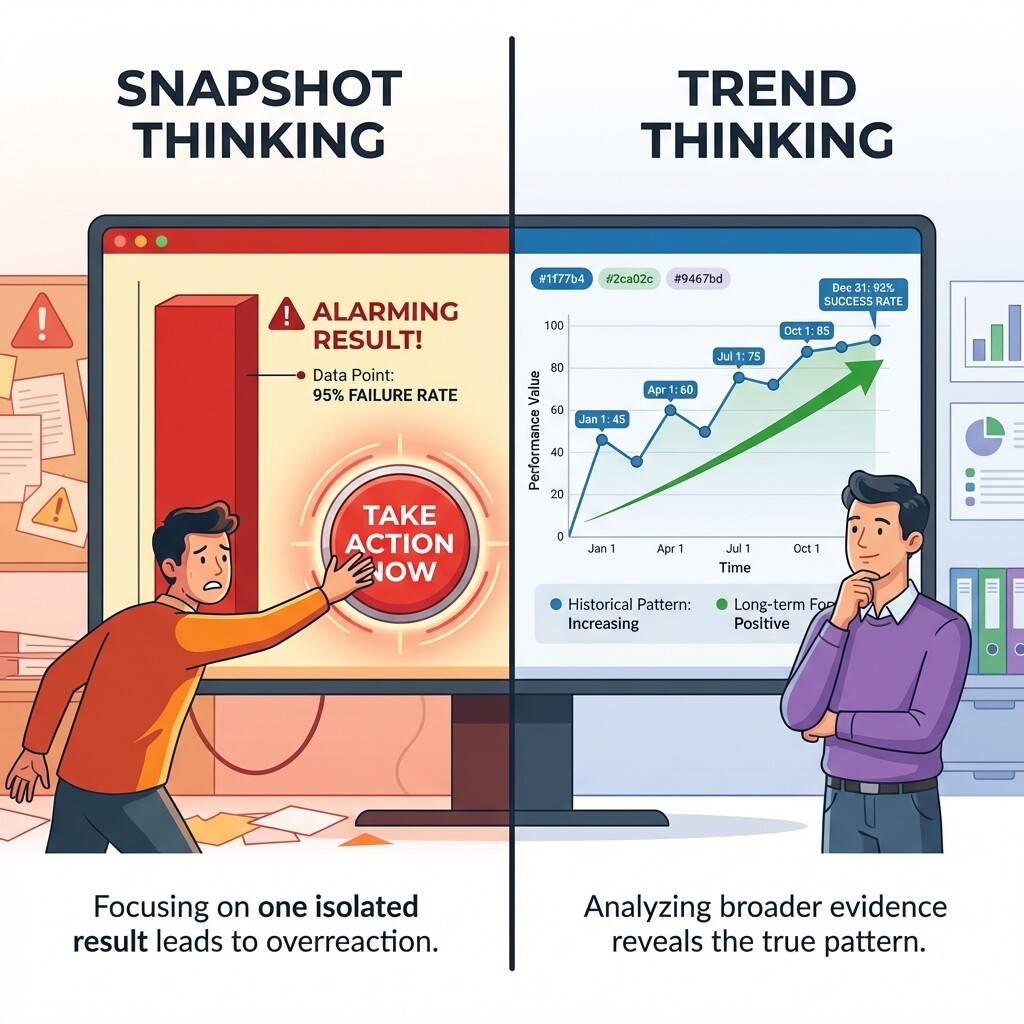
The more consequential the decision, the more evidence you should require. Changing your lunch order because of one bad meal is low-stakes. Overhauling a business strategy because of one rough week is not.
Conclusion and Next Steps
Evaluating whether a pattern is real comes down to disciplined thinking: measure the observation against a reliable baseline, consider how much data supports it, and check whether the pattern holds up consistently over time. Short-term streaks and spikes are a normal part of randomness, and as we have seen throughout this course, our instinct to read meaning into every fluctuation often leads us astray. By pausing to ask the right questions, you give yourself the best chance of separating genuine signals from everyday noise.
Now it is time to sharpen these skills with hands-on practice! In the upcoming exercises, you will judge real-world scenarios, compare streaks to baselines, identify what extra evidence is needed before drawing conclusions, and craft your own data-driven recommendations. Let us find out how well you can tell the real patterns from the random ones!
