Avoiding the "Due" Thinking Trap
Introduction 🎉
Welcome to Avoiding the "Due" Thinking Trap! In the first lesson of this course, you discovered that true randomness is clumpier than most people expect — streaks and clusters are a perfectly normal part of any random process. In this lesson, you will learn to:
- Define the gambler's fallacy and explain why it arises from misunderstanding independent events.
- Distinguish between the probability of an entire sequence and the probability of a single next event after a streak.
- Identify the gambler's fallacy in real-world statements about coins, lotteries, sports, and everyday life.
- Apply the concept of independence to explain why past outcomes do not change future probabilities.
👀 From Noticing Streaks to Expecting Reversals
Knowing that streaks are normal is an important first step, but that knowledge does not always stop our brains from overreacting when we see one. A streak just feels like something unusual is going on, and right behind that feeling lurks a second trap: the urge to believe the streak must end soon, also known as the gambler's fallacy. It is the mistaken belief that after seeing the same outcome several times in a row, the opposite outcome becomes more likely next time. The name comes from casino gambling, where players fall into this trap all the time, but it shows up in everyday thinking far beyond the casino floor.
Picture yourself watching a roulette wheel land on black five spins in a row. Your gut reaction is probably something like, "Red has to come up next — it's overdue!" That feeling is powerful, intuitive, and completely wrong. Understanding why it is wrong is the heart of this lesson.
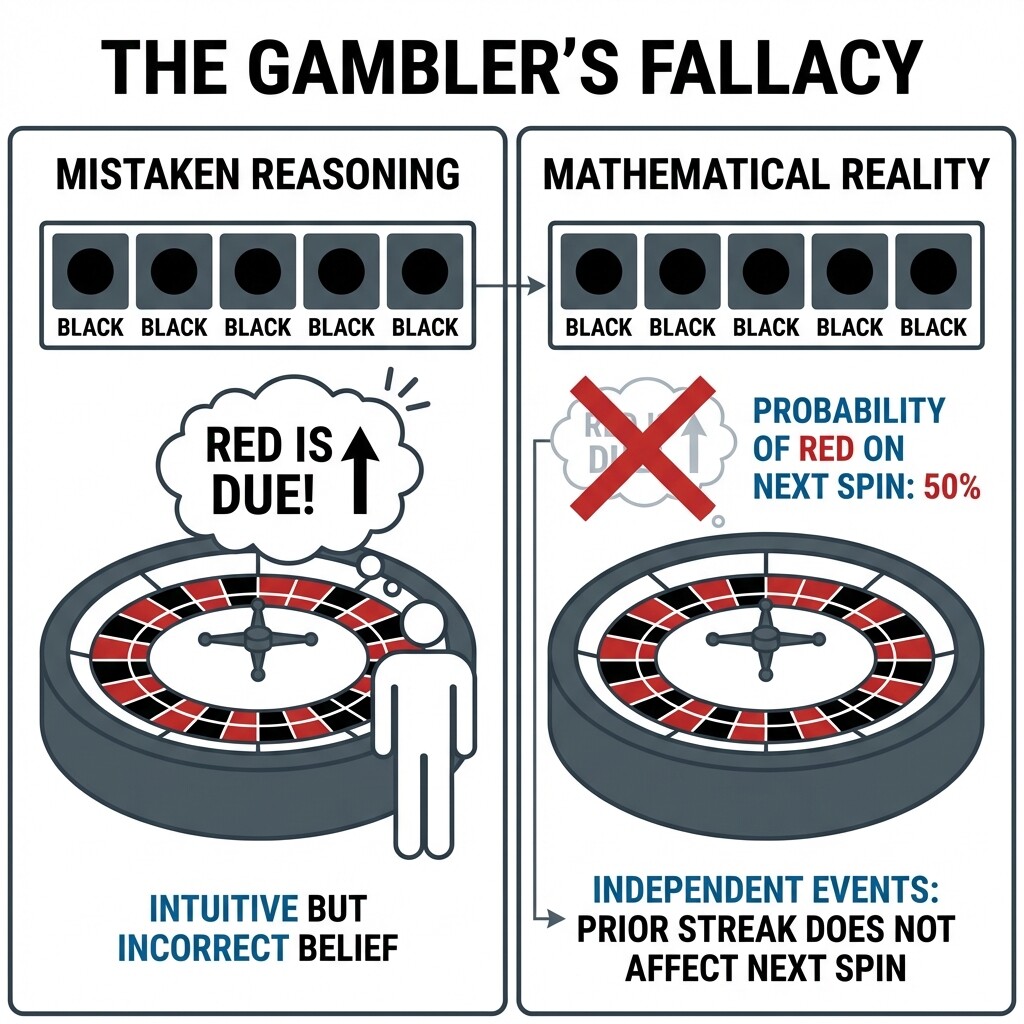
In every case the fallacy follows the same pattern: a streak has occurred, so the universe somehow "owes" us the other outcome to balance things out. You will see concrete examples of this thinking across lotteries, sports, and everyday life later in the lesson — but first, let us understand the mechanism that makes the fallacy wrong.
🎲 Independence Means No Memory
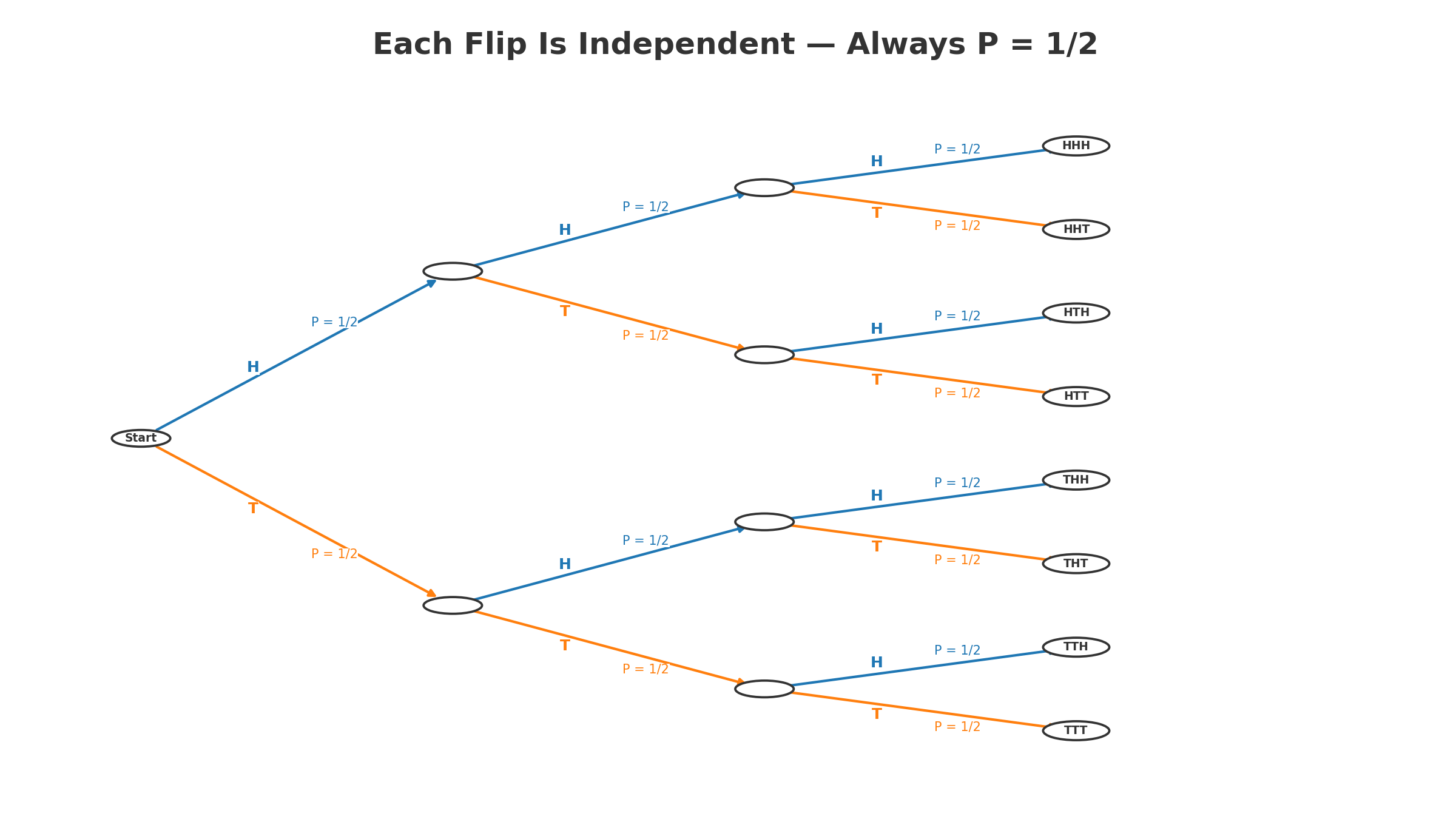
The key concept behind the gambler's fallacy is independence. Two events are independent when the outcome of one has absolutely no effect on the outcome of the other. A fair coin does not remember what it did on the last flip. A roulette wheel does not keep track of its recent results. Each trial starts completely fresh.
For a fair coin, the probability of heads on any single flip is always:
This remains true whether the previous flip was heads, whether the last five flips were all heads, or whether the last fifty flips were all heads. Nothing in the coin's past changes what it will do next. In mathematical terms, for independent events:
The vertical bar () means "given that," so this formula says: the probability of heads on the next flip, given whatever happened before, is still . The history simply does not matter.
⚖️ A Common Confusion: Sequences vs. Single Events
One reason the gambler's fallacy feels so convincing is that people mix up two very different questions without realizing it. Let us look at them side by side.
Question 1: Before you start flipping, what is the chance of getting 6 heads in a row?
Question 2: You have already flipped 5 heads in a row. What is the chance the next flip is heads?
Yes, getting six heads in a row from scratch is unlikely — only about 1.6%. But once five heads have already landed, those flips are done. They are in the past and cannot change. All that is left is one single flip, and that flip has a chance of heads and a chance of tails, same as it always does.
| Question | What it asks | Probability |
|---|---|---|
| Before any flips | Will all 6 flips be heads? | |
| After 5 heads | Will the next flip be heads? |
The fallacy kicks in when people use the logic of Question 1 to answer Question 2. They think, "Six heads in a row would be really rare, so the sixth flip must go the other way." But the first five results are already set in stone — the next flip is a fresh, independent event with the same probability it always had.
🔍 Spotting the Fallacy in Everyday Life
The gambler's fallacy appears far beyond coin flips and casinos. Anytime someone expects a streak to reverse in an independent process, the fallacy may be at work. Here are a few areas where it commonly shows up:
- Lottery tickets: Choosing numbers that "haven't come up in a while" because they feel overdue. Each draw is independent, so every combination has the same chance regardless of history.
- Sports commentary: Saying a basketball player is "due for a miss" after several made shots. While basketball shooting is more complex than a coin flip, the reasoning "a streak must end" alone is not valid evidence.
- Personal life: Believing that after a run of bad luck — flat tires, flight delays, rainy weekends — good luck must be "around the corner." If these events are independent, the universe is not keeping score.
It is worth noting that not everything is independent. If a machine part is wearing down, each day does increase the chance of failure. If a student studies harder, their odds of passing do improve. The gambler's fallacy specifically applies to situations where the events genuinely do not influence each other. In those situations, no streak, no matter how long, changes what comes next.
Conclusion and Next Steps
The gambler's fallacy is the mistaken belief that independent events must "balance out" after a streak, making a specific outcome feel "due." In reality, independent events have no memory, so the probability of the next result remains constant regardless of the rarity of the preceding sequence.
Now it is time to put this understanding into practice! In the upcoming exercises, you will identify the gambler's fallacy hiding in real-world statements, calculate the true probability after a streak, evaluate common lottery reasoning, and explain to a friend why "due" thinking does not hold up. Let us see how sharp your fallacy detector has become!
