Locally Linear Embedding in R
Introduction
Welcome to the fascinating world of Locally Linear Embedding (LLE), a vital tool in our dimensionality reduction toolbox. Unlike linear techniques like Principal Component Analysis (PCA), LLE shines at preserving local neighborhood structure in high-dimensional data.
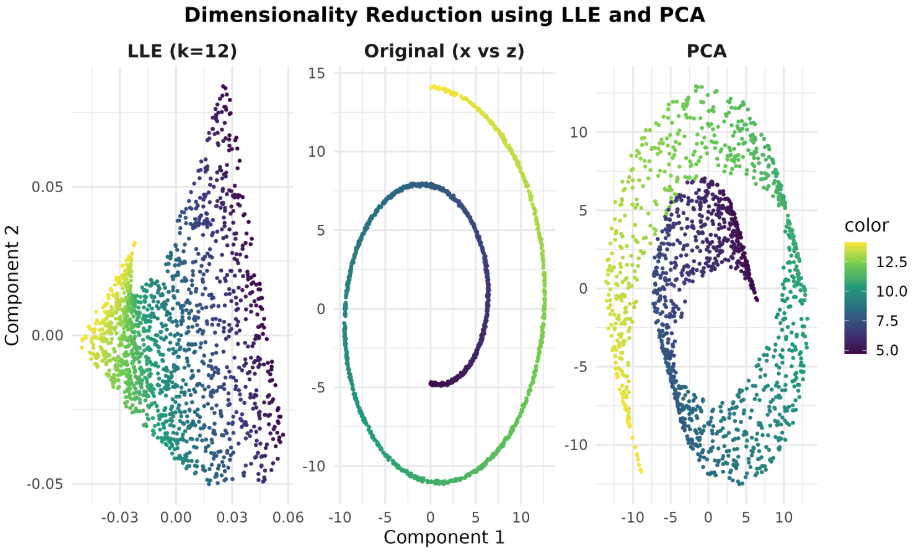
In this lesson, we’ll unpack the LLE algorithm, discuss when to use it, and contrast it with PCA. We’ll implement it in R, using ggplot2 for visualization and a small helper we’ll write to run LLE.
What is Locally Linear Embedding and its Use Cases?
LLE preserves relationships within local neighborhoods while reducing dimensionality, capturing twists and turns in non-linear manifolds (e.g., images, pose, genomics). Like reading a street map vs. a bird’s-eye projection: PCA may distort local distances, whereas LLE maintains them.
Understanding the Theory Behind LLE
Breaking down the LLE Algorithm: Generating the Data
We’ll use the Swiss Roll—a classic 3D manifold that’s hard for linear methods but perfect for LLE.