Converting Pure Repeating Decimals
Introduction
Welcome back to Mastery of Repeating Decimals! With two lessons already under our belt, we are now halfway through the course. In the first lesson, we learned to read and write bar notation fluently. In the second, we sharpened our ability to split a mixed decimal into its non-repeating prefix and repeating block. Now comes the exciting payoff: we will take a repeating decimal and convert it into an exact fraction.
This third lesson focuses on pure repeating decimals, where the cycle starts right after the decimal point with no prefix at all — decimals like , , and . We will learn a clean algebraic technique that works for any block length, and by the end you will be converting these decimals to simplified fractions with confidence.
Why Convert Back to Fractions?
As you may recall from the first course, we used long division to turn fractions like into decimals like That process moved us from a fraction to a decimal. Now we want to go in the opposite direction: start with a repeating decimal and figure out which fraction it represents.
Why does this matter in practice? Imagine three friends split a restaurant bill evenly. A calculator shows each person's share as of the total — an endless string of threes. That is not very satisfying when you need an exact answer. Fractions are compact, exact, and far easier to use in further calculations. By the end of this lesson, you will be able to prove that is exactly , and handle much trickier repeating decimals the same way.
The Algebraic Elimination Method
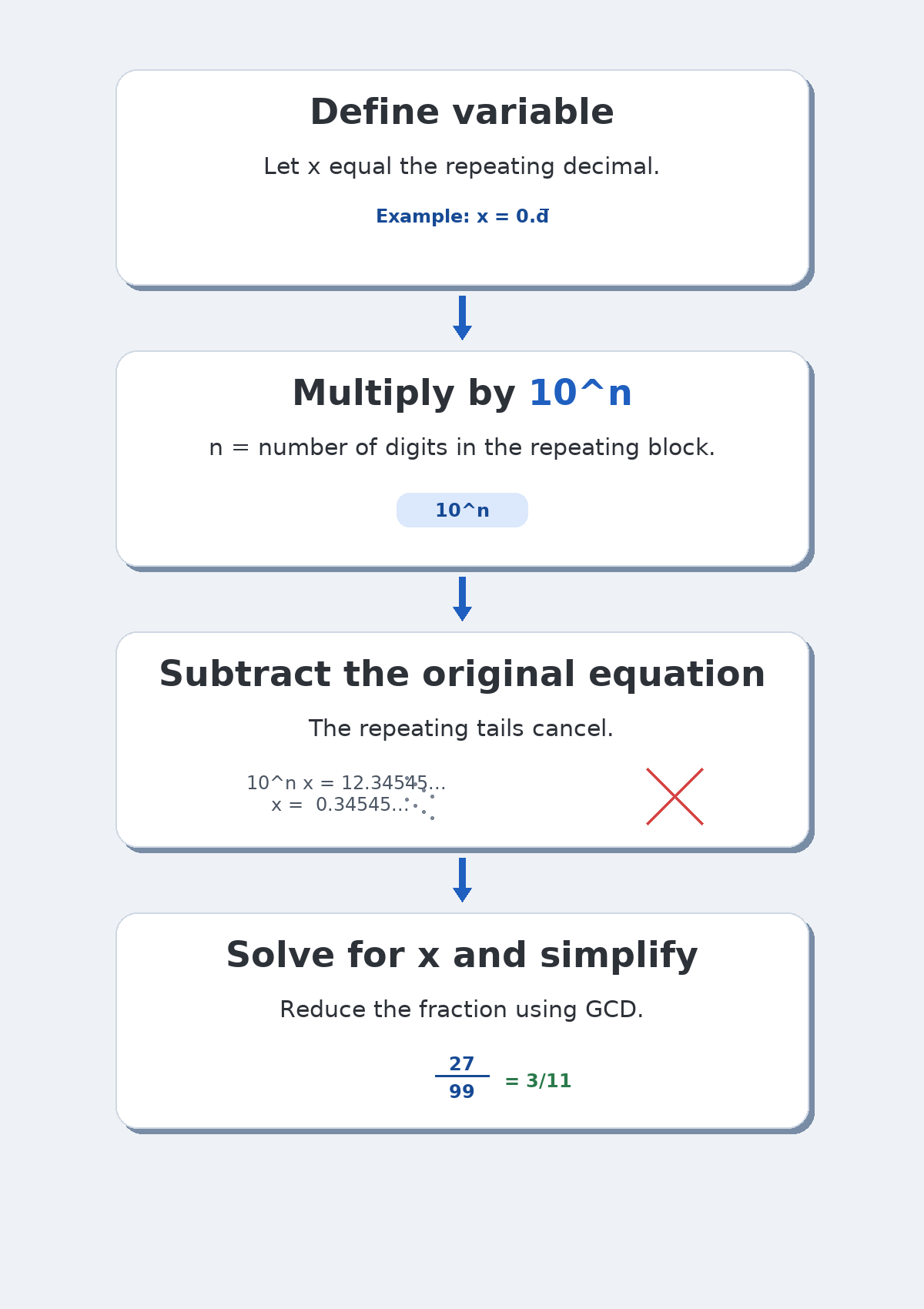
The technique rests on one elegant idea: if we multiply a repeating decimal by the right power of ten, the repeating tail lines up perfectly with the original, and a simple subtraction cancels it out. Let's see this in action with .
Step 1 — Define a variable. Let
Step 2 — Multiply by 10. Because the repeating block is one digit long, we multiply both sides by :
Step 3 — Subtract the original. Place the two equations together and subtract:
The repeating tails cancel, leaving:
Step 4 — Solve for .
That's it! We have shown that . The fraction is already in simplest form because and share no common factor other than .
Building Fluency with Single-digit Blocks
Let's reinforce the pattern with two more conversions so the four-step rhythm feels automatic.
Example:
Let Multiply by :
Subtract: , so , giving us:
Since , the fraction is already in simplest form.
Example:
Let Multiply by , then subtract: , so:
Here and share a common factor of , so we must simplify to . Always check whether the numerator and denominator can be reduced — the answer is not finished until the fraction is in simplest form.
Extending to Two-digit Repeating Blocks
When the repeating block has two digits, we multiply by instead of . The logic is the same: the power of ten must shift the decimal point by exactly one full block length so the repeating tails line up for cancellation.
Example:
Let Multiply by :
Subtract:
We divided numerator and denominator by to reach simplest form.
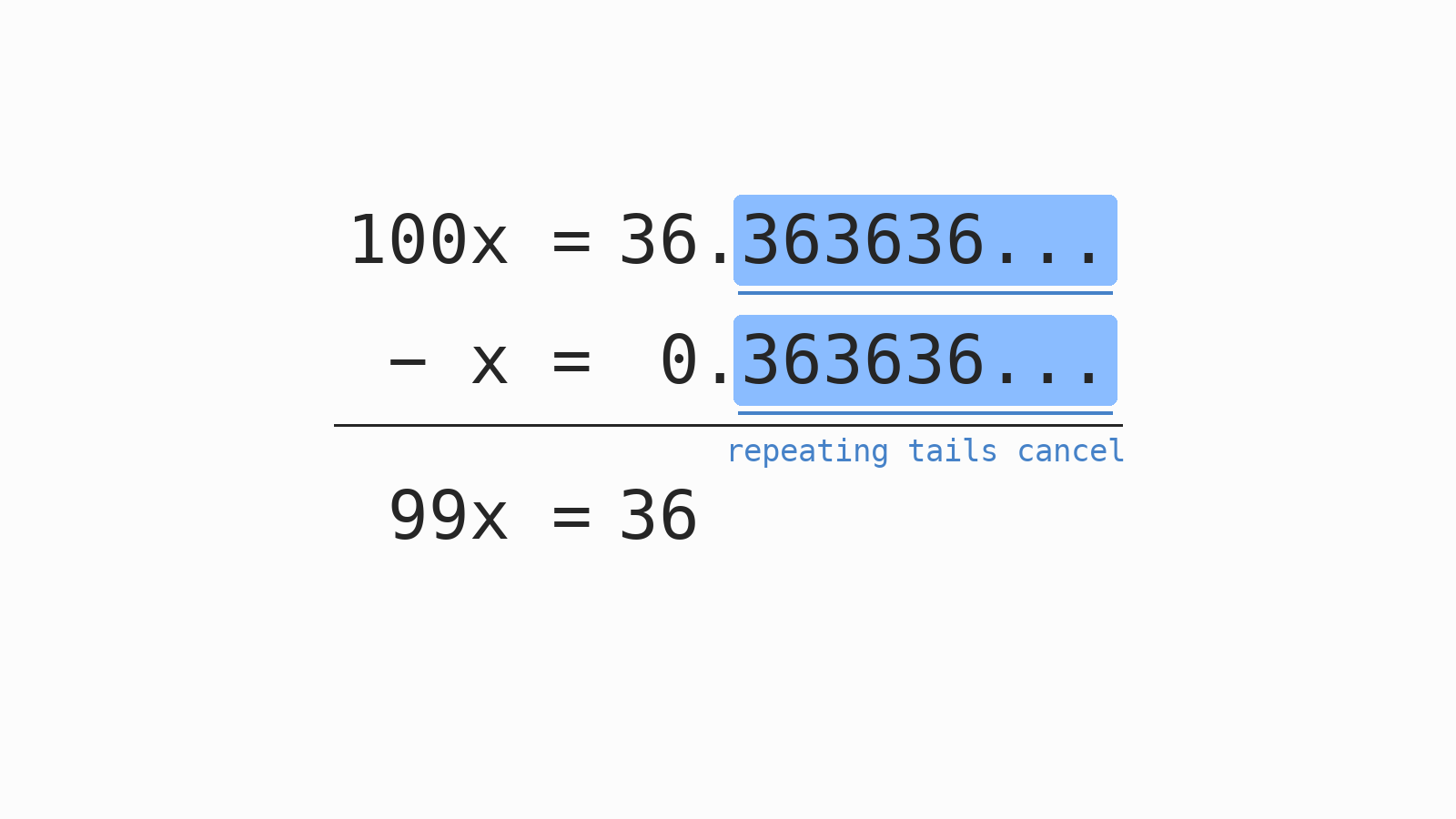
Example:
Let Multiply by , then subtract: , so:
Notice that the denominator before simplification was in both cases. For any two-digit repeating block, the subtraction step always produces on the left side.
Extending to Three-digit Repeating Blocks
By now the pattern should feel predictable. A three-digit repeating block calls for multiplication by .
Example:
Let Multiply by :
Subtract:
We simplified by dividing both numerator and denominator by (since and ).
Example:
Let Multiply by , then subtract: :
Again we divided by . And once again, the denominator before simplification is for every three-digit block.
The General Rule: Repeating Digits over Nines
Let's step back and appreciate the big picture. The table below summarizes what we have observed across all three block lengths:
| Block length | Multiply by | Denominator before simplifying |
|---|---|---|
| 1 digit | ||
| 2 digits | ||
| 3 digits | ||
| digits |
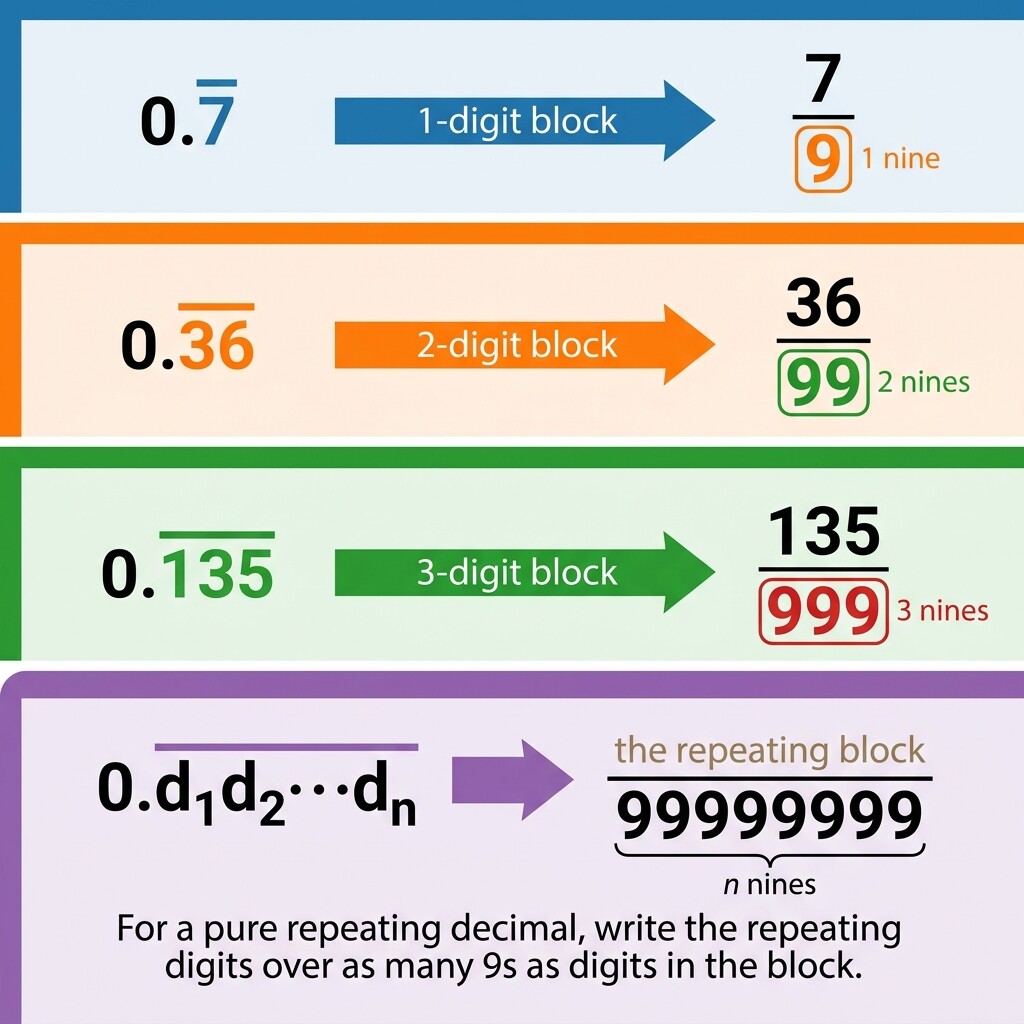
The rule is straightforward: the power of ten matches the number of digits in the repeating block, and the resulting denominator is that many nines. So for any pure repeating decimal , the fraction before simplification is:
The numerator is simply the number formed by the repeating digits, and the denominator is nines. After writing this fraction, always reduce it to simplest form by dividing both parts by their greatest common factor.
Conclusion and Next Steps
In this lesson, we learned the algebraic elimination method for converting pure repeating decimals into fractions. The recipe has four clear steps: assign a variable, multiply by where is the block length, subtract to cancel the repeating tail, and solve. We applied this to one-digit, two-digit, and three-digit blocks, and we uncovered the satisfying pattern that the denominator before simplification is always a string of nines matching the block length.
Now it is time to make this method your own. In the upcoming practice exercises, you will complete a guided walkthrough, write full derivations, convert increasingly longer repeating blocks, and even apply the technique to a real-world scenario involving a split dinner bill. Let's turn that fresh understanding into a well-practiced skill!
