Converting Mixed Repeating Decimals
Introduction
Welcome to the final stop in Mastery of Repeating Decimals! Over the first three lessons you built a powerful toolkit: reading bar notation, identifying repeating blocks in mixed expansions, and using the algebraic elimination method to convert pure repeating decimals into exact fractions. Now we are ready for the capstone skill — converting mixed repeating decimals into exact fractions.
A mixed repeating decimal has one or more non-repeating digits after the decimal point before the cycle begins, like or . This lesson builds directly on the four-step technique from Lesson 3. The core idea stays the same — multiply, subtract, and cancel the repeating tail — but the new wrinkle is that mixed decimals require two different powers of ten instead of one. By the end of this lesson, you will handle any mixed repeating decimal with confidence.
Why Mixed Decimals Need Two Shifts
In the previous lesson, converting a pure repeating decimal like required just one multiplication by . We multiplied, subtracted the original, and the repeating tails canceled neatly. That worked because the cycle started immediately after the decimal point, so a single shift by one block length was enough to line everything up.
Now consider The repeating block () does not begin until after the prefix digit . If we try the old approach and multiply only by , we get Subtracting the original does cancel the repeating part, giving , but the right side is a decimal rather than a whole number.
The calculation still leads to the correct answer, yet it forces an extra step of clearing that decimal. With longer prefixes or blocks, this workaround grows messy fast.
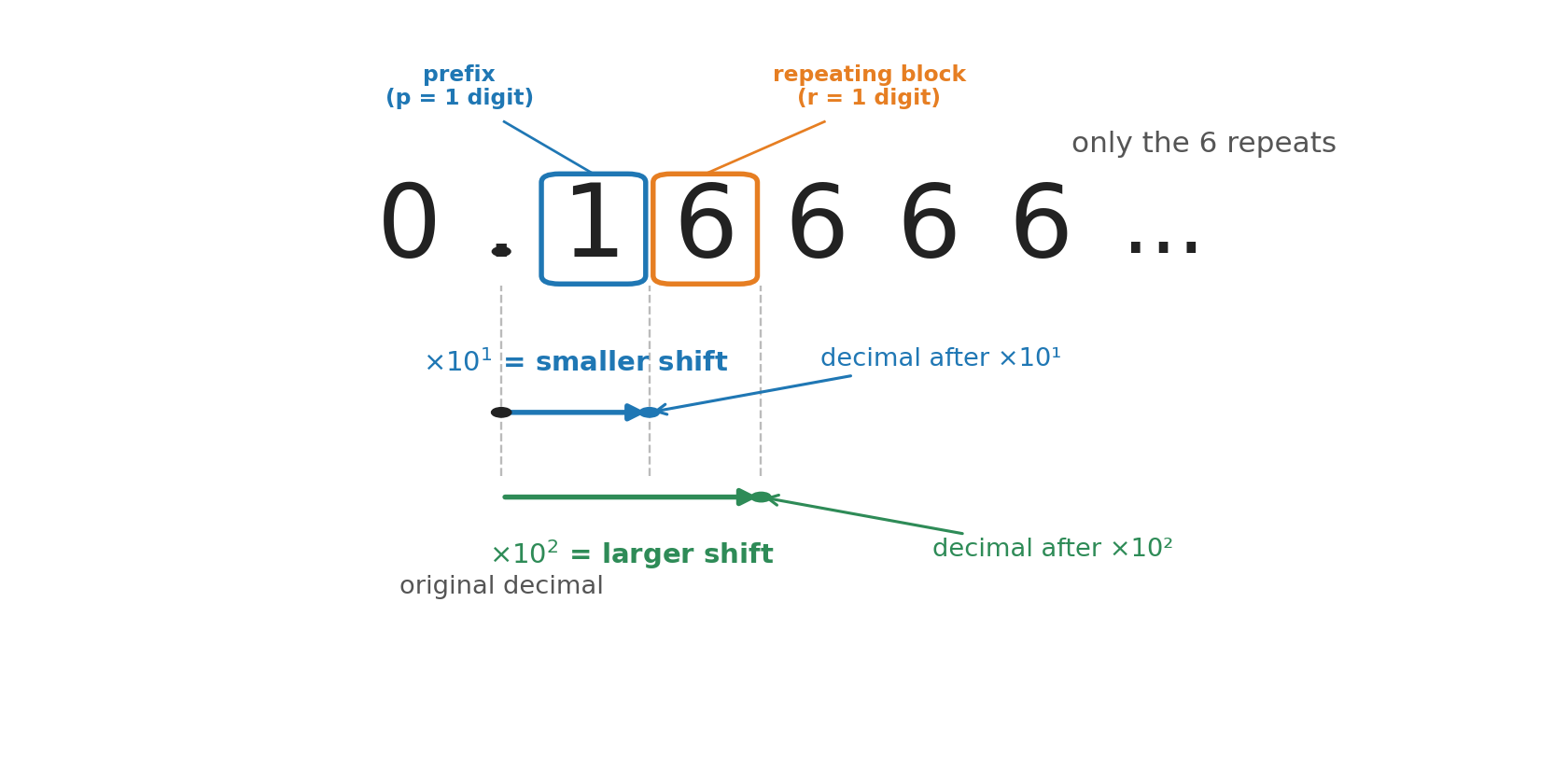
The cleaner strategy uses two multiplications: one that shifts past the prefix and one full repeating block, and another that shifts past just the prefix. Both shifted versions then share identical repeating tails starting right after the decimal point, so subtracting them produces a whole number on the right side every time.
Step by Step: Converting 0.1666...
Let's see the two-shift method in full detail with Here the non-repeating prefix has 1 digit and the repeating block has 1 digit.
Step 1 — Define a variable.
Step 2 — Apply the larger shift. Multiply by to move past the prefix and one full block:
Step 3 — Apply the smaller shift. Multiply by to move past just the prefix:
Step 4 — Subtract. Both and now share the same repeating tail after the decimal point:
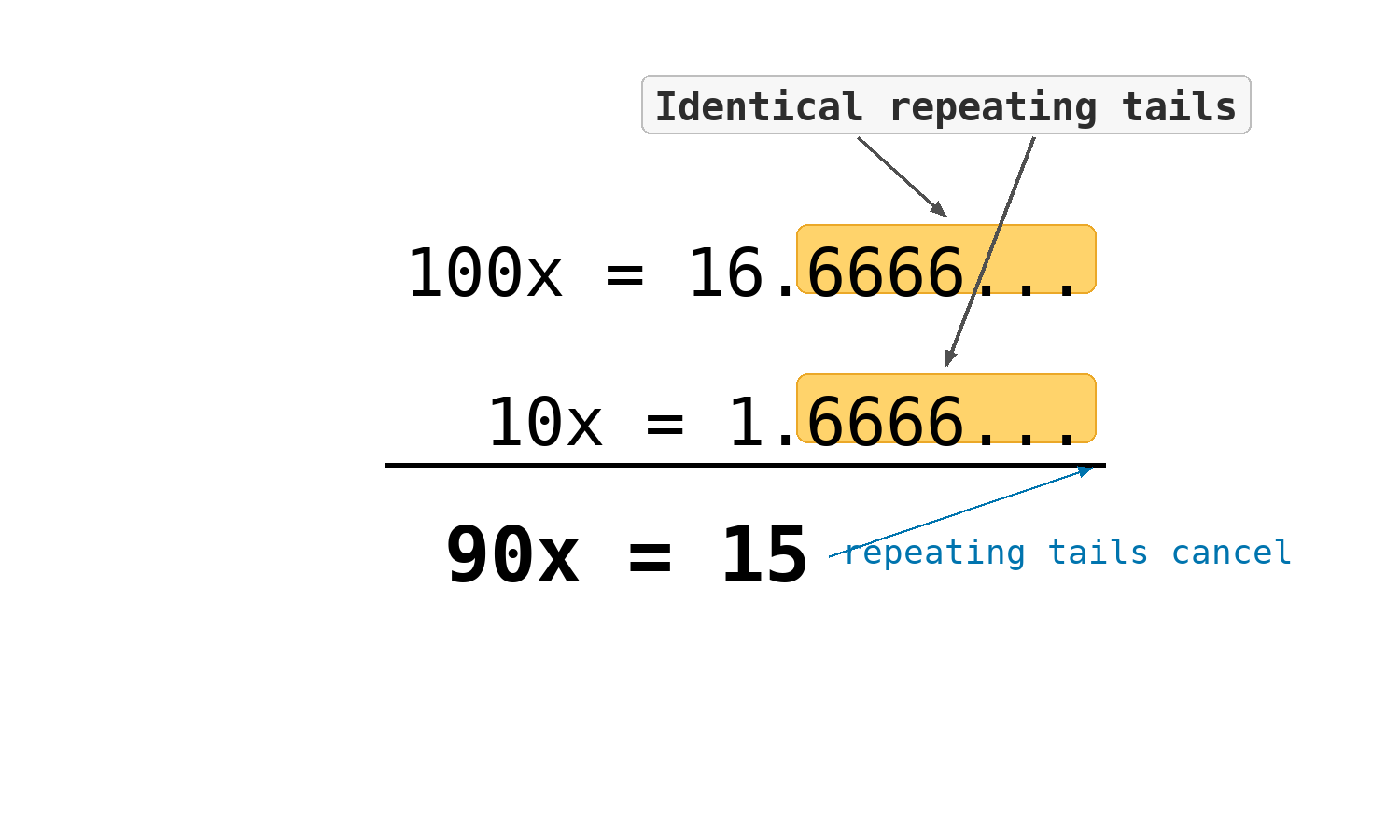
Step 5 — Solve and simplify.
We divided numerator and denominator by . So . A quick check confirms this: ✓
Building Fluency: Converting 0.8333...
Let's try another example with the same structure — one prefix digit and a one-digit block — and move through it a bit more briskly.
Let The prefix has digit and the block has digit, so we multiply by and by :
Subtract:
We simplified by dividing by . Notice the denominator before simplification was in both this example and the previous one. That is not a coincidence — whenever the prefix is digit and the block is digit, we always get .
Handling Longer Repeating Blocks
When the repeating block has more than one digit, the larger power of ten increases to match. Let's convert , which has a 1-digit prefix and a 2-digit repeating block.
- Larger shift:
- Smaller shift:
Subtract:
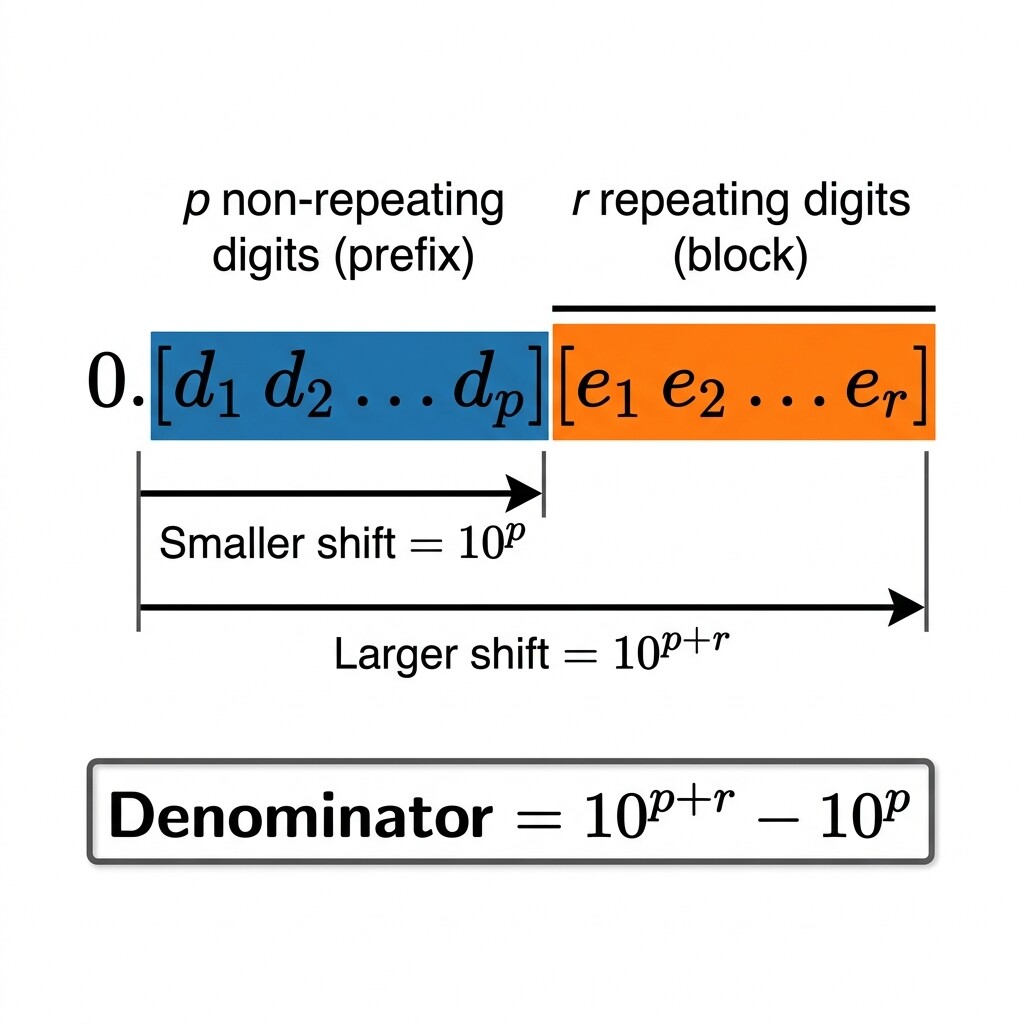
We divided by since . The denominator before simplifying was , which fits the emerging pattern: the denominator is always , where is the number of prefix digits and is the length of the repeating block.
Handling Longer Non-repeating Prefixes
What happens when the prefix is longer than one digit? The same logic applies — we simply increase the smaller power of ten. Let's convert , which has a 2-digit prefix () and a 1-digit repeating block ().
- Larger shift:
- Smaller shift:
Subtract:
We divided by . The key takeaway here is that the smaller power of ten always matches the number of non-repeating digits. This ensures both shifted versions have the repeating part starting right at the decimal point, so the tails cancel perfectly.
Here is a nice real-world connection: if a stopwatch reads hours, that is exactly of an hour, or minutes. Fractions like are far easier to interpret and reuse in further calculations than an infinite decimal string.
The General Formula for Mixed Repeating Decimals
Let's collect everything into a tidy summary. For a mixed repeating decimal with non-repeating digits after the decimal point and repeating digits:
| Component | Value |
|---|---|
| Larger shift | |
| Smaller shift | |
| Denominator (before simplifying) |
The subtraction on the right side always yields a whole number equal to the digits from the decimal point through one full block, minus the prefix digits alone. Written as a formula:
For example, with : the numerator is and the denominator is , giving before simplification. As always, the final step is to divide numerator and denominator by their greatest common factor to reach simplest form.
Conclusion and Next Steps
In this lesson, we extended the algebraic elimination method to mixed repeating decimals by introducing a second power of ten. The smaller shift moves past the non-repeating prefix, the larger shift moves past the prefix plus one full repeating block, and subtracting the two cancels the repeating tail cleanly. We practiced with prefixes and blocks of different lengths and distilled the approach into a general formula.
Now it is time to put this technique into action! In the upcoming practice exercises, you will complete a guided conversion step by step, write full derivations from scratch, tackle mixed decimals of increasing complexity, and even convert a real-world measurement into an exact fraction. Let's turn that fresh knowledge into lasting mastery!
